
서양꿀벌 (Apis mellifera) 봉군 내 꿀벌응애 (Varroa destructor) 밀도 추정법의 비교
Abstract
Honey bees face significant threats from ectoparasitic mites such as Varroa destructor, which impair colony health and contribute to widespread losses. Accurate monitoring of mite populations is critical for timely and effective management. In this study, we evaluated the effectiveness of a novel, non-invasive sugar dusting test as a diagnostic tool for detecting mite infestations, and compared its performance with sugar shaking, brood uncapping, and sticky board. Field monitoring of Varroa mites was conducted during summer of 2024. The RSE values indicated higher precision for sugar shaking (0.100) and sticky board (0.108), whereas sugar dusting showed the highest ratio (0.132), reflected greater variability. Nevertheless, the sugar dusting method exhibited a moderate to strong correlations with brood uncapping and sticky board results, reflecting colony-level mite density trends. These findings suggest that sugar dusting can serve as a practical monitoring tool for routine field surveillance with minimal time investment and colony disturbance, and as a valuable component of integrated Varroa management programs in beekeeping.
Keywords:
Varroa destructor, Density estimation, Sugar shaking, Brood uncapping, Bottom board, precision서 론
꿀벌 (Genus: Apis)은 농업생태계에서 가장 중요한 화분매개곤충으로, 다양한 작물의 번식에 기여한다 (Jung and Shin, 2022; Papa et al., 2022). 전 세계 농작물의 70% 이상이 꿀벌을 포함한 화분매개곤충에 의존하고 있다 (Gallai et al., 2009). 꿀벌의 역할은 생물다양성 유지뿐만 아니라 식량 생산과 인류 사회의 경제적 이익에도 직결된다 (Khalifa et al., 2021). 2006년 미국에서 꿀벌봉군이 사라지는 봉군 붕괴 현상 (Colony Collapse Disorder: CCD)이 보고되었다 (vanEngelsdorp et al., 2007). 국내에서는 2022년 전국적으로 월동 폐사가 보고되었다 (Jung and Bae, 2022; Lee et al., 2022). 최근 수십 년간 전 세계에서 꿀벌 대규모 실종이 반복적으로 보고되고 있다 (Minaud et al., 2024; Kang et al., 2025). 꿀벌 폐사의 주요 원인으로는 기생성 응애, 영양 부족, 농약, 기후변화, 여왕벌 폐사 등이 복합적으로 작용하는 것으로 알려져 있다 (Johnson et al., 2010; Hristov et al., 2020; Lee et al., 2022). 폐사의 주요 원인으로는 외부기생성 응애가 지목된다 (Le Conte et al., 2010).
꿀벌의 주요 외부 기생성인 해충으로 꿀벌응애 (Varroa destructor Anderson and Trueman, 2000)와 중국가시응애 (Tropilaelaps mercedesae Anderson and Morgan, 2007)가 있다. 이 중 꿀벌응애의 원기주는 재래꿀벌 (Apis cerana)로 보고되었다 (Oudemans, 1904). 1950년대를 시작으로 꿀벌응애가 양봉꿀벌 (A. mellifera)에 기주 이동하였고, 이는 무역량 증가로 인해 전 세계로 전파된 것으로 보고 있다 (Denmark et al., 1991). 국내에는 1950년대 경상남도 마산에서 처음으로 꿀벌응애가 확인되었고, 1970년대에 양봉꿀벌에 대한 꿀벌응애 피해가 보고되었다 (Choi et al., 1986; Woo et al., 1993).
꿀벌응애 생활사는 성충에 기생하는 편승 단계, 번데기방 내부에 기생하여 번식하는 번식 단계로 구분한다 (Jung, 2015; Traynor et al., 2020). 여왕벌 산란 8~9일 후 꿀벌응애는 소방 내부로 침입하고, 봉개된 번데기방 내부에서 번식 단계가 진행된다 (Martin, 1994). 침입한 꿀벌응애는 첫 산란을 수컷으로 시작하여 여러 마리 암컷 꿀벌응애를 낳는다. 꿀벌이 출방하기 전에 번데기방 내부에서 교미하게 된다 (Woyke, 1987). 번식 단계에서 꿀벌응애는 꿀벌 번데기의 혈림프 및 지방체를 흡즙하면서 꿀벌의 성장에 영향을 미친다 (Ramsey et al., 2019). 기생 과정에서 날개변형바이러스 (DWV)와 급성마비바이러스 (ABPV)와 같은 바이러스 매개체 역할을 하며 (de Miranda et al., 2010; Mondet et al., 2014), 꿀벌의 건강에 부정적인 영향을 미치고 생리적인 스트레스도 증가시킨다 (Dolezal et al., 2019). 양봉꿀벌은 재래꿀벌에 비해 꿀벌응애와의 공진화 기간이 짧아 저항성이 부족하다. 그로 인해 꿀벌 집단 손실이 발생하기도 한다 (Neumann and Carreck, 2010).
꿀벌응애는 꿀벌봉군 성장과 생존에 영향을 미친다. 꿀벌봉군에 대한 피해를 완화하기 위하여 양봉농가에서는 일반적으로 화학적 방제방법을 사용한다 (Oh and Jung, 2025b). 봉군 내 꿀벌응애 감염이 꿀벌의 10% 정도가 되었을 때는 즉시 방제하지 않으면 꿀벌집단이 폐사하고, 통상적 방제 수준은 3~5%로 결정된다 (Kim and Jung, 2008). 그러나 번식 단계가 진행되는 번데기방은 밀랍으로 덮여 있어 대부분 화학적 방제제가 내부로 작용하지 못해 방제에 어려움을 준다 (Gregorc and Planinc, 2001; Oh and Jung, 2025a). 효과적인 방제를 위해서는 꿀벌응애의 생활사뿐만 아니라 계절적 개체군 변동을 이해하는 것 필수적이다.
꿀벌응애 개체수는 기주인 양봉꿀벌의 개체수와 크게 연관성을 가지고 있다 (Currie and Tahmasbi, 2008; Jung, 2009). 온대 기후에서 꿀벌응애 개체수는 봄에 기온 상승과 번데기방 영역 증가와 함께 늦여름에 최고 밀도에 도달한다 (Jung, 2009). 가을과 겨울에는 번데기방 영역 감소로 응애수가 감소하지만, 상대적 애벌레방 부족으로 소방 하나 당 응애 밀도가 높아져 겨울벌 생산에 큰 스트레스를 줄 수 있다 (Amdam et al., 2004).
계절적 변동과 방제의 한계를 고려할 때, 응애 개체군을 정확히 모니터링하는 것은 방제 시기와 방법을 최적하고 지속 가능한 관리 전략을 수립하는데 매우 중요하다 (Gill et al., 2024). 기존에 사용하는 응애 밀도 조사 방법은 설탕털기법 (Macedo et al., 2002), 끈끈이판법 (Dietemann et al., 2013), 번데기방 열기법 (de Guzman et al., 2015) 등이 있다. 꿀벌 응애 기생율을 조사하는 과정에서 꿀벌 집단을 교란하거나 많은 시간이 소모된다. 번데기방 존재 여부에 따라 정확도 불일치 등 단점이 존재한다. 집단을 교란하지 않으면서도 빠른 시간에 정확한 응애 밀도 조사법에 대한 수요가 증가하고 있다 (Gill et al., 2024).
본 연구는 꿀벌 군집에 교란을 최소화하면서 꿀벌응애 밀도를 신속하고 정확하게 추정할 수 있는 모니터링 방법의 가능성을 검증하고자 했다. 이를 위해 설탕뿌리기법과 기존 조사 방법들 (설탕털기법, 번데기방 열기법, 끈끈이판법) 간의 상관성을 분석하여, 설탕뿌리기 방법이 기존 지표들을 대체하거나 보완할 수 있는지 평가하였다. 궁극적으로 본 연구는 응애 밀도 추정의 신뢰도를 확보하고, 대규모 현장 모니터링 및 통합적 응애 관리 (IPM)에 활용할 수 있는 진단 도구로서의 가능성을 제시하고자 한다.
재료 및 방법
1. 시험 봉군
본 시험은 2024년 7월부터 9월 사이에 진행되었으며, 국립경국대학교 실험 양봉장 (36°32ʹ47ʺN, 128°48ʹ08ʺE)에서 진행하였다. 75개의 양봉꿀벌 봉군을 사용하였으며, 46개 봉군은 6매상, 29개의 봉군은 4매상의 봉군을 사용하였다. 해당 봉군들은 모두 정상적으로 산란을 하고 있는 봉군을 사용하였으며, 5월 이후 살비제를 처리하지 않은 봉군에서 실험을 진행하였다. 벌통 각각에 모든 응애 밀도 조사 방법을 적용하였다.
2. 응애 밀도 조사 방법
설탕털기법은 Kim and Jung (2008)을 참고하여 진행하였다. 벌통 내부에서 번데기 방 소비를 찾은 후, 번데기방 소비에 있는 약 100마리의 성충을 채집하였다. 채집한 벌을 4×4 mm 크기의 매쉬 뚜껑을 가진 플라스틱 통에 담은 후, 20 g의 분말설탕, 슈가 파우더 A+ (주, 뚜레반, 경기, 대한민국)을 넣었다. 벌에 붙어 있는 응애가 떨어질 수 있도록 1분간 세차게 흔든 후, 통을 트레이 위에서 뒤집어 분말설탕과 꿀벌응애가 트레이 위로 떨어지게 한 후, 꿀벌응애 개체수를 확인하였다. 해당 방법은 봉군 당 3회 진행하였다.
해당 방법은 자연적으로 죽거나 바닥으로 떨어지는 응애를 확인하는 방법으로, Dietemann et al. (2013)을 참고하여 진행하였다. 벌통 내에 소비가 있는 영역보다 넓은크기의 흰색 판을 준비하고 해당 판 위에 바세린을 코팅하였다. 본 시험에서는 45×35 cm로 재단한 판을 사용하였으며, 판 위에 눈금선을 그어 응애를 계수하기 용이하게 하였다. 해당 판은 벌통 바닥에 72시간 동안 설치하였으며, 72시간이 지난 후 회수하여 판에 떨어진 꿀벌응애를 계수하였다.
번데기방 열기 방법은 de Guzman et al. (2015)을 따라 수행하였다. 번데기방이 있는 소비를 사용하여 번데기방 내 응애 감염률을 확인하였다. 6매상의 벌통에서는 2개의 소비를 사용하였으며, 4매상 벌통에서는 1개의 소비를 사용하였다. 각 벌통에서 소비를 수거하여 실험실로 가져왔으며, 핀셋과 헤드램프를 사용하여 소비 한 면당 50개의 번데기 방을 열어 응애를 확인하였다. 소비 1개당 100개의 번데기방을 확인하였으며, 6매상의 경우 200개, 4매상은 100개의 번데기방을 확인하였다. 이때, 번데기 단계에 따른 구분은 하지 않았으며, 번데기를 소방에서 완전히 제거하여 확인하였다.
본 시험에서 사용한 방법은 Stanimirović et al. (2011)과 Moon et al. (2025)를 참고하여 진행하였다. 마분지와 같이 두껍고 유연한 종이를 벌통 바닥에 설치하였다. 용지를 설치한 후, 벌통 위에서 벌들이 밀집되어 있는 소비 사이로 40 g의 분말설탕을 골고루 뿌려 주었다. 10분 동안 기다린 후, 바닥에 설치한 종이 위에 떨어진 분말설탕을 수거하였다. 수거한 분말설탕을 실험실로 가져와 물에 녹여 응애 개체수를 확인하였다.
3. 통계 분석
기술 통계량 [평균 (Mean), 표준오차 (SE), 상대표준오차 (RSE), 변동계수 (CV)] 등을 계산하여 각 모니터링 방법의 변동성을 비교하였으며, 재표본추출 (bootstrap, 1,000회 반복)을 수행하여, 표준오차와 95% 신뢰구간을 확인하였다. 정밀도는 상대표준오차와 변동계수를 기반으로 평가하였으며, 상대표준오차와 변동계수의 값이 작을수록 안정적이다고 해석하였다. 피어슨 상관 분석을 사용하여 설탕뿌리기법과 기존의 응애 밀도 조사 방법들 간의 상관관계를 확인하였다. 설탕뿌리기법의 응애수가 다른 방법 (설탕털기법, 끈끈이판법, 번데기방 열기법)의 결과를 예측할 수 있는지 평가하기 위해 단순 선형 회귀 모델을 사용하여 확인하였다. 모든 통계 분석은 SPSS 소프트웨어 (IBM, Armonk, NY, USA)를 사용하여 수행되었다.
결 과
1. 기초 통계량 분석
원본 데이터를 이용하여 기초 통계량을 분석하였을 때 결과는 다음과 같다 (Table 1). 설탕털기법에서 상대표준오차와 변동계수 값이 각 0.100과 1.008로 가장 낮은 값이 나왔으며, 설탕뿌리기법은 상대표준오차, 변동계수 값이 각 0.132, 1.316으로 가장 높은 값을 나타냈다. 번데기방 열기법은 0.109 (RSE), 1.093 (CV), 끈끈이판법은 0.108 (RSE), 1.081 (CV)의 값이 나타났다.

Varroa counts from four methods, sugar dusting (mites/10 min), sugar shaking (mites/300 bees), uncapping brood (mites/100 cells), and sticky board (mites/72 h) from field study conducted in summer, 2024
2. 재표본추출 (bootstrap) 정밀도 평가
재표본추출 (1,000회) 통한 응애 밀도 조사 방법의 평균, 95% 신뢰구간, 그리고 상대표준오차 값은 다음과 같다 (Table 2). 끈끈이판법, 설탕털기법과 설탕뿌리기법은 상대표준오차 값은 0.108에서 0.089로, 0.100에서 0.093, 0.132에서 0.128으로 원본추정치보다 낮은 값이 나타났다. 번데기방 열기법과 설탕뿌리기법의 상대표준오차는 원본 추정치 0.109에서 0.139로 소폭 상승하였다.
Bootstrap mean±SE and 95% confidence interval (CI) of V. destructor counts obtained from four monitoring methods (sugar dusting (mites/10 min, n), sugar shaking (mites/300 bees, n), uncapping brood (mites/100 cells, n), and sticky board (mites/72 h, n), based on 1,000 resampling iterations
3. 피어슨 상관성 분석
기존 응애 밀도 조사방법과 설탕뿌리기법 간의 상관관계는 피어슨 상관분석으로 평가하였다. 설탕뿌리기법은 기존 응애 밀도 조사 방법 모두와 유의미한 양의 상관관계가 나타났다 (Table 3). 설탕털기법은 r=0.540 (p<0.01), 번데기방 열기법은 r=0.686 (p<0.01), 끈끈이판법은 r=0.623 (p<0.01)로 나타났다. 세 가지 방법 모두에서 설탕뿌리기 수치가 증가할수록 개별 봉군 데이터에서도 함께 증가하는 경향이 관찰되었으며, 이러한 분포는 산점도에서도 확인되었다 (Fig. 1).
Pearson correlation coefficients between mite count from sugar dusting (mites/10 min) and three conventional V. destructor detection methods of sugar shaking (mites/300 bees), uncapping brood (mites/200 cells), and sticky board (mites/72 h)
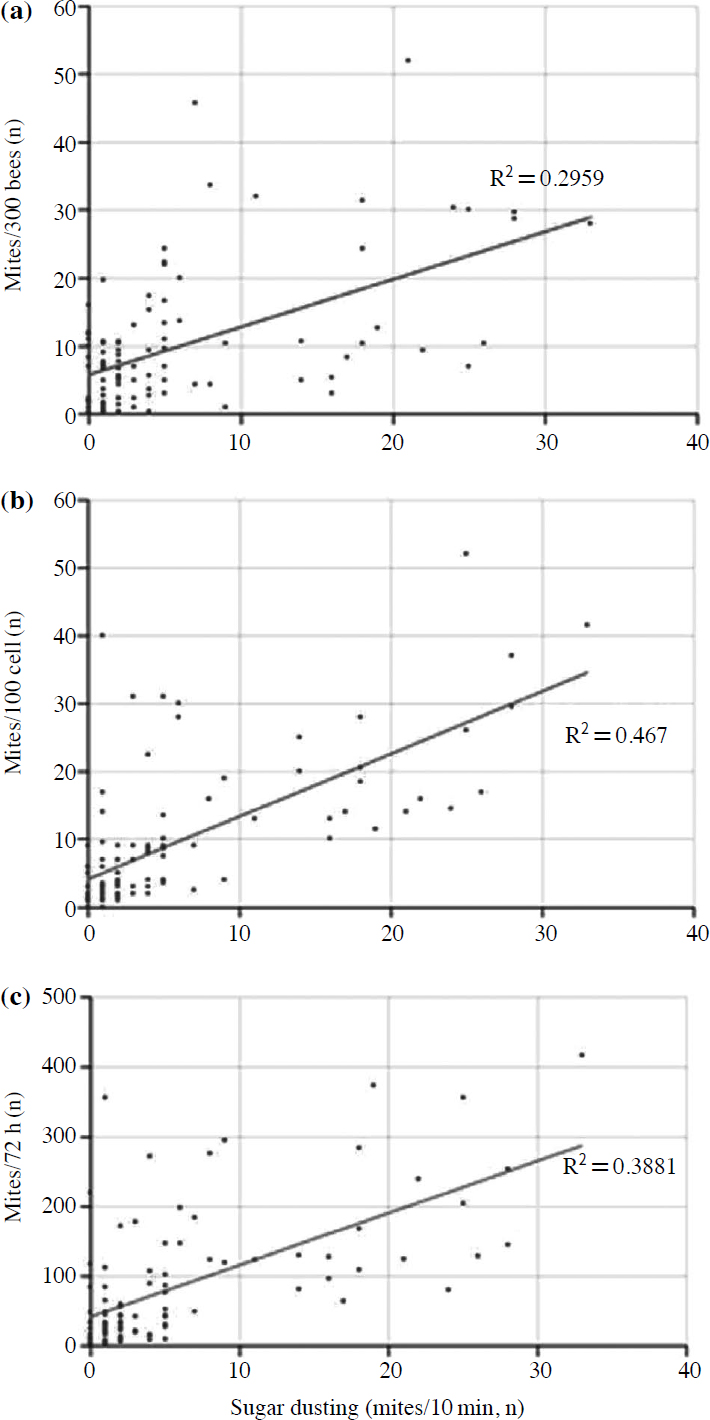
Linear regressions between sugar dusting counts (mites/10 min) and three Varroa mite detection methods: (a) sugar shaking (mites/300 bees), (b) uncapping brood (mites/100 cells), and (c) sticky board (mites/72 h). All models were significant at p<0.001.
4. 선형 회귀 분석
상관관계를 정량적으로 분석하기 위해, 설탕뿌리기법 측정값 (10분당 응애수)을 예측 변수 (X)로, 기존 방법들에서 확인된 응애수을 반응변수 (Y)로 설정하여 단순 선형 회귀모델을 사용하였다. 설탕뿌리기법과 기존 응애 밀도 조사 방법 간의 선형 회귀 결과는 Table 4와 같다. 세 가지 회귀모형 모두 통계적으로 유의미하게 나타났다 (p<0.001, Fig. 1).
Linear regression of varroa mite counts from sugar shaking (mites/300 bees), uncapping brood (mites/100 cells), and sticky board (mites/72 h) relative to sugar dusting (mites/10 min)
각 방법에 대한 선형 회귀식은 다음과 같다. 설탕털기법은 Y=5.852+0.699X, 번데기방 열기법은 Y= 4.197+0.923X, 끈끈이판 Y=42.407+7.436X으로 나타났다. R2 값은 번데기방 열기법에서 가장 높아 0.4670으로 나타났고, 끈끈이판법과 설탕털기법은 각 0.3881, 0.2959로 나타났다.
고 찰
본 시험에서는 새롭게 고안한 설탕뿌리기법의 적용 가능성을 평가하기 위하여 기존 응애 밀도 조사 방법 (설탕털기법, 번데기방열기법, 끈끈이법)과 비교를 하였다. 평가 대상은 꿀벌응애로 진행하였다. 정밀도를 평가하기 위하여 두 가지 지표를 사용하였다. 상대표준오차, 변동계수를 사용하였으며 상대표준오차 표본 평균 추정치의 불확실성을 나타낸다 (Sileshi, 2015). 변동계수는 봉군 간 개체군 수준의 변동성을 반영한다 (Reed et al., 2002). 95% 신뢰구간 (CI)은 추정치가 포함될 범위를 제시하며, 구간 폭이 좁으면 결과의 신뢰성이 높고, 폭이 넓으면 불확실성이 크다는 것을 의미한다 (Neyman, 1941). 상대표준오차와 변동계수 평가 결과, 방법별 차이가 나타났다. 원본 데이터의 상대표준오차 값은 설탕털기법 (0.100)과 끈끈이판법 (0.108), 번데기방 열기법 (0.109) 그리고 설탕뿌리기법은 0.132로 나타났다. 선행연구에 따라 상대표준오차 값이 0.100은 높은 정밀도, 0.25는 실무자 수준의 정밀도의 수치를 나타낸다는 부분에 부합하였다 (Lee et al., 2010). 밀도 조사 방법들의 상대표준오차 값의 차이는 크지 않았다. 반면에, 봉군 간의 변동성을 나타내는 변동계수 값이 전반적으로 1보다 높게 나타났다. 재표본추출의 상대표준오차 결과에서는 끈끈이판법의 상대표준오차 원본 데이터 0.108에서 0.089로 감소하여 반복 추출에서도 안정적인 정밀성을 나타냈다 (Lee et al., 2010). 끈끈이판법은 72시간 동안 봉군 전체에서 떨어지는 응애를 누적적으로 수집하는 방법이다 (Dietemann et al., 2013). 값이 감소한 이유로는 장기적으로 설치하기 때문에 하루 단위의 기온 변화, 봉군 활동성과 같은 단기적인 요인이 평균화 되었기 때문으로 보인다 (Branco et al., 2006; Dietemann et al., 2013). 설탕뿌리기법은 재표본추출법에서 상대표준오차 값이 각각 0.132에서 0.128로 다소 감소하였으나, 원본데이터와 유사하게 다른 방법들에 비하여 상대적으로 높은 값이 나타났다 (Lee et al., 2010). 이는 밀도 조사 방법의 특성에 기인한다. 설탕뿌리기법은 봉군 전체를 대상으로 수행되지만, 분말설탕의 살포량과 위치, 벌의 밀집도, 습도, 바닥 용지 회수 과정 등 절차적, 환경적 요인에 의해 결과가 영향을 받아 반복 조사에서 변동성 높은 것으로 보인다 (Stanimirović et al., 2011). 동일한 조건에서 수행된 선행연구에서도 처리 간격과 군집 특성에 따라 결과가 달라지며, 효율이 변동한다고 보고하였다 (Stanimirović et al., 2011). 번데기방 열기법은 상대표준오차 값이 0.109에서 0.139로 증가하였다. 번데기방의 위치와 발달 단계에 따라 응애 분포가 달라지기 때문으로 보인다. 선행연구에서도 봉개 직후나 번데기 발달 단계에 따라 검출률이 달라질 수 있음을 보고하였다 (Martin, 1994). 각 방법별 평균값의 95% 신뢰구간을 평균 대비 폭으로 비교한 결과, 끈끈이판법과 설탕털기법은 상대 폭이 각각 27%로 나타났고, 설탕뿌리기법은 38%, 번데기방 열기법은 40%로 나타났다. Lee et al. (2010)에서 제시한 값들을 기준을 계산하였을 때, 27%는 연구자 기준보다 신뢰구간이 좁아 안정적인 추정치가 나타나고, 설탕뿌리기법과 번데기방 열기법은 연구자 기준에 근접하는 것으로 확인된다. 이는 재표본추출법의 상대표준오차 값 순위와 일치한다. 상대표준오차, 변동계수, 그리고 95% 신뢰구간을 종합적으로 살펴보았을 때, 끈끈이판법과 설탕털기법은 안정성이 높고, 봉군 간의 차이가 비교적 작은 방법으로 나타났다.
설탕뿌리기법을 통해 검출된 응애수는 기존 방법들과 유의미한 양의 상관관계를 나타냈다. 번데기방 열기법 (r=0.686)은 설탕뿌리기법과 중등도 이상의 상관관계가 나타났으며 (Mukaka, 2012), 기존 방법들 중 가장 강한 상관관계가 나타났다. 번데기방 열기법은 응애가 실제로 번식하는 번데기 방 내부를 직접 확인하는 방법으로, 봉군 내 응애 감염을 정밀하게 반영하는 신뢰성 높은 진단방법으로 알려져 있다 (Gill et al., 2024). 따라서 설탕뿌리기법이 번데기방 열기법과 유사한 경향을 보였음은 해당 방법이 봉군 내 응애 수준을 추정하는 데에도 충분한 신뢰성을 가진다는 것을 보여준다.
선형 회귀분석 결과에서도 설탕뿌리기법으로 측정된 응애수는 세 가지 기존 응애 밀도 조사 방법의 결과를 유의미하게 예측하였다 (p<0.001). 각 회귀식 기울기는 설탕털기법은 0.70, 번데기방 열기법은 0.92, 끈끈이판법은 7.44로 나타났으며, 설탕뿌리기법에서 검출된 응애 1마리는 기존 방법들에서도 일관되게 증가하는 패턴을 보였다. 이는 설탕뿌리기법이 신속하고 비파괴적인 조사 방법과 더불어 기존 밀도 조사 방법들의 결과를 설명하고 예측할 수 있음을 시사한다 (Fakhimzadeh, 2001a).
각 밀도 조사 방법은 장단점을 가지는데, 방법별 정리한 표는 다음과 같다 (Table 5). 설탕털기법은 가장 보편화된 방법으로 가장 많이 사용되는 방법이지만 소비를 꺼내어 꿀벌을 샘플링 진행한다 (Kim and Jung, 2008). 해당 방법은 소량의 성충만을 대상으로 밀도 조사를 하기 때문에 봉군 전체를 대표할 수 없다고 선행연구에서 언급한다 (Taylor et al., 2025). 번데기방 열기법은 번데기방 내부 밀도를 직접 조사할 수 있어 정확도가 높지만 소비를 꺼내서 실험실로 가져오고, 소방을 하나씩 확인해야 하므로 시간이 많이 소요된다 (Pettis et al., 2013). 번데기방을 여는 등 직접적인 손상을 끼치게 되는 단점이 존재한다 (Pettis et al., 2013). 끈끈이판법은 봉군 전체의 응애 밀도를 확인할 수 있으나 최소 24시간 동안 설치하여야 하기 때문에 즉각적인 밀도를 확인할 수 없다는 단점이 있다 (Dietemann et al., 2013). 판 위에 덮개를 씌우지 않을 경우에는 청소 행동 등 외부 요인의 영향을 받을 수 있으며, 덮개사용과 같은 보완책을 병행하는 것이 필요하다 (Dietemann et al., 2013). 설탕뿌리기법은 분말설탕의 살포량이나 습도에 영향을 받아 결과 변동성 및 정밀도가 낮은 단점이 존재하나, 적은 노동력과 시간이 소요되어, 하루에 많은 군집을 평가할 수 있어 대규모 조사나 실시간 조사에 적합하다 (Fakhimzadeh, 2001b).
Comparison of four Varroa mite monitoring methods (sugar dusting, sugar shaking, uncapping brood, and sticky board) advantages, limitations, in terms of time requirements, and precision (SE/Mean)
결론적으로, 설탕뿌리기법은 기존 방법들에 비해 군집 간 변동성이 크며, 평균 추정의 안정성 또한 낮아 상대적으로 정밀도가 떨어지는 한계가 있다. 그럼에도 불구하고, 봉군을 해치지 않고 신속하게 반복 적용할 수 있어 현장에서 보조적 진단 도구로 활용할 수 있다 (Stanimirović et al., 2011). 계절별 응애 발생 추세 파악, 그리고 대규모 조사에서 스크리닝 기법으로 적합할 것으로 보인다. 특히 끈끈이판법과 병행할 경우, 단기적인 변화 (살포 직후 응애 낙하)와 장기적인 추세 (72시간 누적)를 동시에 반영할 수 있어 보다 신뢰성 있는 모니터링 체계 구축이 가능하다 (Branco et al., 2006). 나아가 이러한 진단 전략은 방제 시기 결정과 약제 효과 평가, 통합적 해충 관리 (IPM) 등 실제 양봉 현장에서의 응애 관리 효율성을 높이는 데 기여할 수 있을 것으로 판단된다.
Acknowledgments
본 연구는 농촌진흥청 농업정책지원기술개발 사업 꿀벌 강건성 연구 과제 (이상기온 대응 꿀벌 스마트 관리 기술개발, RS-2023-00232847)의 지원으로 수행되었습니다.
References
-
Amdam, G. V., K. Norberg, M. K. Fondrk and R. E. Page Jr. 2004. Reproductive ground plan may mediate colony-level selection effects on individual foraging behavior in honey bees. Proc. Natl. Acad. Sci. USA 101(31): 11350-11355.
[https://doi.org/10.1073/pnas.0403073101]

-
Branco, M. R., N. A. Kidd and R. S. Pickard. 2006. A comparative evaluation of sampling methods for Varroa destructor (Acari: Varroidae) population estimation. Apidologie 37(4): 452-461.
[https://doi.org/10.1051/apido:2006010]
- Choi, S. U., K. S. Woo and Y. S. Kim. 1986. Questionary survey on the Varroa mites in Korean beekeeping. J. Apic. 1(1): 62-75.
-
Currie, R. W. and G. H. Tahmasbi. 2008. The ability of high- and low-grooming lines of honey bees to remove the parasitic mite Varroa destructor is affected by environmental conditions. Can. J. Zool. 86(9): 1059-1066.
[https://doi.org/10.1139/Z08-083]
-
De Guzman, L. I., T. E. Rinderer, A. M. Frake and M. J. Kirrane. 2015. Brood removal influences fall of Varroa destructor in honey bee colonies. J. Apic. Res. 54(3): 216-225.
[https://doi.org/10.1080/00218839.2015.1117294]
-
de Miranda, J. R., G. Cordoni and G. Budge. 2010. The acute bee paralysis virus-Kashmir bee virus-Israeli acute paralysis virus complex. J. Invertebr. Pathol. 103(Suppl.): S30-S47.
[https://doi.org/10.1016/j.jip.2009.06.014]
- Denmark, H. A., H. L. Cromroy, L. Cutts and M. T. Sanford. 1991. Varroa mite, Varroa jacobsoni Oudemans. Entomology Circular No. 347, Florida Department of Agriculture and Consumer Services, Division of Plant Industry, Gainesville, FL.
-
Dietemann, V., F. Nazzi, S. J. Martin, D. L. Anderson, B. Locke, K. S. Delaplane, … and J. D. Ellis. 2013. Standard methods for varroa research. J. Apic. Res. 52(1): 1-54.
[https://doi.org/10.3896/IBRA.1.52.1.09]
-
Dolezal, A. G., J. Carrillo-Tripp, T. M. Judd, W. A. Miller, B. C. Bonning and A. L. Toth. 2019. Interacting stressors matter: diet quality and virus infection in honeybee health. R. Soc. Open Sci. 6(2): 181803.
[https://doi.org/10.1098/rsos.181803]
-
Fakhimzadeh, K. 2001a. The effects of powdered sugar varroa control treatments on Apis mellifera colony development. J. Apic. Res. 40(3-4): 105-109.
[https://doi.org/10.1080/00218839.2001.11101058]
-
Fakhimzadeh, K. 2001b. Effectiveness of confectioner sugar dusting to knock down Varroa destructor from adult honey bees in laboratory trials. Apidologie 32(2): 139-148.
[https://doi.org/10.1051/apido:2001119]
-
Gallai, N., J. M. Salles, J. Settele and B. E. Vaissière. 2009. Economic valuation of the vulnerability of world agriculture confronted with pollinator decline. Ecol. Econ. 68(3): 810-821.
[https://doi.org/10.1016/j.ecolecon.2008.06.014]
-
Gill, M. C., B. Chuttong, P. Davies, D. Etheridge, L. Panyaraksa, V. Tomkies, … and P. Chantawannakul. 2024. Assessment of the efficacy of field and laboratory methods for the detection of Tropilaelaps spp. PLoS ONE 19(9): e0301880.
[https://doi.org/10.1371/journal.pone.0301880]
-
Gregorc, A. and I. Planinc. 2001. Acaricidal effect of oxalic acid in honeybee (Apis mellifera) colonies. Apidologie 32(4): 333-340.
[https://doi.org/10.1051/apido:2001133]
-
Hristov, P., R. Shumkova, N. Palova and B. Neov. 2020. Factors associated with honey bee colony losses: A mini-review. Vet. Sci. 7(4): 166.
[https://doi.org/10.3390/vetsci7040166]
-
Johnson, R. M., M. D. Ellis, C. A. Mullin and M. Frazier. 2010. Pesticides and honey bee toxicity-USA. Apidologie 41(3): 312-331.
[https://doi.org/10.1051/apido/2010018]
- Jung, C. 2009. Frame work of the adaptive population dynamic model of varroa mite in Korean beekeeping environment. J. Apic. 24: 67-74.
-
Jung, C. 2015. Simulation study of varroa population under the future climate conditions. J. Apic. 30(4): 349-358.
[https://doi.org/10.17519/apiculture.2015.11.30.4.349]
- Jung, C. and J. H. Shin. 2022. Evaluation of crop production increase through insect pollination service in Korean agriculture. Korean J. Appl. Entomol. 61(1): 229-238.
-
Jung, C. and Y. H. Bae. 2022. Production and characteristics of winter generation honey bees, Apis mellifera: Discussion with overwintering failure. J. Apic. 37(3): 265-274.
[https://doi.org/10.17519/apiculture.2022.09.37.3.265]
-
Kang, Y., M. Esmaeily and C. Jung. 2025. Comparative analysis of fat body and vitellogenin expression in honey bees overwintering in the field and pollinating in a greenhouse. J. Apic. 40(1): 13-20.
[https://doi.org/10.17519/apiculture.2025.04.40.1.13]
-
Khalifa, S. A. M., E. H. Elshafiey, A. A. Shetaia, A. A. A. El-Wahed, A. F. Algethami, S. G. Musharraf, M. F. AlAjmi, C. Zhao, S. H. D. Masry, M. M. Abdel-Daim, M. F. Halabi, G. Kai, Y. A. Naggar, M. Bishr, M. A. M. Diab and H. R. El-Seedi. 2021. Overview of bee pollination and its economic value for crop production. Insects 12(8): 688.
[https://doi.org/10.3390/insects12080688]
- Kim, D. and C. Jung. 2008. Evaluation of chemical susceptibility of the ectoparasitic mite Varroa destructor in honey bee (Apis mellifera L.). J. Apic. 23: 261-268.
-
Le Conte, Y., M. Ellis and W. Ritter. 2010. Varroa mites and honey bee health: can Varroa explain part of the colony losses? Apidologie 41(3): 353-363.
[https://doi.org/10.1051/apido/2010017]
-
Lee, K. V., R. D. Moon, E. C. Burkness, W. D. Hutchison and M. Spivak. 2010. Practical sampling plans for Varroa destructor (Acari: Varroidae) in Apis mellifera (Hymenoptera: Apidae) colonies and apiaries. J. Econ. Entomol. 103(4): 1039-1050.
[https://doi.org/10.1603/EC10037]
-
Lee, S. J., S. H. Kim, J. Y. Lee, J. H. Kang, S. M. Lee, H. J. Park and C. Jung. 2022. Impact of ambient temperature variability on the overwintering failure of honeybees in South Korea. J. Apic. 37(3): 331-347.
[https://doi.org/10.17519/apiculture.2022.09.37.3.331]
-
Macedo, P. A., J. Wu and M. D. Ellis. 2002. Using inert dusts to detect and assess varroa infestations in honey bee colonies. J. Apic. Res. 41(1-2): 3-6.
[https://doi.org/10.1080/00218839.2002.11101062]
-
Martin, S. J. 1994. Ontogenesis of the mite Varroa jacobsoni Oud. in worker brood of the honeybee Apis mellifera L. under natural conditions. Exp. Appl. Acarol. 18(2): 87-100.
[https://doi.org/10.1007/BF00055033]
-
Minaud, E., F. Rebaudo, G. Mainardi, P. Vardakas, F. Hatjina, I. Steffan-Dewenter and F. Requier. 2024. Temperature in overwintering honey bee colonies reveals brood status and predicts colony mortality. Ecol. Indic. 169: 112961.
[https://doi.org/10.1016/j.ecolind.2024.112961]
-
Mondet, F., J. R. de Miranda, A. Kretzschmar, Y. Le Conte and A. R. Mercer. 2014. On the front line: quantitative virus dynamics in honeybee (Apis mellifera L.) colonies along a new expansion front of the parasite Varroa destructor. PLoS Pathog. 10(8): e1004323.
[https://doi.org/10.1371/journal.ppat.1004323]
-
Moon, K., S. Cho, J. Lee, S. H. Lee, K. M. Seong and Y. H. Kim. 2025. Molecular detection and phylogenetic analysis of six bee viruses from Varroa destructor in Korea. J. Apic. Res. 64(4): 1105-1116.
[https://doi.org/10.1080/00218839.2024.2411769]
- Mukaka, M. M. 2012. A guide to appropriate use of correlation coefficient in medical research. Malawi Med. J. 24(3): 69-71.
-
Neumann, P. and N. L. Carreck. 2010. Honey bee colony losses. J. Apic. Res. 49(1): 1-6.
[https://doi.org/10.3896/IBRA.1.49.1.01]
-
Neyman, J. 1941. Fiducial argument and the theory of confidence intervals. Biometrika 32(2): 128-150.
[https://doi.org/10.1093/biomet/32.2.128]
-
Oh, H. and C. Jung. 2025a. Evaluation of the efficacy of formic acid and oxalic acid against Varroa destructor and Tropilaelaps mercedesae in Apis mellifera colonies during summer season. J. Apic. 40(1): 1-12.
[https://doi.org/10.17519/apiculture.2025.04.40.1.1]
-
Oh, H. and C. Jung. 2025b. Comparative evaluation of acaricidal effects on Varroa destructor during the spring season. J. Apic. 40(2): 113-120.
[https://doi.org/10.17519/apiculture.2025.06.40.2.113]
- Oudemans, A. C. 1904. On a new genus and species of parasitic acari. Notes from the Leyden Museum 24(4): 216-222.
-
Papa, G., R. Maier, A. Durazzo, M. Lucarini, I. K. Karabagias, M. Plutino, E. Bianchetto, R. Aromolo, G. Pignatti, A. Ambrogio, M. Pellecchia and I. Negri. 2022. The honey bee Apis mellifera: An insect at the interface between human and ecosystem health. Biology 11(2): 233.
[https://doi.org/10.3390/biology11020233]
-
Pettis, J. S., R. Rose, E. M. Lichtenberg, P. Chantawannakul, N. Buawangpong, W. Somana, P. Sukumalanand and D. Vanengelsdorp. 2013. A rapid survey technique for Tropilaelaps mite (Mesostigmata: Laelapidae) detection. J. Econ. Entomol. 106(4): 1535-1544.
[https://doi.org/10.1603/EC12339]
-
Ramsey, S. D., R. Ochoa, G. Bauchan, C. Gulbronson, J. D. Mowery, A. Cohen and D. vanEngelsdorp. 2019. Varroa destructor feeds primarily on honey bee fat body tissue and not hemolymph. Proc. Natl. Acad. Sci. USA 116(5): 1792-1801.
[https://doi.org/10.1073/pnas.1818371116]
-
Reed, G. F., F. Lynn and B. D. Meade. 2002. Use of coefficient of variation in assessing variability of quantitative assays. Clin. Vaccine Immunol. 9(6): 1235-1239.
[https://doi.org/10.1128/CDLI.9.6.1235-1239.2002]
- Sileshi, G. W. 2015. The relative standard error: An index for checking the reliability of regression coefficients. Bull. Entomol. Res. 105(6): 671-679.
-
Stanimirović, Z., N. Aleksić, J. Stevanović, D. Ćirković, M. Mirilović, N. Ðelić and V. Stojić. 2011. The influence of pulverised sugar dusting on the degree of infestation of honey bee colonies with Varroa destructor. Acta Vet. 61(2-3): 309-325.
[https://doi.org/10.2298/AVB1103309S]
-
Taylor, M. A., R. M. Goodwin, H. M. McBrydie, H. M. Cox and B. C. Dominiak. 2025. Relative effectiveness of methods that sample worker honey bees to estimate Varroa destructor populations in Apis mellifera colonies. Apidologie, 56(1): 14.
[https://doi.org/10.1007/s13592-024-01143-y]
-
Traynor, K. S., F. Mondet, J. R. de Miranda, M. Techer, V. Kowallik and M. A. Oddie, P. Chantawannakul and A. McAfee. 2020. Varroa destructor: a complex parasite, crippling honey bees worldwide. Trends Parasitol. 36(7): 592-606.
[https://doi.org/10.1016/j.pt.2020.04.004]
- vanEngelsdorp, D., R. Underwood, D. Caron and J. J. Hayes. 2007. An estimate of managed colony losses in the winter of 2006-2007. Am. Bee J. 147: 599-603.
- Woo, K. S. and J. H. Lee. 1993. The study on the mites inhabiting the bee-hives in Korea: I. J. Apic. 8(2): 140-146.
-
Woyke, J. 1987. Infestation of honeybee (Apis mellifera) colonies by the parasitic mites Varroa jacobsoni and Tropilaelaps clareae in South Vietnam and results of chemical treatment. J. Apic. Res. 26: 64-67.
[https://doi.org/10.1080/00218839.1987.11100738]