
Management and Landscape Factors Associated with the Infestation Levels of Varroa destructor and Tropilaelaps mercedesae in Apis mellifera Colonies from Korea
Abstract
Honey bees are important pollinators but facing threats from ectoparasitic mites of Varroa destructor and Tropilaelaps mercedesae. Nationwide monitoring of mites and associated beekeeping and landscape factors was conducted in 2024-2025. Honey bee parasitic mites were collected by sugar dusting method. Management factors were questioned, and landscape factors were extracted from geographic information system. Infestation levels per hive were 13.16±22.45 Varroa and 0.12±0.30 Tropilaelaps in 2024, and 5.09±7.95 Varroa and 0.02±0.08 Tropilaelaps in 2025, with a statistically significant difference observed in Varroa between years. In 2024, Tropilaelaps detection was significantly higher in migratory apiaries than in stationary ones. Landscape analysis revealed that Varroa infestation was significantly higher in non-dominant type. These findings indicate that year-to-year variation, migratory beekeeping, and landscape composition influence mite distribution. Implementing targeted surveillance and seasonally adjusted management could enhance control of honey bee ectoparasitic mites and support sustainable apiculture in Korea.
Keywords:
Varroa destructor, Tropilaelaps mercedesae, Migratory apiary, Landscape analysis, Nationwide surveyINTRODUCTION
Beekeeping plays a vital role in agricultural systems, generating farm income through hive products such as honey, royal jelly, and propolis, while also contributing to food security through pollination services (Lee et al., 2010). In Korea, 26,686 farms managed 2.58 million colonies in 2023 (MAFRA, 2024). The colony density per unit area averages 11.67 colonies/km2, which is 3.8-130 times higher than that of other countries (Jeong et al., 2016; Sampat and Jung, 2016). The economic value of pollination services provided by honey bees has been estimated at 5.9 trillion KRW (Jung, 2008), with insect pollination contributing to 28% of national crop production - equivalent to 6.8 trillion KRW (Jung, 2008; Jung and Shin, 2022). Globally, approximately 75% of major food crops depend on pollination, accounting for 30% of crop yield (Buchmann, 1996; Klein et al., 2007; Jung, 2008).
Despite their economic and ecological importance, honey bee colonies have suffered recurrent large-scale losses. Colony Collapse Disorder (CCD) was first reported in the United States in 2006 (vanEngelsdorp et al., 2007), and widespread overwintering losses were observed in Korea in 2022 (Jung and Bae, 2022; Lee et al., 2022). Over the past decades, repeated reports of global mass colony losses have emerged (Minaud et al., 2024; Kang et al., 2025), attributed to multiple interacting stressors, including ectoparasitic mites, nutritional stress, pesticides, climate change, and queen loss (Johnson et al., 2010; Hristov et al., 2020; Lee et al., 2022). Surveys in Korea identified ectoparasitic mites and acaricide treatment frequency as key drivers of overwintering mortality (Kang et al., 2024).
The two most damaging ectoparasites of Apis mellifera are Varroa destructor (Anderson and Trueman, 2000, hereafter “Varroa”) and Tropilaelaps mercedesae (Anderson and Morgan, 2007, hereafter “Tropilaelaps”). Varroa originally parasitized A. cerana (Oudemans, 1904; Delfinado, 1963), but shifted hosts to A. mellifera in the 1960s, leading to its current global distribution (Matheson, 1995; Anderson and Roberts, 2013). Tropilaelaps, initially associated with A. dorsata and A. laboriosa (Burgett et al., 1983; Oldroyd and Wongsiri, 2009), shifted to A. mellifera in the 1970s and has since expanded into Central Asia and Europe, with recent detections in Russia and Georgia (Brandorf et al., 2024; Janashia et al., 2024; Namin et al., 2024). Both species parasitize brood, feeding on hemolymph and fat body (de Guzman et al., 2017; Ramsey et al., 2019). This parasitism reduces host survival, alters immune- and metabolism-related gene expression, and facilitates the spread of pathogens such as Deformed Wing Virus (DWV), which causes wing deformities and impairs flight ability (Martin et al., 2012; Zanni et al., 2017).
Although the impacts of these mites are well established, most studies in Korea have been restricted to specific regions or single years (Truong et al., 2023). Meanwhile, high colony densities and migratory beekeeping practices are thought to exacerbate mite infestation and spread (Nolan IV and Delaplane, 2017; Martínez-López et al., 2022). However, nationwide empirical data linking mite occurrence with management practices remain limited.
This study investigates the nationwide distribution of Varroa and Tropilaelaps in Korea during 2024-2025. It also examines correlations between mite prevalence and management factors such as beekeeper experience, colony number, migratory beekeeping, and overwintering mortality. These results provide a foundation for developing integrated pest management (IPM) strategies for sustainable apiculture.
MATERIALS AND METHODS
1. Survey and collection of ectoparasitic mites
Monitoring was conducted in seven provinces of Korea from June to July 2024 and again from June to July 2025. For sampling, participating beekeepers were provided with powdered sugar, flexible paper sheets, collection containers, and written instructions. The sampling procedure followed the method of Stanimirović et al. (2011) and Oh and Jung (2025). Sampling was conducted at five hives per apiary, and the detailed method is as follows. A flexible sheet of paper was placed on the bottom board of the hive, and powdered sugar was dusted over the areas of combs where bees were densely clustered so that the sugar adhered to their bodies. Beekeepers were instructed to fill the collection container completely with powdered sugar and to apply the entire amount once per hive. When the container was filled to the top, the powdered sugar weighed approximately 70 g. The sugar was sprinkled between the comb frames, and after approximately 10 minutes, the powdered sugar that had fallen to the bottom of the hive was collected. To minimize variability among apiaries, all participants used identical materials and received standardized written instructions. Samples were transported at ambient temperature. Beekeepers then transferred the collected material into the provided containers and sent the samples to GyeongKuk National University. In the laboratory, the powdered sugar was dissolved in water. Mites were then identified and counted under a stereomicroscope based on the morphological keys Anderson and Trueman (2000) and Anderson and Morgan (2007). Mite abundance was expressed as the number of mites per hive for subsequent statistical analyses.
2. Questionnaire to beekeepers
A structured survey consisting of five items was conducted to assess colony management factors. The questionnaire included: (i) apiary location, (ii) beekeeping experience, (iii) number of managed colonies at the time of sampling, (iv) practice of migratory beekeeping, and (v) overwintering mortality rate. The reasons for selecting these variables are as follows. Apiary location was recorded to allow potential landscape analysis. Beekeeping experience was included as an indicator of management skill level. The number of managed colonies was considered because larger apiaries are more likely to promote the spread of mites (Kulhanek et al., 2021). Overwintering mortality was surveyed since ectoparasitic mites are recognized as a major driver of winter losses (Claing et al., 2024). Migratory beekeeping was included because colony movements may increase the risk of mite transmission and infestation (Martínez-López et al., 2022).
3. Landscape analysis of apiary locations
Based on the survey responses, the latitude and longitude of each apiary were identified using Google Earth. Considering the dispersal characteristics of ectoparasitic mites that parasitize and move with honey bees, the surrounding environment within a 1.5 km radius was selected as the study area. Environmental variables were derived from the National Environmental Spatial Information Service (www.data.neins.go.kr) using the broad-category land cover classification map. Land cover types were categorized into coniferous forest, deciduous forest, mixed forest, rice paddies, dry fields, residential areas, rivers (and coastal areas), roads, vacant land and green space. Landscape analysis was conducted using QGIS software (ver. 3.16.1) to examine the major environmental variables associated with each site.
4. Statistical analysis
Depending on data normality, differences in mite detection between years were analyzed using the Mann-Whitney U test, and regional differences within each year were analyzed using the Kruskal-Wallis test. Year-to-year differences within each province were also evaluated using the Mann-Whitney U test. The relationships between mite detection and management factors were examined using Spearman’s correlation analysis, while differences according to the presence or absence of migatory beekeeping were assessed using the Mann-Whitney U test. For the landscape analysis, nine land-cover variables within a 1.5 km radius of each apiary were standardized and subjected to principal component analysis (PCA) to obtain four principal component scores. The sites were then classified into clusters using K-means clustering, and differences among clusters were evaluated with the Kruskal-Wallis test. All statistical analyses were performed using SPSS for Windows version 17.0 (IBM, Armonk, NY, USA).
RESULTS
1. Distribution of Varroa and Tropilaelaps
The number of mites detected by year was as follows: in 2024, Varroa averaged 13.16±22.45 per colony, while Tropilaelaps averaged 0.12±0.30. In 2025, Varroa averaged 5.09±7.95, and Tropilaelaps averaged 0.02±0.08. The Varroa difference between years was statistically significant (U=2064.5, Z= -2.598, p<0.01).
The detection levels of Varroa and Tropilaelaps in 2024 are summarized in Table 1. A total of 95 beekeeping farms were surveyed in 2024, including 3 in Gangwon, 13 in Gyeonggi, 10 in Gyeongsangnam, 43 in Gyeongsangbuk, 6 in Jeollanam, 14 in Chungcheongnam, and 6 in Chungcheongbuk. In each apiary, five colonies were examined, and colony-level data were used for the statistical analysis. Regional comparisons were conducted using the Kruskal-Wallis test. For Varroa, no significant differences were observed among regions, whereas for Tropilaelaps, regional differences were statistically significant(H=23.869, p<0.001).

Mite density per hive and infestation rate per apiary (%) from seven provinces in Korea surveyed during June to July 2024 and 2025 by sugar dusting method.
In 2025, surveys were conducted on 3 farms in Gangwon, 11 in Gyeonggi, 2 in Gyeongsangnam, 27 in Gyeongsangbuk, 3 in Jeollanam, 9 in Chungcheongnam, and 3 in Chungcheongbuk. Again, five colonies per apiary were examined, and colony-level values were used for regional comparisons. The Kruskal-Wallis test showed no statistically significant regional differences for either Varroa or Tropilaelaps. However, interpretation of the results is limited in some provinces (Gangwon, Gyeongsangnam, Chungcheongbuk) due to small sample sizes (n≤3).
When comparing regional differences between years, Varroa in Gyeongsangbuk showed a statistically significant difference (U=363.0, Z= -2.626, p<0.01). No significant differences between years were observed in other provinces.
2. Relationship with management factors
The relationships between mite detection and beekeeping experience, number of managed colonies at the time of sampling, and overwintering mortality were analyzed. The analysis was conducted only on responses received from participating beekeepers. In 2024, 31 beekeepers reported practicing migratory beekeeping, while 50 operated stationary beekeeping. No significant correlations were found between Varroa or Tropilaelaps infestations and any of these factors. When comparing detection levels according to migratory beekeeping, Varroa infestation averaged 16.2±24.6 mites per hive in migratory apiaries and 12.5±20.7 in stationary apiaries, showing no significant difference between the two groups. In contrast, Tropilaelaps infestation averaged 0.22±0.39 mites per hive in migratory apiaries and 0.09±0.27 in stationary apiaries, showing a statistically significant difference (U=600.0, Z= -2.114, p<0.05; Fig. 1). In 2025, 29 beekeepers practiced migratory beekeeping and 27 operated stationary beekeeping, and no significant correlations were observed between mite detection and beekeeping experience, colony number, or overwintering mortality. No significant difference was also found between migratory and stationary apiaries.
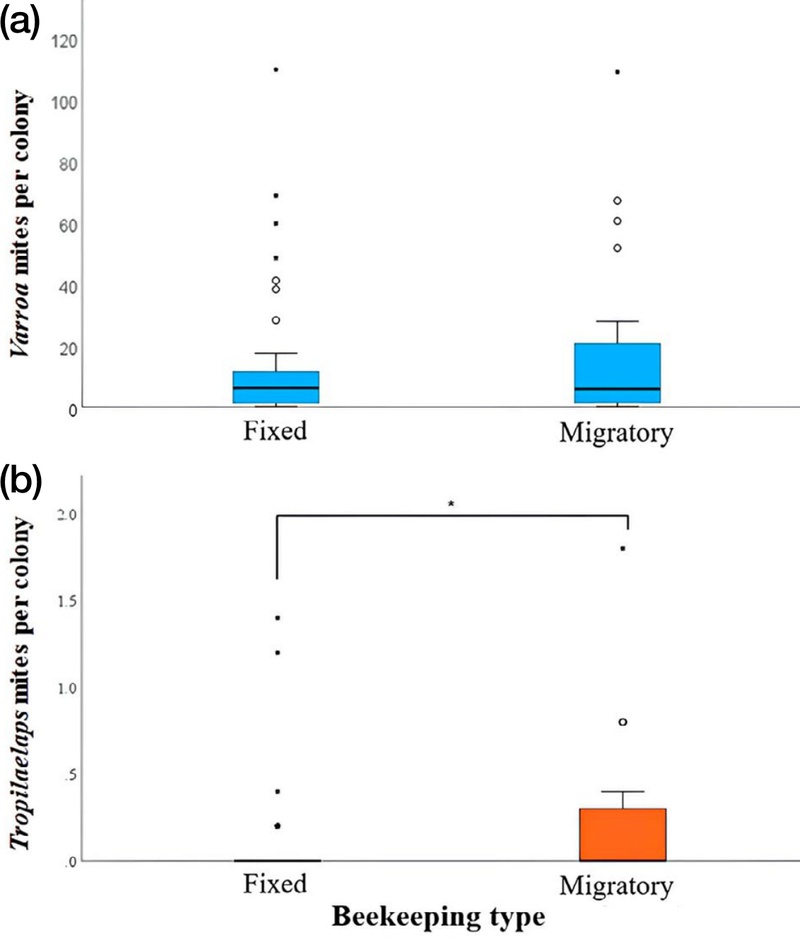
Numbers of Varroa (a) and Tropilaelaps (b) mites per hive (mean±SD) were compared with beekeeping type in 2024. Asterisks indicate statistically significant differences between beekeeping types(Mann-Whitney U test, p<0.05).
3. Landscape analysis
Landscape variables included coniferous forest, deciduous forest, mixed forest, dry fields, rice paddies, residential areas, roads, vacant land, and green space. Principal component analysis (PCA) was performed to extract four principal component scores, which were then used for K-means clustering. As a result, all surveyed apiaries were classified into four clusters. Cluster 1 showed the highest score for the “roads, residential areas, and vacant land” component and was therefore classified as the urban type. Cluster 2 showed a high score for the “mixed forest” component and was classified as the green type. Cluster 3 had low scores across all PCA components and was defined as the non-dominant type. Cluster 4 showed a high “dry fields and rice paddies” score and was classified as the agricultural type. Based on the four clusters identified by K-means clustering, the abundance of Varroa was compared, showing a statistically significant difference among clusters (H=14.527, p<0.01). In contrast, Tropilaelaps showed no significant difference among clusters. In 2025, the same analytical procedure was applied. In 2025, neither Varroa nor Tropilaelaps showed statistically significant differences among clusters.
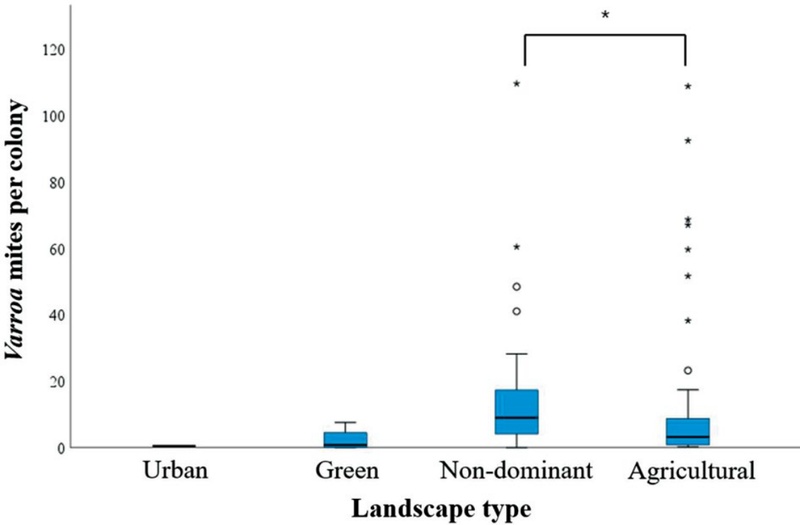
Mean number of Varroa per colony (mean±SD) detected in 2024 were compared with the landscape types by the K-mean clustering analysis. Clusters were represented as the urban, green, non-dominant, and agricultural types. Asterisks indicate statistically significant differences among clusters(Kruskal-Wallis test, p<0.05).
DISCUSSION
This study analyzed the nationwide distribution of ectoparasitic mites of honey bees and their relationships with management and landscape factors in Korea during 2024-2025. In both 2024 and 2025, Varroa were detected in most apiaries, indicating a widespread national distribution. No significant regional differences were found in Varroa detection, suggesting that Varroa is evenly distributed across regions, consistent with previous reports (Truong et al., 2023). In contrast, Tropilaelaps were detected at much lower levels. The abundance ratio of Varroa to Tropilaelaps was within the range of 50-100 to one, implying that parasitic pressure from Varroa is much higher than from Tropilaelaps in Korea.
The results showed that mite detection levels were generally lower in 2025 than in 2024. A comparison of average air temperatures between the two years revealed that those in February and April 2025 were significantly lower than in 2024 (Paired t-test, February: t=6.002, p<0.001; April: t=2.753, p<0.05). Low temperatures during spring are known to delay post-winter oviposition and the recovery of colony strength and can also negatively affect brood and larval survival (Wang et al., 2016). Considering that Varroa and Tropilaelaps mites parasitize within brood cells (de Guzman et al., 2017; Ramsey et al., 2019), the lower temperatures observed in February and April 2025 likely delayed or reduced brood production, which may have resulted in lower mite densities at the time of the June-July survey. In contrast, the relatively mild winter and early spring of 2024 may have accelerated queen oviposition and brood rearing, creating suitable conditions for mite reproduction even before the main breeding season. Warmer winters can extend brood availability, enabling continuous mite reproduction and faster population growth (Rajagopalan et al., 2024). Therefore, interannual variation in temperature likely influenced both brood dynamics and subsequent mite densities observed in each year.
In 2024, significant regional differences of Tropilaelaps abundance were observed. Among the apiaries sampled in Jeollanam Province where Tropilaelaps detection was highest (83.3%) practiced migratory beekeeping. This is consistent with the finding that Tropilaelaps detection was significantly higher in migratory apiaries than in stationary ones. Tropilaelaps cannot feed on adult bees and parasitize only brood (Woyke, 1994). Consequently, their phoretic period on adult bees is short (Woyke, 1987; Jung et al., 2014). However, a recent study confirmed the presence of Tropilaelaps on foraging bees exiting colonies, indicating possible phoretic transmission (Tokach et al., 2025). Therefore, the higher detection of Tropilaelaps in certain regions may be associated with migratory beekeeping. In the Korean context, Varroa populations typically increase through late summer, coinciding with the rearing of long-lived winter bees in September-October (Jung, 2015). Tropilaelaps mercedesae shows a similar but slightly earlier peak in other Asian regions, with infestation rates highest in early to mid-autumn (Luo et al., 2011). Given that our surveys were conducted in early summer(June-July), it is likely that both mite populations-especially in 2025 when brood development was delayed by lower spring temperatures-had not yet reached their seasonal peaks. Consequently, yearly differences in temperature and brood dynamics may have influenced the overall detection levels observed between the two years. In 2025, neither species showed significant differences related to migratory practices or regional distribution, likely due partly to small sample sizes in some provinces (n≤3), which limited reproducibility of the 2024 pattern. No significant correlations were observed between mite detection and management factors such as beekeeping experience, colony number, or overwintering mortality in either year.
Landscape analysis, using PCA-based K-means clustering, categorized apiaries into four landscape types: urban, green, non-dominant, and agricultural. In 2024, Varroa detection differed significantly among clusters, with relatively higher levels observed in the non-dominant landscapes, while Tropilaelaps showed no significant difference. In 2025, neither species showed significant differences among clusters. The mixed type represents a mosaic landscape characterized by fragmented patches of multiple land-cover elements within a 1.5 km radius (Wiens, 1995). Such heterogeneous landscapes create overlapping foraging zones among colonies, which could be associated with increased contact rates between bees and the horizontal transmission of ectoparasitic mites(Rittschof and Nieh, 2021).
In 2025, the absence of significant differences among clusters may reflect that the same apiaries were not surveyed in both years, and interannual contextual factors may have moderated cluster differences. Landscape ecology emphasizes that the effects of landscape patterns are context-dependent and vary according to spatial scale, year, and resource conditions (Turner, 1989). Honey bee colonies are likewise strongly influenced by surrounding environmental conditions. Previous long-term studies have shown that year effects can exceed land-use effects, and that in some years, year×landscape interactions amplify or alter landscape effects (Smart et al., 2016). In this study, mite detection levels were generally lower in 2025, median cluster values were similar, and the number of apiaries with zero detection increased, reducing statistical power. Thus, the weakened contrasts among clusters likely reflect both changes in sample composition and yearly variation rather than intrinsic differences among landscape types.
The sugar dusting method used for sampling in this study is suitable for large-scale field monitoring of mite infestations at the colony level (Oh and Jung, 2025). This method allows beekeepers to easily collect samples and provides sufficient sample sizes for landscape-level comparisons. However, sugar dusting results can vary with humidity, sugar quantity, application site, and colony density (Fakhimzadeh, 2001). Therefore, the combination of methodological variability and interannual environmental differences may have influenced detection efficiency.
In summary, Varroa was found to be widely distributed across Korea in both years, whereas Tropilaelaps showed regional variation. Not all apiaries surveyed in 2024 were resampled in 2025. In addition, because the sugar dusting method is sensitive to environmental and procedural factors, variation in detection efficiency among colonies should be considered, particularly in years with low overall infestation levels (Stanimirović et al., 2011; Oh and Jung, 2025). Future studies should repeatedly monitor the same apiaries across different seasons and years, including during periods of peak mite density. In addition, genetic analyses should be conducted to clarify the phylogenetic relationships and population structure of mite species occurring in Korea.
Acknowledgments
This study was carried out with the support of RDA, NIAS project(Development of smart management technology for honey bees in response to abnormal climates, RS-2023-00232847).
References
-
Anderson, D. L. and J. M. Roberts. 2013. Standard methods for Tropilaelaps mites research. J. Apic. Res. 52(4): 1-16.
[https://doi.org/10.3896/IBRA.1.52.4.21]

-
Anderson, D. L. and J. W. H. Trueman. 2000. Varroa jacobsoni (Acari: Varroidae) is more than one species. Exp. Appl. Acarol. 24(3): 165-189.
[https://doi.org/10.1023/A:1006456720416]
-
Anderson, D. L. and M. J. Morgan. 2007. Genetic and morphological variation of bee-parasitic Tropilaelaps mites (Acari: Laelapidae): new and re-defined species. Exp. Appl. Acarol. 43(1): 1-24.
[https://doi.org/10.1007/s10493-007-9103-0]
-
Brandorf, A., M. M. Ivoilova, O. Yañez, P. Neumann and V. Soroker. 2024. First report of established mite populations. Tropilaelaps mercedesae, in Europe. J. Apic. Res. 64(3): 842-844.
[https://doi.org/10.1080/00218839.2024.2343976]
- Buchmann, S. L. 1996. Competition between honey bees and native bees in the Sonoran Desert and global bee conservation issues. pp. 125-142. in The Conservation of Bees, eds. by A. Matheson et al. Academic Press, New York.
-
Burgett, M., P. Akratanakul and R. A. Morse. 1983. Tropilaelaps clareae: a parasite of honeybees in south-east Asia. Bee World 64(1): 25-28.
[https://doi.org/10.1080/0005772X.1983.11097904]
- Claing, G., P. Dubreuil, M. Bernier, J. Ferland, Y. L’Homme, E. Rodriguez and J. Arsenault. 2024. Varroa destructor and deformed wing virus interaction increases incidence of winter mortality in honey bee colonies. Can. J. Vet. Res. 88(3): 69-76.
-
de Guzman, L. I., G. R. Williams, K. Khongphinitbunjong and P. Chantawannakul. 2017. Ecology, life history, and management of Tropilaelaps mites. J. Econ. Entomol. 110(2): 319-332.
[https://doi.org/10.1093/jee/tow304]
-
Delfinado, M. D. 1963. Mites of the honeybee in South-East Asia. J. Apic. Res. 2(2): 113-114.
[https://doi.org/10.1080/00218839.1963.11100070]
-
Fakhimzadeh, K. 2001. Effectiveness of confectioner sugar dusting to knock down Varroa destructor from adult honey bees in laboratory trials. Apidologie 32(2): 139-148.
[https://doi.org/10.1051/apido:2001119]
-
Hristov, P., R. Shumkova, N. Palova and B. Neov. 2020. Factors associated with honey bee colony losses: A mini-review. Vet. Sci. 7(4): 166.
[https://doi.org/10.3390/vetsci7040166]
-
Janashia, I., A. Uzunov, C. Chen, C. Costa and G. Cilia. 2024. A scientific note on the first report on Tropilaelaps mercedesae presence in Georgia: the mite is on the move westward! J. Apic. Sci. 68(2):183-188.
[https://doi.org/10.2478/jas-2024-0010]
-
Jeong, S., C. Lee, D. Kim and C. Jung. 2016. Questionnaire study on the overwintering success and pest management of honey bee and damage assessment of Vespa hornets in Korea. J. Apic. 31: 201-210.
[https://doi.org/10.17519/apiculture.2016.09.31.3.201]
-
Johnson, R. M., M. D. Ellis, C. A. Mullin and M. Frazier. 2010. Pesticides and honey bee toxicity - USA. Apidologie 41(3): 312-331.
[https://doi.org/10.1051/apido/2010018]
- Jung, C. 2008. Economic value of honeybee pollination on major fruit and vegetable crops in Korea. J. Apic. 23(2): 147-152.
-
Jung, C. 2015. Simulation study of Varroa population under the future climate conditions. J. Apic. 30(4): 349-358.
[https://doi.org/10.17519/apiculture.2015.11.30.4.349]
- Jung, C. and J. H. Shin. 2022. Evaluation of crop production increase through insect pollination service in Korean agriculture. Korean J. Appl. Entomol. 61: 229-238.
-
Jung, C. and Y. H. Bae. 2022. Production and characteristics of winter generation honey bees, Apis mellifera: Discussion with overwintering failure. J. Apic. 37(3): 265-274.
[https://doi.org/10.17519/apiculture.2022.09.37.3.265]
-
Jung, C., D. W. Kim and J. W. Kim. 2014. Redefined species of Tropilaelaps mercedesae Anderson and Morgan, 2007. (Acari: Laelapidae) parasitic on Apis mellifera in Korea. J. Apic. 29: 217-221.
[https://doi.org/10.17519/apiculture.2014.11.29.4.217]
-
Kang, Y., M. Esmaeily and C. Jung. 2025. Comparative analysis of fat body and vitellogenin expression in honey bees overwintering in the field and pollinating in a greenhouse. J. Apic. 40(1): 13-20.
[https://doi.org/10.17519/apiculture.2025.04.40.1.13]
-
Kang, Y., S. H. Kwon and C. Jung. 2024. Correlation analysis between honeybee pest occurrences and winter failure based on the questionnaire from beekeepers in Korea. Korean J. Apic. 39(3): 185-193.
[https://doi.org/10.17519/apiculture.2024.09.39.3.185]
-
Klein, A. M., B. E. Vaissière, J. H. Cane, I. Steffan-Dewenter, S. A. Cunningham, C. Kremen and T. Tscharntke. 2007. Importance of pollinators in changing landscapes for world crops. Proc. R. Soc. B. Biol. Sci. 274(1608): 303-313.
[https://doi.org/10.1098/rspb.2006.3721]
-
Kulhanek, K., A. Garavito and D. VanEngelsdorp. 2021. Accelerated Varroa destructor population growth in honey bee (Apis mellifera) colonies is associated with visitation from non-natal bees. Sci. Rep. 11(1): 7092.
[https://doi.org/10.1038/s41598-021-86558-8]
- Lee, M. Y., I. P. Hong, Y. S. Choi, N. S. Kim, H. K. Kim, K. G. Lee and M. L. Lee. 2010. Present status of Korean beekeeping industry. Korean J. Apic. 25(2): 137-144.
-
Lee, S. J., S. H. Kim, J. Y. Lee, J. H. Kang, S. M. Lee, H. J. Park and C. Jung. 2022. Impact of ambient temperature variability on the overwintering failure of honeybees in South Korea. J. Apic. 37(3): 331-347.
[https://doi.org/10.17519/apiculture.2022.09.37.3.331]
-
Luo, Q. H., T. Zhou, P. L. Dai, H. L. Song, Y. Y. Wu and Q. Wang. 2011. Prevalence, intensity and associated factor analysis of Tropilaelaps mercedesae infesting Apis mellifera in China. Exp. Appl. Acarol. 55(2): 135-146.
[https://doi.org/10.1007/s10493-011-9459-z]
-
Martin, S. J., A. C. Highfield, L. Brettell, E. M. Villalobos, G. E. Budge, M. Powell and D. C. Schroeder. 2012. Global honey bee viral landscape altered by a parasitic mite. Science 336(6086): 1304-1306.
[https://doi.org/10.1126/science.1220941]
-
Martínez-López, V., C. Ruiz and P. De la Rúa. 2022. Migratory beekeeping and its influence on the prevalence and dispersal of pathogens to managed and wild bees. Int. J. Parasitol. Parasites. Wildl. 18: 184-193.
[https://doi.org/10.1016/j.ijppaw.2022.05.004]
-
Matheson, A. 1995. World bee health update. Bee World 76(1): 31-39.
[https://doi.org/10.1080/0005772X.1995.11099235]
-
Minaud, E., F. Rebaudo, G. Mainardi, P. Vardakas, F. Hatjina, I. Steffan-Dewenter and F. Requier. 2024. Temperature in overwintering honey bee colonies reveals brood status and predicts colony mortality. Ecol. Indic. 169: 112961.
[https://doi.org/10.1016/j.ecolind.2024.112961]
- Ministry of Agriculture Food and Rural Affairs (MAFRA). 2024. Domestic animals statistics. MAFRA Press, Se-jong, Korea. pp. 44-46.
-
Namin, M. S., O. Joharchi, S. Aryal, R. Thapa, S. H. Kwon, B.A. Kakhramanov and C. Jung. 2024. Exploring genetic variation and phylogenetic patterns of Tropilaelaps mercedesae (Mesostigmata: Laelapidae) populations in Asia. Front. Ecol. Evol. 12: 1275995.
[https://doi.org/10.3389/fevo.2024.1275995]
-
Nolan IV, M. P. and K. S. Delaplane. 2017. Distance between honey bee Apis mellifera colonies regulates populations of Varroa destructor at a landscape scale. Apidologie 48(1): 8-16.
[https://doi.org/10.1007/s13592-016-0443-9]
-
Oh, H. and C. Jung. 2025. Comparison of density estimation methods of Varroa destructor inside the honey bee (Apis mellifera) colony. J. Apic. 40(3): 235-243.
[https://doi.org/10.17519/apiculture.2025.09.40.3.235]
-
Oldroyd, B. P. and S. Wongsiri. 2009. Asian honey bees: biology, conservation, and human interactions. Harvard Univ. Press, Cambridge, MA, USA.
[https://doi.org/10.2307/j.ctv2drhcfb]
- Oudemans, A. C. 1904. On a new genus and species of parasitic acari. Notes from the Leyden Museum 24(4): 216-222.
-
Rajagopalan, K., G. DeGrandi-Hoffman, M. Pruett, V. P. Jones, V. Corby-Harris, J. Pireaud, R. Curry, B. Hopkins and T. D. Northfield. 2024. Warmer autumns and winters could reduce honey bee overwintering survival with potential risks for pollination services. Sci. Rep. 14(1): 5410.
[https://doi.org/10.1038/s41598-024-55327-8]
-
Ramsey, S. D., R. Ochoa, G. Bauchan, C. Gulbronson, J. D. Mowery, A. Cohen and D. vanEngelsdorp. 2019. Varroa destructor feeds primarily on honey bee fat body tissue and not hemolymph. Proc. Natl. Acad. Sci. U S A. 116(5): 1792-1797.
[https://doi.org/10.1073/pnas.1818371116]
-
Rittschof, C. C. and J. C. Nieh. 2021. Honey robbing: could human changes to the environment transform a rare foraging tactic into a maladaptive behavior? Curr. Opin. Insect. Sci. 45: 84-90.
[https://doi.org/10.1016/j.cois.2021.02.005]
-
Sampat, G. and C. Jung. 2016. Global honeybee colony trends is positively related to crop yields of medium pollination dependence. Korean J. Apic. 31: 85-95.
[https://doi.org/10.17519/apiculture.2016.04.31.1.85]
-
Smart, M. D., J. S. Pettis, N, Euliss and M. S. Spivak. 2016. Land use in the northern great plains region of the US influences the survival and productivity of honey bee colonies. Agric. Ecosyst. Environ. 230: 139-149.
[https://doi.org/10.1016/j.agee.2016.05.030]
-
Stanimirović, Z., N. Aleksić, J. Stevanović, D. Ćirković, M. Mirilović, N. Đelić and V. Stojić. 2011. The influence of pulverised sugar dusting on the degree of infestation of honey bee colonies with Varroa destructor. Acta Vet. 61(2-3): 309-325.
[https://doi.org/10.2298/AVB1103309S]
-
Tokach, R., D. Aurell, B. Chuttong and G. R. Williams. 2025. Observation of Tropilaelaps mercedesae (Mesostigmata: Laelapidae) on Western honey bees (Apis mellifera) exiting colonies. J. Econ. Entomol. 118(2): 966-969.
[https://doi.org/10.1093/jee/toae305]
-
Truong, A. T., M. S. Yoo, S. K. Seo, T. J. Hwang, S. S. Yoon and Y. S. Cho. 2023. Prevalence of honey bee pathogens and parasites in South Korea: A five-year surveillance study from 2017 to 2021. Heliyon 9(2): e13494.
[https://doi.org/10.1016/j.heliyon.2023.e13494]
-
Turner, M. G. 1989. Landscape ecology: the effect of pattern on process. Ann. Rev. Ecol. Syst. 20: 171-197.
[https://doi.org/10.1146/annurev.es.20.110189.001131]
- vanEngelsdorp, D., R. Underwood, D. Caron and J. J. Hayes. 2007. An estimate of managed colony losses in the winter of 2006-2007. Am. Bee J. 147: 599-603.
-
Wang, Q., X. Xu, X. Zhu, L. Chen, S. Zhou, Z. Y. Huang and B. Zhou. 2016. Low-temperature stress during capped brood stage increases pupal mortality, misorientation and adult mortality in honey bees. PLoS One 11(5): e0154547.
[https://doi.org/10.1371/journal.pone.0154547]
-
Wiens, J. A. 1995. Landscape mosaics and ecological theory. pp. 1-26. in Mosaic landscapes and ecological processes. Springer Netherlands, Dordrecht.
[https://doi.org/10.1007/978-94-011-0717-4_1]
-
Woyke, J. 1987. Length of successive stages in the development of the mite Tropilaelaps clareae in relation to honeybee brood age. J. Apic. Res. 26(2): 110-114.
[https://doi.org/10.1080/00218839.1987.11100746]
-
Woyke, J. 1994. Tropilaelaps clareae females can survive for four weeks when given open bee brood of Apis mellifera. J. Apic. Res. 33(1): 21-25.
[https://doi.org/10.1080/00218839.1994.11100845]
-
Zanni, V., D. A. Galbraith, D. Annoscia, C. M. Grozinger and F. Nazzi. 2017. Transcriptional signatures of parasitization and markers of colony decline in Varroa-infested honey bees (Apis mellifera). Insect. Biochem. Mol. Biol. 87: 1-13.
[https://doi.org/10.1016/j.ibmb.2017.06.002]