
국내 남부지역 양봉농가 채집 꿀벌부채명나방의 전압의존성 나트륨채널에서의 피레스로이드 저항성 돌연변이 발달 조사
Abstract
The Greater Wax Moth, Galleria mellonella, is a notable pest in apiculture. This moth feeds on honey and damages colonies of honey bees by tunneling within the hive and destroying the comb. In addition, previous studies have suggested its potential as a vector for pathogens that cause honey bees diseases. Despite these risks, control measures against the G. mellonella are rarely implemented in apiaries. Meanwhile, the pyrethroid acaricide tau-fluvalinate, widely used to control Varroa destructor, an ectoparasitic mite of honey bees, is thought to be chronically exposed to non-target organisms within the hive, particularly in G. mellonella. Therefore, this research investigated the presence of resistance mutations in Voltage-Gated Sodium Channel (VGSC) gene of G. mellonella considering the persistence of fluvalinate residues in beeswax. Thus, the presence of resistance mutations was assessed using PCR-based assays. However, no mutations that conferred resistance were detected. This result is likely due to low toxicity of fluvalinate toward wax moths, as previous studies have shown that field concentrations of fluvalinate do not reach levels sufficient to cause toxicity. In addition, amino acid substitution associated resistance in VGSC reported in V. destructor is conserved among insects, implying a low susceptibility of G. mellonella to pyrethroid pesticides. Furthermore, the life cycle and reproductive characteristics of G. mellonella provide an explanation for the absence of resistance mutations in VGSC. In conclusion, the physiological, genetic, and ecological characteristics of G. mellonella are consistent with the absence of pyrethroids resistance associated mutations in VGSC observed in this study.
Keywords:
Galleria mellonella, Voltage gated sodium channel, Resistance mutation, Fluvalinate, Non-target toxicity서 론
꿀벌부채명나방(Galleria mellonella)은 양봉산업에 있어서 꿀벌(Apis mellifera)과 봉군에 피해를 주는 주요 해충으로 알려져 있다(Ellis et al., 2013; Kwadha et al., 2017). 꿀벌부채명나방의 유충은 소비장의 꿀뿐만 아니라 밀랍을 먹이로 하며, 소비장 내부에 굴을 만들면서 파괴하고 벌 방에 침투해 꿀벌 유충과 번데기의 정상적인 발달을 저해할 뿐만 아니라, 고치를 만들기 위해 생산하는 실은 꿀벌 성충이 완전히 우화하지 못하도록 한다(Nielsen and Brister, 1979; Ellis et al., 2013). 또한 꿀벌부채명나방은 꿀벌에 질병을 유발하는 병원체의 매개체로 작용할 수 있다. 이스라엘 급성마비병 바이러스(Israeli Acute Paralysis Virus)와 여왕벌 흑색병 바이러스(Black Queen Cell Virus)가 꿀벌부채명나방 유충에서 검출되었고(Traiyasut et al., 2016), 노제마병을 일으키는 Nosema ceranae와 Nosema apis는 꿀벌부채명나방에서 면역반응을 일으키지 않았지만 중장에서 병원체의 군집이 확인되어 꿀벌부채명나방이 노제마병을 전파하는 매개체로 작용할 수 있다는 가능성이 제시되었다(Ozgor et al., 2017; Özgör, 2021). 이처럼 꿀벌부채명나방은 꿀벌에 직·간접적인 피해를 일으키는 주요 해충이지만, 국내의 양봉농가에 미치는 정확한 피해 규모에 대한 통계적 조사와 지속적인 약제 노출에 따른 내성이나 저항성 발달에 대한 연구는 크게 주목되지 못했다(Türker et al., 1993; Kwadha et al., 2017).
한편 봉군 내부에 서식하는 꿀벌부채명나방은 다른 양봉해충 방제를 위해 처리되는 약제들에 노출될 수 있다. 특히 꿀벌의 외피에 부착해 지방체를 흡즙하고, 날개기형 바이러스(Deformed Wing Virus)를 매개하는 꿀벌응애(Varroa destructor) 방제를 위해 플루발리네이트(Fluvalinate)가 널리 사용되어 왔는데(Lee et al., 2004; Erban et al., 2015; Jeong et al., 2016; Ramsey et al., 2019; Jack and Ellis, 2021), 이는 꿀벌부채명나방의 플루발리네이트 장기 노출 가능성을 시사한다. 플루발리네이트는 지용성의 피레스로이드계(Pyrethroids) 살비제로, 왁스 성분인 밀랍에 축적되며, 비휘발성 특성으로 인해 수십 년간 봉군 내부에 잔류하고 꿀로도 확산될 수 있다(Wallner, 1999; Adamczyk et al., 2010; Kast et al., 2021). 따라서 밀랍과 꿀을 먹이로 하고 소비장을 기어다니는 꿀벌부채명나방도 플루발리네이트에 지속적으로 노출되었을 가능성이 제시된다. 피레스로이드계 살충제는 신경세포막의 Voltage-Gated Sodium Channel (VGSC)을 지속적으로 활성화시켜 신경의 과흥분을 유발하는 약제로, 모기나 빈대를 비롯한 해충 방제를 위한 살충제, 응애나 진드기 방제를 위한 살비제들로 개발되어 지금까지 사용되어 왔다(Ray and Fry, 2006; Davies et al., 2007; Nyoni et al., 2011; Gajendiran and Abraham, 2018). 그러나 피레스로이드계 살충제는 수십 년간 사용되면서 얼룩날개모기속(Anopheles)과 집모기속(Culex)의 모기를 비롯한 다양한 해충에서 저항성 돌연변이가 발생했으며(Liu et al., 2006a; Nyoni et al., 2011), 뿐만 아니라 꿀벌 해충인 꿀벌응애 방제를 위해 플루발리네이트가 지속적으로 처리됨에 따라 꿀벌응애에서도 저항성 돌연변이가 발달되었다(Liu et al., 2006b; Hubert et al., 2014; González-Cabrera et al., 2016; Benito-Murcia et al., 2021). 꿀벌응애에서는 VSGC 유전자의 M918L 돌연변이를 비롯한 L925V/M/I 돌연변이가 발견되었고(González-Cabrera et al., 2013, 2018; Millán-Leiva et al., 2021; Vlogiannitis et al., 2021; Benito-Murcia et al., 2022), 나비목 곤충에서는 V410M, M918I, T929I, L932F, L1014F/H 돌연변이가 대표적으로 보고되었으며(Park and Taylor, 1997; Park et al., 1997; Schuler et al., 1998; Sonoda et al., 2008; Hopkins and Pietrantonio, 2010; Carvalho et al., 2013), 모기(Aedes aegypti, Anopheles sinensis, Culex pipiens), 진드기(Aphis gossypii), 빈대(Cimex luctularis) 등 다른 곤충에서 VSGC의 918, 925, 929, 1014, 1016번째 아미노산 서열을 포함한 다양한 저항성 돌연변이가 보고되었다(Martinez-Torres et al., 1999; Bass et al., 2004; Kim et al., 2007; Saavedra-Rodriguez et al., 2007; Yoon et al., 2008; Carletto et al., 2010; Marshall et al., 2012; Wang et al., 2012). 돌연변이로 인한 살충제 저항성 발달뿐만 아니라 해독작용, 외피의 큐티클층 변화, 회피행동 등 다양한 요인들이 곤충이 살충제에 대한 작용을 약화시키는 내성에 기여하는 것으로 잘 알려져 있다(Zhang et al., 2022; Krewing et al., 2024). 해독작용에는 독성물질을 산화시켜 반응성이 높이는 Cytochrome P450 (Nauen et al., 2022), 산화된 살충제와 결합해 살충제의 작용을 방해하는 Glutathione S-transferase와 Uridine 5ʹ-diphospho-glucuronosyltransferase (Vontas et al., 2001; Cheng et al., 2021), 독성물질을 외부로 배출하는 작용을 하는 ATP-binding cassette와 같은 해독효소들이 관여한다(Epis et al., 2014). 또한 키틴질의 지질층으로 구성된 외피를 통과해 독성을 나타내는 유기인계나 피레스로이드계 등의 지용성 살충제의 경우(Lovell, 1963; Lin et al., 2012), 살충제에 노출된 집단에서 두꺼운 외피를 만들어내는 개체는 그렇지 않은 개체보다 살충제의 침투를 감소시키고 이는 더 높은 생존율로 나타나 살충제에 대한 내성을 발달시킬 수 있다(Ahmad et al., 2006; Cai et al., 2024). 뿐만 아니라, 곤충들은 살충제를 회피하는 행동을 통해 살충제에 노출될 가능성을 감소시키기도 하는데, 살충제에 대한 저항성 돌연변이가 없는 모기들에서 살충제가 처리된 장소를 떠나는 횟수와 비행시간이 저항성 돌연변이가 있는 개체보다 더 많이 나타나며, 살충제에 노출되지 않은 잎보다 살충제가 뿌려진 잎에서 배추좀나방(Plutella xylostella)의 산란행동이 감소하는 등 살충제가 있는 장소를 회피하는 행동을 통해 살충제에 노출되는 기회를 낮춰 생존하기도 한다(Nansen et al., 2016; He et al., 2019).
살충제는 살포목적이 되는 표적생물 외의 비표적생물에도 저항성을 발달시킬 수 있다. 해충으로부터의 농작물 보호를 위해 투약되어 온 네오니코티노이드계 살충제의 비표적생물인 모기(Anopheles coluzzii)의 경우, 비농업환경에서보다 농업환경에서 채집된 개체들에서 더 높은 저항성 비율이 확인되었다(Mouhamadou et al., 2019). 또한 메토밀(Methomyl)은 농업뿐만 아니라 도시에서도 해충방제를 위해 주로 사용되는 살충제로, 집파리(Musca domestica)는 직접적인 방제 대상이 아니지만 도시의 야외에서 채집된 집파리가 메토밀에 노출시키지 않은 실험실에서 사육된 개체보다 8배 높은 반수치사량(LD50)을 나타내 살충제에 노출될 수 있는 환경은 비표적생물의 저항성 발달과 연관될 수 있음을 시사한다(Desaeger et al., 2011; Khan, 2024).
이러한 점을 고려하면, 꿀벌부채명나방은 꿀벌응애 방제를 위해 사용되어 온 플루발리네이트에 대한 비표적생물이지만, 유충 시기 동안 봉군 내부에 축적된 플루발리네이트에 지속적으로 노출되어 저항성이 발달했을 가능성이 있다(Kwadha et al., 2017; Boaventura et al., 2020). 따라서 본 연구에서는 국내 남부지역 양봉장에서 채집된 꿀벌부채명나방을 대상으로 VGSC 유전자의 저항성 돌연변이 발달 여부를 조사하였다.
재료 및 방법
1. 저항성 돌연변이 후보 탐색
플루발리네이트 노출로 발생할 수 있는 VSGC의 저항성 돌연변이 부위를 탐색을 위해 꿀벌응애와 나비목 해충을 비롯한 곤충에서 저항성 돌연변이를 제시하는 연구 결과들을 참고하였다(Bass et al., 2004; Sonoda et al., 2008; Yoon et al., 2008; Carletto et al., 2010; Marshall et al., 2012; Wang et al., 2012; Carvalho et al., 2013; González-Cabrera et al., 2013; Benito-Murcia et al., 2022). 그중 꿀벌응애에서 발달한 돌연변이를 필수로 선정하였고, 나비목 곤충과 이외 다른 해충에서 공통적으로 발달한 돌연변이를 포함해 VGSC의 M918, L925, T929, L1014를 꿀벌부채명나방의 플루발리네이트에 대한 저항성 돌연변이 후보 위치로 선정하였다. 또한 National Center for Biotechnology Information (NCBI)에 기재된 꿀벌부채명나방의 VSGC에 대한 아미노산(XP_052752141.1)과 mRNA(XM_052896181.1) 서열을 다른 5종의 나비목 곤충과 비교해 각 저항성 돌연변이 후보의 서열을 확인하였다. 뿐만 아니라 꿀벌응애 VGSC의 감수성(AY259834.1) 및 저항성(KF771992.1, KY584080.1) 서열과 비교해 플루발리네이트 노출로 인한 저항성 돌연변이 유전자 서열을 확인하였다. 이와 더불어 꿀벌응애에서 VGSC의 1770번 아미노산이 류신(Leucine)에서 프롤린(Proline)으로 전환되는 L1770P 저항성 돌연변이가 꿀벌부채명나방을 비롯한 여러 곤충에서 프롤린으로 보존되어 존재한다는 연구 결과를 참고해(Liu et al., 2006b), NCBI에 등록된 꿀벌부채명나방을 비롯해 꿀벌(A. mellifera), 노랑초파리(Drosophila melanogaster), 누에나방(Bombyx mori), 집파리(M. domestica)의 아미노산 서열을 꿀벌응애의 L1770 아미노산 서열과 비교하였다.
2. 꿀벌부채명나방 채집 및 DNA 추출
2024년 6월부터 2025년 8월까지 11개 지역에 소재하는 13개 양봉장에서 꿀벌부채명나방을 채집하였다(Fig. 1). 꿀벌부채명나방은 벌통 내부와 소비장을 기어다니는 유충과 성충, 우화 전의 번데기를 채집하였으며 상주(SJ) 지역에서는 유충, 번데기, 성충의 모든 발달단계의 샘플이 채집되었고, 창원(CW), 하동B(HD B), 여수A(YS A) 양봉장에서는 유충과 번데기를, 그 외 지역에서는 유충만이 채집되었다(Table 1). 채집 후 즉시 드라이아이스가 있는 아이스박스에 보관한 후 실험실에서 DNA 추출 전까지 -80℃로 유지되는 초저온 냉동고(Deepfreezer) (PHCbi, Tokyo, Japan)에 보관하였다. 5개체 이상 채집된 상주는 10마리, 밀양은 6마리, 하동A 지역은 8마리를 혼합(Pooling)해 지역 내 꿀벌부채명나방에서 저항성 돌연변이가 존재하는지 확인했으며, 시료가 5개체 이하로 채집된 지역은 채집된 개체의 정확한 저항성 돌연변이 발달 확인을 위해 각각(Individual) DNA를 추출했다. DNA 추출은 DNA blood and tissue kit (Qiagen, Hilden, Germany)를 사용해 제조사 매뉴얼에 따라 실시하였다.
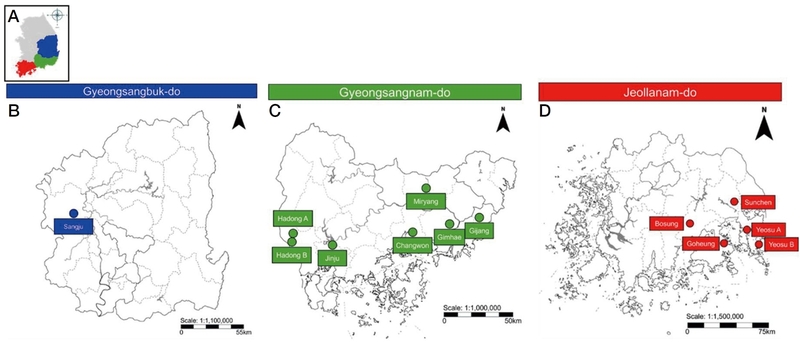
Geographic regions where the Greater Wax Moth (Galleria mellonella) was collected. An overview of the collection regions is shown, with Gyeongsangbuk-do indicated in blue, Gyeongsangnam-do in green, and Jeollanam-do in red (A). The collection site in Gyeongsangbuk-do was Sangju (B). Collection sites in Gyeongsangnam-do included Gimhae, Gijang, Miryang, Jinju, Changwon, and Hadong; samples from Hadong were collected at two locations (Hadong A and Hadong B) (C). Collection sites in Jeollanam-do included Goheung, Boseong, Suncheon, and Yeosu; samples from Yeosu were collected at two locations (Yeosu A and Yeosu B) (D).

Regions, locations, and developmental stages of the Greater Wax Moth (Galleria mellonella) collected
3. PCR(Polymerase Chain Reaction) 및 서열분석
저항성 돌연변이 확인을 위해 M918-T929와 L1014 두 구역에 대한 primer 세트를 따로 디자인하였다(Fig. 2). 두 세트의 primer에 대한 정보는 Table 2를 통해 제시하였다. PCR에는 WizPureTM Taq DNA Polymerase PCR (Wizbiosolutions, Sungnam, Korea) 키트를 사용하였으며, PCR reaction에는 Taq DNA polymerase 0.2 μL, 10× PCR buffer 2 μL, dNTP mix 1.6 μL, DNA template 2 μL (200 ng), nuclease water 10.2 μL, forward, reverse primer 각 2 μL씩 혼합하여 진행하였다. PCR 과정으로, M918-T929 서열을 PCR하기 위해 primer set A를 사용했을 때 95℃에서 5분 (Predenature), 95℃에서 30초(Denaturation), 56℃에서 30초(Annealing), 72℃에서 30초(Extension), 72℃에서 5분(Final extension)으로 진행되었으며, denaturation부터 extension은 35회 반복하였다. L1014 서열을 위한 primer set B를 사용할 때는 extension 시간을 1분으로 설정하였으며, 그 외 조건은 동일하다. PCR 이후 QIAquick PCR Purification Kit (Qiagen, Hilden, Germany)를 사용해 정제하였고, QuickDrop 분광광도계(Molecular Devices, San Jose, CA, USA)를 사용하여 농도를 측정한 후 PCR에 사용된 것과 동일한 primer로 Macrogen, Inc (Sejong, Korea)에서 DNA 염기서열분석을 진행하였다.
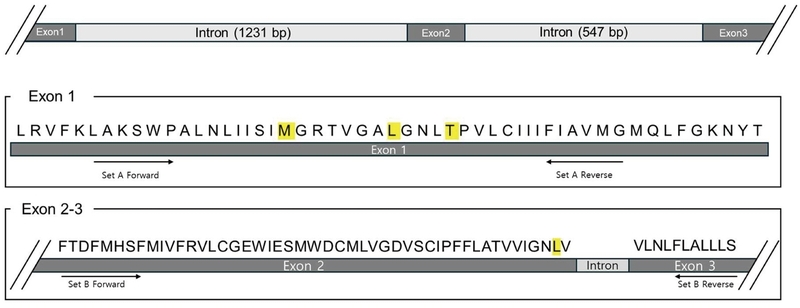
Schematic map illustrating the Voltage-Gated Sodium Channel structure of Galleria mellonella from M918 to L1014. The target mutation sites are distributed across two exons. Exon 1 contains three mutation sites (M918, L925, and T929), whereas L1014 is in exon 2. Based on this exon distribution, two sets of primers were designed in this study.
PCR primers used to assess resistance-associated mutations in the Voltage-Gated Sodium Channel (VGSC) of Galleria mellonella
결 과
1. 꿀벌부채명나방 전압의존성 나트륨채널 서열 비교 분석
꿀벌응애의 VGSC 돌연변이 발생 부위를 포함하는 아미노산과 mRNA 서열을 NCBI에 기재된 꿀벌부채명나방을 포함한 다른 나비목 생물과 비교한 결과(Figs. 3, 4), M918, T929, L1014 돌연변이 발생 지점의 mRNA 서열이 동일하게 존재했고(M918: ATG, T929: ACC, L1014: CTT), L923 서열의 경우 꿀벌부채명나방을 포함한 세 종(G. mellonella, Helicoverpa zea, Spodoptera frugiperda)에서 TTA, 다른 세 종(Achroia grisella, B. mori, Spodoptera litura)에서 TTG였다(Fig. 3). 그러나 이들의 아미노산 서열에는 변화가 없었다(Fig. 4). 이를 꿀벌응애의 감수성, 저항성 서열과 비교한 결과 감수성 서열의 경우 M918은 ATG, T929는 ACC로 차이가 없었고, L925와 L1014의 경우 염기서열이 CTG로 달라졌지만 아미노산 서열에는 차이가 없었다(Figs. 3, 4). 그러나 L925V 저항성 서열의 경우 염기서열은 CTG가 GTG로, 아미노산 서열은 류신이 발린(Valine)으로 변해 문헌적으로 보고된 저항성 돌연변이를 확인할 수 있었다(Figs. 3, 4).
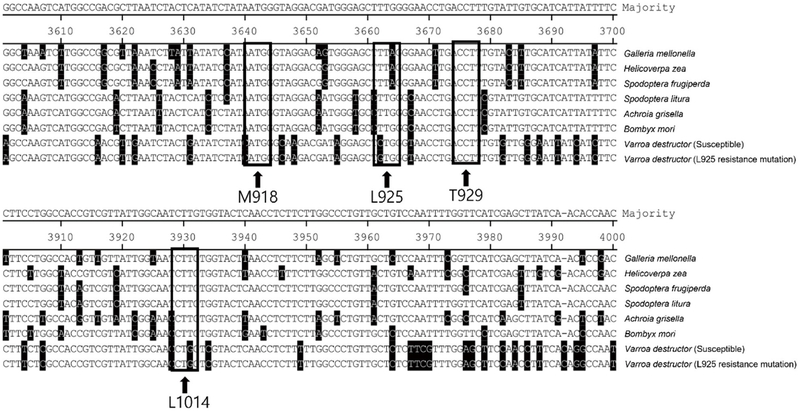
Alignment of Voltage-Gated Sodium Channel DNA sequences across six lepidopteran species, including Galleria mellonella, with comparison to susceptible and resistant variants of Varroa destructor. Target resistance-associated mutation regions are indicated by black boxes and arrows. In G. mellonella, the corresponding codons are ATG for M918, TTA for L925, ACC for T929, and CTT for L1014. In susceptible V. destructor, the TTG codon at L925 and the CTT codon at L1014 are substituted by CTG; however, these substitutions are synonymous and do not alter the encoded amino acids. In contrast, the L925 resistance mutation involves a CTG-to-GTG substitution, resulting in a nonsynonymous amino acid change from leucine to valine.
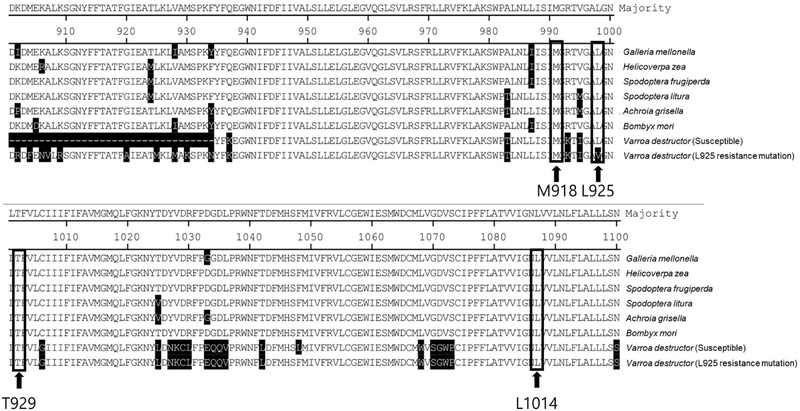
Alignment of Voltage-Gated Sodium Channel amino acid sequences across six lepidopteran species, including Galleria mellonella, with comparison to susceptible and resistant variants of Varroa destructor. Target resistance-associated mutation regions are indicated by black boxes and arrows. The L925 resistance mutation in V. destructor results in a leucine-to-valine substitution.
그리고 꿀벌응애 VGSC의 L1770P 저항성 돌연변이를 꿀벌부채명나방을 비롯한 다른 곤충들의 서열과 비교했을 때 꿀벌응애에서는 류신으로 나타나는 아미노산 서열이 꿀벌부채명나방, 꿀벌, 집파리, 노랑초파리, 누에나방에서는 모두 프롤린으로 나타나는 것을 확인할 수 있었다(Fig. 5).
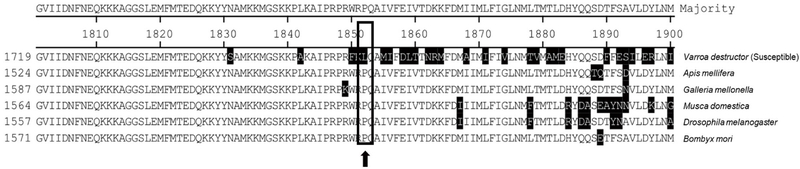
Alignment of Voltage-Gated Sodium Channel (VGSC) amino acid sequences from Varroa destructor and insects, including Galleria mellonella. The leucine (L) at position 1770 in the VGSC of V. destructor is substituted by proline (P) in resistant variants and is conserved as leucine in insects (black box). The L1770P mutation is known to contribute to fluvalinate resistance in V. destructor.
2. PCR 및 서열분석
13곳의 양봉장에서 채집된 꿀벌부채명나방을 대상으로 실시한 PCR 결과 예상한 크기에 맞는 증폭결과물을 확인하였고, 이를 정제한 후 DNA 염기서열분석을 진행해 크로마토그램을 통해 서열분석 결과를 확인하였다(Figs. 6~9). M918의 경우 밀양을 제외한 지역의 샘플에서는 모두 저항성 돌연변이가 발생하지 않은 것으로 확인되었다. 그러나 밀양샘플에서는 크로마토그래피의 특이도가 낮아 정확한 저항성 돌연변이 발생 여부를 판단할 수 없었지만 가장 큰 peak를 기준으로 ATG의 서열이 확인되어 밀양샘플 또한 저항성 돌연변이가 발달하지 않은 것으로 판단되었다 (Fig. 6). L925는 서열분석의 모든 결과가 TTA로 NCBI에 기재된 것과 동일한 서열 결과가 나타났다(Fig. 7). T929에서는 김해, 밀양, 하동1, 고흥의 5번 샘플, 순천의 모든 샘플, 여수의 2번 샘플에서 트레오닌(Threonine)의 세 번째 염기서열에서 사이토신(Cytosine)과 함께 아데닌(Adenine)의 peak가 확인되었지만, 아미노산에는 변화를 주지 않는다 (Fig. 8). 마지막으로 L1014에서는 모든 지역의 샘플에서 저항성 돌연변이가 확인되지 않았다(Fig. 9). 이에 따라 우리나라 남부지방에서는 꿀벌부채명나방의 VGSC에 저항성 돌연변이가 발생하지 않은 것으로 확인된다.
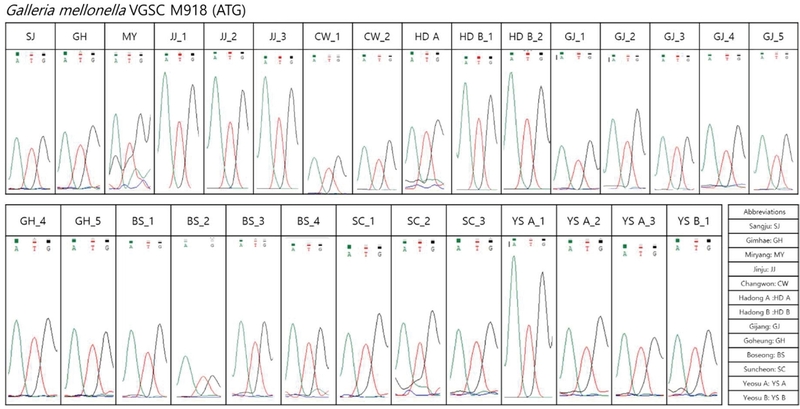
Sequencing results of the M918 site in the Voltage-Gated Sodium Channel of Galleria mellonella. The wild-type codon at M918 was ATG, and no resistance-associated mutations were detected.
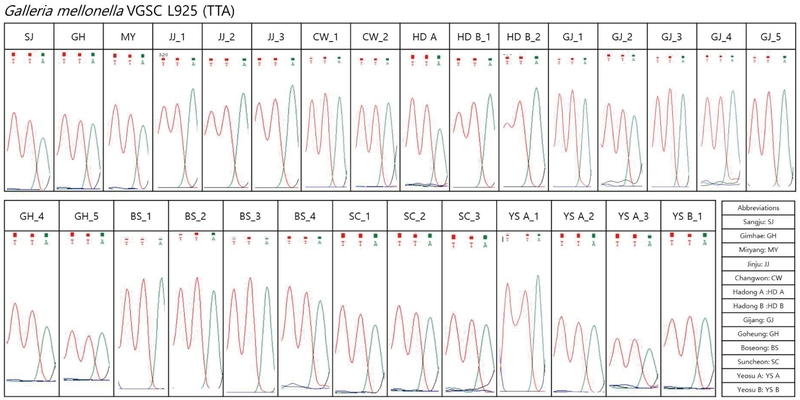
Sequencing results of the L925 site in the Voltage-Gated Sodium Channel of Galleria mellonella. The wild-type codon at L925 was TTA, and no resistance-associated mutations were detected.
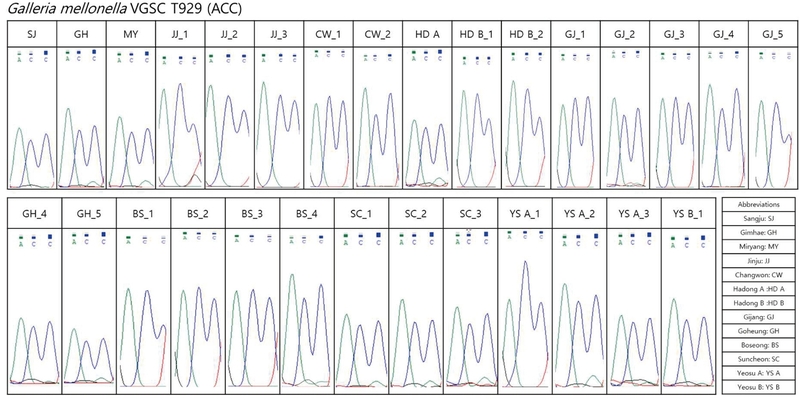
Sequencing results of the T929 site in the Voltage-Gated Sodium Channel of Galleria mellonella. The wild-type codon at T929 was ACC. Minor peak variations were observed at the wobble position; however, these did not result in any amino acid substitutions.
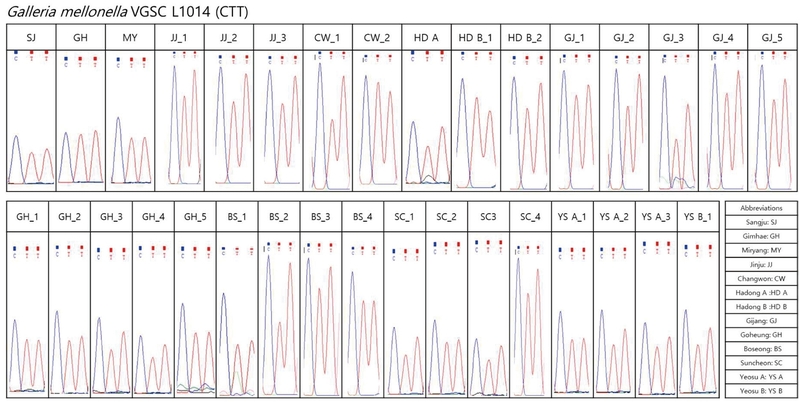
Sequencing results of the L1014 site in the Voltage-Gated Sodium Channel of Galleria mellonella. The wild-type codon at L1014 was CTT, and no resistance-associated mutations were detected.
고 찰
본 연구는 해충 방제를 위해 사용되는 약제에 비표적생물이 노출되었을 때의 저항성 발달 가능성을 염두하여 양봉농가에서 꿀벌응애 방제를 위해 처리되는 플루발리네이트에 대해 비표적생물인 꿀벌부채명나방에서 저항성 돌연변이 발달 여부를 조사하였다.
플루발리네이트는 지용성의 피레스로이드계 살비제로 봉군에 지속적으로 처리됨에 따라 밀랍에 잔류하며 축적되어 왔음이 지적되어 왔고, 이에 따라 봉군 내부에서 유충 시기를 보내고 소비장을 기어다니며 꿀과 밀랍을 섭식하는 꿀벌부채명나방에서도 저항성이 발달했을 수 있다고 가정하였다(Khan, 2024; Li et al., 2025). 이에 따라 국내 남부지역 11개 시군의 13곳의 양봉장에서 채집된 꿀벌부채명나방에서 피레스로이드 저항성에 관여하는 것으로 알려진 VGSC의 M918, L925, T929, L1014에서의 저항성 돌연변이 발생 여부를 확인하였다. 이를 위해 나비목 생물과 꿀벌응애에서 피레스로이드계 살충제, 플루발리네이트 노출로 발생한 저항성 돌연변이 위치를 참고해 꿀벌부채명나방 VGSC 유전자 서열을 확인하고, 채집된 샘플의 서열을 분석했으나, 저항성 돌연변이가 확인되지 않았다(Figs. 6~9).
이 결과는 플루발리네이트가 꿀벌응애에서 저항성 돌연변이를 발달시킨 것과는 다르게, 꿀벌부채명나방에는 저항성을 발달시키는 선택압으로 작용할 만큼의 독성을 나타내지 못한 것으로 예상된다. 플루발리네이트는 국내에서 홍사방, 왕스 등의 상품명의 스트립제가 판매되고 있으며, 한 스트립당 30 mg의 플루발리네이트가 포함되어 있다(Kim and Lee, 2022; Oh and Jung, 2025). 플루발리네이트가 봉군 내에 잔류하는 농도는 국내에서 연구된 바는 없지만 스페인에서 수행된 연구에서 화분떡(Beebread)에 최소 160 ppb에서 최대 1960 ppb 수준이며, 밀랍에는 평균적으로 70 ppb 수준으로 잔류하는 것으로 나타났다(Benito-Murcia et al., 2021). 그러나 꿀벌부채명나방을 대상으로 한 독성실험에서는 고체사료 1 kg에 포함된 먹이에 대해 LC50이 야외에서 채집된 집단은 2.63 mg/kg, 실험실에서 사육된 집단 3.38 mg/kg으로 나타나 두 집단에는 큰 차이를 나타내지 않았지만 봉군 내부에 잔류하는 농도에 비해 매우 높은 농도인데(Li et al., 2025), 이는 봉군 내부에 잔류하거나 응애방제를 위해 처리되는 플루발리네이트에 꿀벌부채명나방이 노출되었다 하더라도 그 농도가 독성 또는 저항성을 발달시킬 수 있을 만큼 높은 농도가 아님을 알 수 있다. 뿐만 아니라, 노랑초파리(D. melanogaster), 집파리(M. domestica), 꿀벌(A. mellifera), 누에나방(B. mori) 및 꿀벌부채명나방의 VGSC의 1770번째 아미노산 서열이 프롤린 서열로 나타났는데(Fig. 5), 꿀벌응애에서 L1770P 돌연변이가 플루발리네이트 저항성에 관여한다는 보고(Liu et al., 2006b; Hubert et al., 2014)와 독일바퀴의 1770번 아미노산을 프롤린에서 류신으로 변환시켰을 때 플루발리네이트에 대한 민감도가 증가한 연구 결과를 고려할 때(Liu et al., 2006b), 꿀벌부채명나방의 VGSC의 1770번째 아미노산 서열이 프롤린인 것이 플루발리네이트에 대한 꿀벌부채명나방의 낮은 독성의 원인인 것으로 사료된다.
또한 꿀벌부채명나방에서 저항성 돌연변이가 발생하더라도 집단 수준에서의 확산 가능성은 제한적이다. 꿀벌응애는 봉군 내부에서 번식하며 한 세대의 수명이 짧고, 단성생식을 통해 수컷을 만들고, 수정된 난자는 암컷으로 발달하며 봉군 내부에서는 세대의 구분 없이 근친교배가 일어난다(Garrido and Rosenkranz, 2003; Nazzi and Le Conte, 2016; Beaurepaire et al., 2017). 이를 통해 봉군 내부에서 생활하며 플루발리네이트에 노출된 꿀벌응애는 저항성 개체가 살아남아 저항성 돌연변이를 가진 집단이 선택될 뿐만 아니라, 단성생식을 통해 어미와 같은 유전자를 가진 수컷이 나타나고, 근친교배를 통해 저항성 돌연변이 유전자가 봉군 내 꿀벌응애 집단에 우점적으로 존재해 꿀벌응애의 저항성 돌연변이 발달에 기여한다(Beaurepaire et al., 2017; Reams and Rangel, 2022; Lee et al., 2023). 그러나 꿀벌부채명나방은 유충 시기를 봉군 내부에서 보내며 플루발리네이트에 노출될 수 있지만 성충으로 우화한 후에는 번식을 위해 봉군 외부로 나가게 되어 생활사 전체에서 플루발리네이트에 노출되는 꿀벌응애와 달리 플루발리네이트에 노출되지 않을 수 있는 저항성 선택압이 작용하지 않는 시기가 존재한다(Kwadha et al., 2017). 또한 봉군 외부에서 다른 개체와의 유성생식을 통해서만 번식이 이뤄지기 때문에 단성생식으로도 번식할 수 있는 응애와 달리 감수성 형질이 유입될 가능성이 높다(Nielsen and Cantwell, 1973). 따라서 꿀벌부채명나방의 꿀벌응애와 다른 생활사와 번식방법으로 인해 저항성 돌연변이가 발달했다 하더라도 집단에서 유지되지 않아 저항성 돌연변이 유전자가 집단 내에 고정되는 것을 약화시키는 것으로 사료된다(Morjan and Rieseberg, 2004; Kwadha et al., 2017; Wojda et al., 2020).
이처럼 꿀벌부채명나방이 플루발리네이트에 노출되었다 하더라도 플루발리네이트에 대해 독성이 낮은 생리적 특성, 꿀벌부채명나방 VGSC의 아미노산 서열에서 피레스로이드계 약제에 대한 저항성에 기여하는 부분이 존재하는 유전적 특성과, 저항성 돌연변이가 집단 내에 유지되기 어려운 생태적 특징이 꿀벌부채명나방에서 저항성 돌연변이가 발달하지 못한 이유로 여겨진다(Liu et al., 2006b; Kwadha et al., 2017; Li et al., 2025).
적 요
꿀벌부채명나방은 봉군 내부에 서식하며 봉군에 부정적인 영향을 미치는 양봉해충이다. 플루발리네이트는 꿀벌응애 방제를 위해 봉군에 지속적으로 처리되어 꿀벌응애의 VGSC에서 저항성 돌연변이가 발달하였고, 봉군 내부에 서식하는 꿀벌부채명나방 또한 저항성 돌연변이가 발달할 수 있다고 가정하였다. 이를 확인하기 위해 국내 11개 지역의 13개 양봉장에서 꿀벌부채명나방을 채집했다. 시료에서 DNA를 추출한 후 PCR 및 서열분석을 통해 저항성 돌연변이의 발생 현황을 확인했지만 서열분석 결과 저항성 돌연변이는 확인되지 않았다. 그리고 꿀벌응애와 달리 꿀벌부채명나방의 플루발리네이트에 대한 낮은 독성을 나타내는 생리적, 유전적 특성과 저항성 돌연변이가 발달하고 유지되기 어려운 생태적 특성에 대한 연구들은 꿀벌부채명나방의 VGSC에서 저항성 돌연변이가 확인되지 않은 본 연구 결과를 지지한다.
Acknowledgments
이 논문은 2023학년도 경북대학교 연구년 교수 연구비에 의해 연구되었음.
References
-
Adamczyk, S., R. Lázaro, C. Pérez-Arquillué, S. Bayarri and A. Herrera. 2010. Impact of the use of fluvalinate on different types of beeswax from Spanish hives. Arch. Environ. Contam. Toxicol. 58: 733-739.
[https://doi.org/10.1007/s00244-009-9387-7]

-
Ahmad, M., I. Denholm and R. H. Bromilow. 2006. Delayed cuticular penetration and enhanced metabolism of deltamethrin in pyrethroid-resistant strains of Helicoverpa armigera from China and Pakistan. Pest Manag. Sci. 62: 805-810.
[https://doi.org/10.1002/ps.1225]
-
Bass, C., I. Schroeder, A. Turberg, L. M. Field and M. S. Williamson. 2004. Identification of mutations associated with pyrethroid resistance in the para-type sodium channel of the cat flea, Ctenocephalides felis. Insect Biochem. Mol. Biol. 34: 1305-1313.
[https://doi.org/10.1016/j.ibmb.2004.09.002]
-
Beaurepaire, A. L., K. J. Krieger and R. F. Moritz. 2017. Seasonal cycle of inbreeding and recombination of the parasitic mite Varroa destructor in honeybee colonies and its implications for the selection of acaricide resistance. Infect. Genet. Evol. 50: 49-54.
[https://doi.org/10.1016/j.meegid.2017.02.011]
-
Benito-Murcia, M., C. Bartolomí, X. Maside, J. Bernal, J. L. Bernal, M. J. Del Nozal, A. Meana, C. Botías, R. Martín-Hernández and M. Higes. 2021. Residual tau-fluvalinate in honey bee colonies is coupled with evidence for selection for Varroa destructor resistance to pyrethroids. Insects 12: 731.
[https://doi.org/10.3390/insects12080731]
-
Benito-Murcia, M., R. Martín-Hernández, A. Meana, C. Botías and M. Higes. 2022. Study of pyrethroid resistance mutations in populations of Varroa destructor across Spain. Res. Vet. Sci. 152: 34-37.
[https://doi.org/10.1016/j.rvsc.2022.07.021]
-
Boaventura, D., M. Martin, A. Pozzebon, D. Mota-Sanchez and R. Nauen. 2020. Monitoring of target-site mutations conferring insecticide resistance in Spodoptera frugiperda. Insects 11: 545.
[https://doi.org/10.3390/insects11080545]
-
Cai, T., X. Wang, B. Liu, H. Zhao, C. Liu, X. Zhang, Y. Zhang, H. Gao, C. Schal and F. Zhang. 2024. A cuticular protein, BgCPLCP1, contributes to insecticide resistance by thickening the cockroach endocuticle. Int. J. Biol. Macromol. 254: 127642.
[https://doi.org/10.1016/j.ijbiomac.2023.127642]
-
Carletto, J., T. Martin, F. Vanlerberghe-Masutti and T. Brévault. 2010. Insecticide resistance traits differ among and within host races in Aphis gossypii. Pest Manag. Sci. 66: 301-307.
[https://doi.org/10.1002/ps.1874]
-
Carvalho, R. A., C. Omoto, L. M. Field, M. S. Williamson and C. Bass. 2013. Investigating the molecular mechanisms of organophosphate and pyrethroid resistance in the fall armyworm Spodoptera frugiperda. PLoS One 8: e62268.
[https://doi.org/10.1371/journal.pone.0062268]
-
Cheng, Y., Y. Li, W. Li, Y. Song, R. Zeng and K. Lu. 2021. Inhibition of hepatocyte nuclear factor 4 confers imidacloprid resistance in Nilaparvata lugens via the activation of cytochrome P450 and UDP-glycosyltransferase genes. Chemosphere 263: 128269.
[https://doi.org/10.1016/j.chemosphere.2020.128269]
-
Davies, T., L. Field, P. Usherwood and M. Williamson. 2007. DDT, pyrethrins, pyrethroids and insect sodium channels. IUBMB Life 59: 151-162.
[https://doi.org/10.1080/15216540701352042]
-
Desaeger, J. A., M. Rivera, R. Leighty and H. Portillo. 2011. Effect of methomyl and oxamyl soil applications on early control of nematodes and insects. Pest Manag. Sci. 67: 507-513.
[https://doi.org/10.1002/ps.2058]
-
Ellis, J. D., J. R. Graham and A. Mortensen. 2013. Standard methods for wax moth research. J. Apic. Res. 52: 1-17.
[https://doi.org/10.3896/IBRA.1.52.1.10]
-
Epis, S., D. Porretta, V. Mastrantonio, F. Comandatore, D. Sassera, P. Rossi, C. Cafarchia, D. Otranto, G. Favia and C. Genchi. 2014. ABC transporters are involved in defense against permethrin insecticide in the malaria vector Anopheles stephensi. Parasit. Vectors 7: 349.
[https://doi.org/10.1186/1756-3305-7-349]
-
Erban, T., K. Harant, M. Hubalek, P. Vitamvas, M. Kamler, P. Poltronieri, J. Tyl, M. Markovic and D. Titera. 2015. Indepth proteomic analysis of Varroa destructor: Detection of DWV-complex, ABPV, VdMLV and honeybee proteins in the mite. Sci. Rep. 5: 13907.
[https://doi.org/10.1038/srep13907]
-
Gajendiran, A. and J. Abraham. 2018. An overview of pyrethroid insecticides. Front. Biol. 13: 79-90.
[https://doi.org/10.1007/s11515-018-1489-z]
-
Garrido, C. and P. Rosenkranz. 2003. The reproductive program of female Varroa destructor mites is triggered by its host, Apis mellifera. Exp. Appl. Acarol. 31: 269-273.
[https://doi.org/10.1023/B:APPA.0000010386.10686.9f]
-
González-Cabrera, J., H. Bumann, S. Rodríguez-Vargas, P. J. Kennedy, K. Krieger, G. Altreuther, A. Hertel, G. Hertlein, R. Nauen and M. S. Williamson. 2018. A single mutation is driving resistance to pyrethroids in European populations of the parasitic mite, Varroa destructor. J. Pest Sci. 91: 1137-1144.
[https://doi.org/10.1007/s10340-018-0968-y]
-
González-Cabrera, J., S. Rodríguez-Vargas, T. E. Davies, L. M. Field, D. Schmehl, J. D. Ellis, K. Krieger and M. S. Williamson. 2016. Novel mutations in the voltage-gated sodium channel of pyrethroid-resistant Varroa destructor populations from the Southeastern USA. PLoS One 11: e0155332.
[https://doi.org/10.1371/journal.pone.0155332]
-
González-Cabrera, J., T. E. Davies, L. M. Field, P. J. Kennedy and M. S. Williamson. 2013. An amino acid substitution (L925V) associated with resistance to pyrethroids in Varroa destructor. PLoS One 8: e82941.
[https://doi.org/10.1371/journal.pone.0082941]
-
He, Z., J. Zhang, Z. Shi, J. Liu, J. Zhang, Z. Yan and B. Chen. 2019. Modification of contact avoidance behaviour associated with pyrethroid resistance in Anopheles sinensis(Diptera: Culicidae). Malar. J. 18: 131.
[https://doi.org/10.1186/s12936-019-2765-3]
-
Hopkins, B. and P. Pietrantonio. 2010. The Helicoverpa zea (Boddie)(Lepidoptera: Noctuidae) voltage-gated sodium channel and mutations associated with pyrethroid resistance in field-collected adult males. Insect Biochem. Mol. Biol. 40: 385-393.
[https://doi.org/10.1016/j.ibmb.2010.03.004]
-
Hubert, J., M. Nesvorna, M. Kamler, J. Kopecky, J. Tyl, D. Titera and J. Stara. 2014. Point mutations in the sodium channel gene conferring tau-fluvalinate resistance in Varroa destructor. Pest Manag. Sci. 70: 889-894.
[https://doi.org/10.1002/ps.3679]
-
Jack, C. J. and J. D. Ellis. 2021. Integrated pest management control of Varroa destructor(Acari: Varroidae), the most damaging pest of (Apis mellifera L.(Hymenoptera: Apidae)) colonies. J. Insect Sci. 21: 6.
[https://doi.org/10.1093/jisesa/ieab058]
-
Jeong, S., C. Lee, D. Kim and C. Jung. 2016. Questionnaire study on the overwintering success and pest management of honeybee and damage assessment of Vespa hornets in Korea. Korean J. Apic. 31.
[https://doi.org/10.17519/apiculture.2016.09.31.3.201]
-
Kast, C., V. Kilchenmann and J. D. Charrière. 2021. Long-term monitoring of lipophilic acaricide residues in commercial Swiss beeswax. Pest Manag. Sci. 77: 4026-4033.
[https://doi.org/10.1002/ps.6427]
-
Khan, H. A. A. 2024. Resistance risk assessment, cross-resistance potential and realized heritability of resistance to methomyl in Musca domestica Linnaeus. Ecotoxicology 33: 226-234.
[https://doi.org/10.1007/s10646-024-02742-2]
-
Kim, H., J. H. Baek, W.-J. Lee and S. H. Lee. 2007. Frequency detection of pyrethroid resistance allele in Anopheles sinensis populations by real-time PCR amplification of specific allele (rtPASA). Pest. Biochem. Physiol. 87: 54-61.
[https://doi.org/10.1016/j.pestbp.2006.06.009]
-
Kim, Y. H. and S. Lee. 2022. Current status of fluvalinate resistance in Varroa destructor in Korea and suggestion for possible solution. J. Apic. 37: 301-313.
[https://doi.org/10.17519/apiculture.2022.09.37.3.301]
-
Krewing, M., E. Mönch, A. Bolten and H. Niesalla. 2024. Resistance or tolerance? Highlighting the need for precise terminology in the field of disinfection. J. Hosp. Infect. 150: 51-60.
[https://doi.org/10.1016/j.jhin.2024.05.006]
-
Kwadha, C. A., G. O. Ong’amo, P. N. Ndegwa, S. K. Raina and A. T. Fombong. 2017. The biology and control of the greater wax moth, Galleria mellonella. Insects 8: 61.
[https://doi.org/10.3390/insects8020061]
-
Lee, J., K. Moon, S. Cho, Y. Lim, S. Kim, S.-b. Kim, S.-M. Han, Y. H. Kim and S. H. Lee. 2023. Establishment and application of bioassay-and molecular marker-based methods for monitoring fluvalinate resistance of varroa mites. Pest. Biochem. Physiol. 197: 105655.
[https://doi.org/10.1016/j.pestbp.2023.105655]
- Lee, M., C. Ryu, M. Lee, Y. Kim, S. Nam and S. Chang. 2004. Preliminary tests of miticides and several natural compounds for control of Varroa destructor. Korean J. Apic. 19: 16-17.
-
Li, S., L.-H. Liao, W.-Y. Wu and M. R. Berenbaum. 2025. Residual tau-fluvalinate, a beehive acaricide, disrupts growth and metabolism in the greater wax moth, Galleria mellonella. Pest. Biochem. Physiol. 212: 106465.
[https://doi.org/10.1016/j.pestbp.2025.106465]
-
Lin, Y., T. Jin, L. Zeng and Y. Lu. 2012. Cuticular penetration of β-cypermethrin in insecticide-susceptible and resistant strains of Bactrocera dorsalis. Pest. Biochem. Physiol. 103: 189-193.
[https://doi.org/10.1016/j.pestbp.2012.05.002]
-
Liu, N., Q. Xu, F. Zhu and L. Zhang. 2006a. Pyrethroid resistance in mosquitoes. Insect Sci. 13: 159-166.
[https://doi.org/10.1111/j.1744-7917.2006.00078.x]
-
Liu, Z., J. Tan, Z. Y. Huang and K. Dong. 2006b. Effect of a fluvalinate-resistance-associated sodium channel mutation from varroa mites on cockroach sodium channel sensitivity to fluvalinate, a pyrethroid insecticide. Insect Biochem. Mol. Biol. 36: 885-889.
[https://doi.org/10.1016/j.ibmb.2006.08.006]
-
Lovell, B. J. 1963. The relationship of anticholinesterase activity, penetration, and insect and mammalian toxicity of certain organophosphorus insecticides. J. Econ. Entomol. 56: 310-317.
[https://doi.org/10.1093/jee/56.3.310]
-
Marshall, K. L., C. Moran, Y. Chen and G. A. Herron. 2012. Detection of kdr pyrethroid resistance in the cotton aphid, Aphis gossypii (Hemiptera: Aphididae), using a PCR-RFLP assay. J. Pestic. Sci. 37: 169-172.
[https://doi.org/10.1584/jpestics.D11-017]
-
Martinez-Torres, D., C. Chevillon, A. Brun-Barale, J. B. Bergé, N. Pasteur and D. Pauron. 1999. Voltage-dependent Na+ channels in pyrethroid-resistant Culex pipiens L mosquitoes. Pestic. Sci. 55: 1012-1020.
[https://doi.org/10.1002/(SICI)1096-9063(199910)55:10<1012::AID-PS39>3.0.CO;2-5]
-
Millán-Leiva, A., Ó. Marín, P. De la Rúa, I. Muñoz, A. Tsagkarakou, H. Eversol, K. Christmon, D. VanEngelsdorp and J. González-Cabrera. 2021. Mutations associated with pyrethroid resistance in the honey bee parasite Varroa destructor evolved as a series of parallel and sequential events. J. Pest Sci. 94: 1505-1517.
[https://doi.org/10.1007/s10340-020-01321-8]
-
Morjan, C. L. and L. H. Rieseberg. 2004. How species evolve collectively: Implications of gene flow and selection for the spread of advantageous alleles. Mol. Ecol. 13: 1341-1356.
[https://doi.org/10.1111/j.1365-294X.2004.02164.x]
-
Mouhamadou, C. S., S. S. de Souza, B. K. Fodjo, M. G. Zoh, N. K. Bli and B. G. Koudou. 2019. Evidence of insecticide resistance selection in wild Anopheles coluzzii mosquitoes due to agricultural pesticide use. Infect. Dis. Poverty 8: 64.
[https://doi.org/10.1186/s40249-019-0572-2]
-
Nansen, C., O. Baissac, M. Nansen, K. Powis and G. Baker. 2016. Behavioral avoidance-will physiological insecticide resistance level of insect strains affect their oviposition and movement responses? PLoS One 11: e0149994.
[https://doi.org/10.1371/journal.pone.0149994]
-
Nauen, R., C. Bass, R. Feyereisen and J. Vontas. 2022. The role of cytochrome P450s in insect toxicology and resistance. Annu. Rev. Entomol. 67: 105-124.
[https://doi.org/10.1146/annurev-ento-070621-061328]
-
Nazzi, F. and Y. Le Conte. 2016. Ecology of Varroa destructor, the major ectoparasite of the western honey bee, Apis mellifera. Annu. Rev. Entomol. 61: 417-432.
[https://doi.org/10.1146/annurev-ento-010715-023731]
-
Nielsen, R. A. and C. Brister. 1979. Greater wax moth: Behavior of larvae. Ann. Entomol. Soc. Am. 72: 811-815.
[https://doi.org/10.1093/aesa/72.6.811]
-
Nielsen, R. A. and G. E. Cantwell. 1973. The question of parthenogenesis in the greater wax moth. J. Econ. Entomol. 66: 37-38.
[https://doi.org/10.1093/jee/66.1.37]
-
Nyoni, B. N., K. Gorman, T. Mzilahowa, M. S. Williamson, M. Navajas, L. M. Field and C. Bass. 2011. Pyrethroid resistance in the tomato red spider mite, Tetranychus evansi, is associated with mutation of the para-type sodium channel. Pest Manag. Sci. 67: 891-897.
[https://doi.org/10.1002/ps.2145]
-
Oh, H. and C. Jung. 2025. Comparative evaluation of acaricidal effects on Varroa destructor during the spring season. J. Apic. 40: 113-120.
[https://doi.org/10.17519/apiculture.2025.06.40.2.113]
-
Özgör, E. 2021. The effects of Nosema apis and Nosema ceranae infection on survival and phenoloxidase gene expression in Galleria mellonella (Lepidoptera: Galleriidae) compared to Apis mellifera. Insects 12: 953.
[https://doi.org/10.3390/insects12100953]
-
Ozgor, E., I. Celebier, M. Ulusoy and N. Keskin. 2017. First detection of Nosema ceranae and Nosema apis in greater wax moth Galleria mellonella. J. Apic. Sci. 61: 185.
[https://doi.org/10.1515/jas-2017-0015]
-
Park, Y. and M. F. Taylor. 1997. A novel mutation L1029H in sodium channel gene hscp associated with pyrethroid resistance for Heliothis virescens(Lepidoptera: Noctuidae). Insect Biochem. Mol. Biol. 27: 9-13.
[https://doi.org/10.1016/S0965-1748(96)00077-X]
-
Park, Y., M. F. Taylor and R. Feyereisen. 1997. A valine 421 to methionine mutation in IS6 of the hscp voltage-gated sodium channel associated with pyrethroid resistance in Heliothis virescens F. Biochem. Biophys. Res. Commun. 239: 688-691.
[https://doi.org/10.1006/bbrc.1997.7511]
-
Ramsey, S. D., R. Ochoa, G. Bauchan, C. Gulbronson, J. D. Mowery, A. Cohen, D. Lim, J. Joklik, J. M. Cicero and J. D. Ellis. 2019. Varroa destructor feeds primarily on honey bee fat body tissue and not hemolymph. Proc. Natl. Acad. Sci. U. S. A. 116: 1792-1801.
[https://doi.org/10.1073/pnas.1818371116]
-
Ray, D. E. and J. R. Fry. 2006. A reassessment of the neurotoxicity of pyrethroid insecticides. Pharmacol. Ther. 111: 174-193.
[https://doi.org/10.1016/j.pharmthera.2005.10.003]
-
Reams, T. and J. Rangel. 2022. Understanding the enemy: A review of the genetics, behavior and chemical ecology of Varroa destructor, the parasitic mite of Apis mellifera. J. Insect Sci. 22: 18.
[https://doi.org/10.1093/jisesa/ieab101]
-
Saavedra-Rodriguez, K., L. Urdaneta-Marquez, S. Rajatileka, M. Moulton, A. Flores, I. Fernandez-Salas, J. Bisset, M. Rodriguez, P. McCall and M. Donnelly. 2007. A mutation in the voltage-gated sodium channel gene associated with pyrethroid resistance in Latin American Aedes aegypti. Insect Mol. Biol. 16: 785-798.
[https://doi.org/10.1111/j.1365-2583.2007.00774.x]
-
Schuler, T. H., D. Martinez-Torres, A. J. Thompson, I. Denholm, A. L. Devonshire, I. R. Duce and M. S. Williamson. 1998. Toxicological, electrophysiological, and molecular characterisation of knockdown resistance to pyrethroid insecticides in the diamondback moth, Plutella xylostella (L.). Pest. Biochem. Physiol. 59: 169-182.
[https://doi.org/10.1006/pest.1998.2320]
-
Sonoda, S., C. Igaki and H. Tsumuki. 2008. Alternatively spliced sodium channel transcripts expressed in field strains of the diamondback moth. Insect Biochem. Mol. Biol. 38: 883-890.
[https://doi.org/10.1016/j.ibmb.2008.06.006]
- Traiyasut, P., W. Mookhploy, K. Kimura, M. Yoshiyama, K. Khongphinitbunjong, P. Chantawannakul, N. Buawangpong, P. Saraithong, M. Burgett and E. Chukeatirote. 2016. First detection of honey bee viruses in wax moth. Chiang Mai J. Sci. 43: 695-698.
-
Türker, L., I. Togan, S. Ergezen and M. Özer. 1993. Novel attractants of Galleria mellonella L (Lepidoptera Pyralidae Galleriinae). Apidologie 24: 425-430.
[https://doi.org/10.1051/apido:19930409]
-
Vlogiannitis, S., W. Jonckheere, D. Laget, D. C. de Graaf, J. Vontas and T. Van Leeuwen. 2021. Pyrethroid target-site resistance mutations in populations of the honey bee parasite Varroa destructor (Acari: Varroidae) from Flanders, Belgium. Exp. Appl. Acarol. 85: 205-221.
[https://doi.org/10.1007/s10493-021-00665-9]
-
Vontas, J. G., G. J. Small and J. Hemingway. 2001. Glutathione S-transferases as antioxidant defence agents confer pyrethroid resistance in Nilaparvata lugens. Biochem. J. 357: 65-72.
[https://doi.org/10.1042/bj3570065]
-
Wallner, K. 1999. Varroacides and their residues in bee products. Apidologie 30: 235-248.
[https://doi.org/10.1051/apido:19990212]
-
Wang, Z. M., C. X. Li, D. Xing, Y. H. Yu, N. Liu, R. D. Xue, Y. D. Dong and T. Y. Zhao. 2012. Detection and widespread distribution of sodium channel alleles characteristic of insecticide resistance in Culex pipiens complex mosquitoes in China. Med. Vet. Entomol. 26: 228-232.
[https://doi.org/10.1111/j.1365-2915.2011.00985.x]
-
Wojda, I., B. Staniec, M. Sułek and J. Kordaczuk. 2020. The greater wax moth Galleria mellonella: Biology and use in immune studies. Pathog. Dis. 78: ftaa057.
[https://doi.org/10.1093/femspd/ftaa057]
-
Yoon, K. S., D. H. Kwon, J. P. Strycharz, C. S. Hollingsworth, S. H. Lee and J. M. Clark. 2008. Biochemical and molecular analysis of deltamethrin resistance in the common bed bug (Hemiptera: Cimicidae). J. Med. Entomol. 45: 1092-1101.
[https://doi.org/10.1603/0022-2585(2008)45[1092:BAMAOD]2.0.CO;2]
-
Zhang, L., S. Lv, M. Li, M. Gu and X. Gao. 2022. A general signal pathway to regulate multiple detoxification genes drives the evolution of Helicoverpa armigera adaptation to xenobiotics. Int. J. Mol. Sci. 23: 16126.
[https://doi.org/10.3390/ijms232416126]