
Memory-related Signaling Pathways Revealed by Transcriptomic and Structural Analyses in Apis mellifera
Abstract
Honey bees (Apis mellifera) are essential pollinators with advanced cognitive abilities, but the molecular basis of their learning and memory remains poorly defined. In this study, we integrated brain RNA-seq data and comparative in silico analyses to characterize A. mellifera orthologs of canonical insect memory-related genes. Candidate genes were identified from a de novo assembled brain transcriptome by BLASTx, full-length coding sequences and proteins were retrieved from the A. mellifera reference genome, and their expression was confirmed by RT-PCR. Physicochemical properties were computed using ProtParam, protein-protein interaction networks were inferred via STRING and visualized in Cytoscape, and three-dimensional structural models of representative proteins were generated with SWISS-MODEL. Memory-related proteins segregated into two major groups: large, hydrophilic, and intrinsically unstable transcriptional/signaling regulators, and smaller, more stable and/or hydrophobic receptors and kinases. Network analysis highlighted hub nodes such as CrebB, CaMKII, dnc, Dop1R1, NF1, and Syn, forming conserved dopaminergic, cAMP-PKA-Creb, and Ca2+-dependent synaptic plasticity modules analogous to those described in Drosophila. These results indicate that core memory pathways are evolutionarily conserved in honey bees and provide a comparative molecular framework for future functional studies on honey bee cognition under environmental stress.
Keywords:
Apis mellifera, Brain, Cognition, Learning, Memory, RNA-seqINTRODUCTION
Honey bees (Apis mellifera Linnaeus) are widely utilized as key pollinators in agricultural ecosystems worldwide (Ollerton et al., 2011; Sung et al., 2023; Choi and Park, 2024). They contribute to the pollination of approximately 70% of 124 major food crops that together account for 90% of global food production, and about one-third of all crop species rely on honey bee-mediated pollination (Klein et al., 2007; Gallai et al., 2009; Choi and Park, 2024). The economic value of pollination services provided by honey bees has been estimated to be approximately 200-500 billion US dollars per year (Lautenbach et al., 2012). Consequently, declines in pollinators such as honey bees can lead to yield reductions, deterioration of crop quality, and increases in the prices of pollination-dependent crops, thereby posing serious risks to food security and biodiversity through wide-ranging economic and societal impacts (IPBES, 2016).
Over the course of evolution, honey bees have developed highly sophisticated sensory systems and advanced capacities for learning and memory, and their basic neural mechanisms are broadly comparable to those of vertebrates (Giurfa, 2003; Zhang and Srinivasan, 2004; Dyer et al., 2005). Owing to these similarities, honey bees have attracted considerable attention as a suitable model organism for studies on the neurobiology of learning and memory (Kim and Jung, 2025). During foraging, honey bees must learn and remember not only the color and shape of flowers that provide nectar and pollen, but also the routes leading to these floral resources (Collett et al., 2003; Wehner, 2003). In particular, honey bees have evolved a high level of cognitive ability that enables them to rapidly learn, store, and recall complex information such as surrounding landmarks, flight paths, and the temporal availability of floral resources because the species of flowers in bloom vary with time and location (Gould and Gould, 1988; von Frisch, 1993).
Honey bee learning and memory are supported by a sense of time that allows individuals to modulate their responses to the same stimulus depending on the time of day. Studies on circadian memory rhythms have demonstrated that honey bees can learn and memorize odors and colors as time-linked cues and retain this information with a 24 h periodicity (Zhang et al., 2006; Gong et al., 2018). Such a circadian system enables organisms to measure time in a way that promotes adaptation to periodic environmental changes (Moore-Ede et al., 1982). Honey bees synchronize their foraging activity with the daily flowering rhythms of plants and typically forage only when nectar and pollen concentrations are highest, remaining inside the hive at other times to minimize energy expenditure associated with flight (Moore, 2001).
In the social insect, honey bee workers form short-term memories (STMs) and consolidate them into stable long-term memories (LTMs) (Menzel and Müller, 1996). This capacity varies with the age and task of the worker, and is enhanced when mature workers (around 20 days old) begin foraging activity (Winston, 1987; Ichikawa and Sasaki, 2003). Although the exact duration of LTM has not been fully clarified, however, it may be maintained throughout the individual’s lifespan (approximately 33-45 days) (Winston, 1987). Such LTMs in honey bees are reported to persist over winter or even across the entire life history of the individual (Gong et al., 2018). The maintenance of LTM depends on de novo protein synthesis (Menzel, 2001) and DNA methylation (Wang et al., 2006).
Transcriptome-based studies in honey bees have been conducted across a wide range of environmental stressors and pathogenic infections. Dickey et al. (2023) examined the effects of acaricides commonly used for Varroa mite control, together with widely applied agricultural fungicides and insecticides, on queen bees, and suggested that pesticide exposure may induce neurotoxicity and behavioral alterations. In addition, Zhang et al. (2023) analyzed tissue-specific (head, thorax, abdomen, legs, and wings) transcriptomic responses of worker bees to heat stress and identified candidate genes involved in thermo-tolerance. Gene Ontology (GO) enrichment analysis of differentially expressed genes (DEGs) revealed prominent enrichment of pathways related to protein processing in the endoplasmic reticulum and lifespan regulation. Infection with Nosema ceranae, which increases the energetic demands of honey bees and reduces their survival, was shown to disrupt amino acid metabolism by down-regulating genes associated with antimicrobial peptides, cuticle formation, and odorant-binding proteins (Badaoui et al., 2017). Shah et al. (2009) reported that the transcriptomic responses of the mushroom body (MB), higher-order brain centers associated with cognitive function, in the brains of honey bees infected with deformed wing virus (DWV). Interestingly, DWV infection led to increased expression of immune-related genes (e.g., hymenoptacin, apidaecin) and significant differential expression of noncoding RNAs involved in gene regulatory networks, although a clear association between viral infection and cognitive function could not be established. Comparative analyses of micro RNA (miRNA) expression in the brain have identified several miRNA targets that may influence olfactory learning behavior (Huang et al., 2023). Previous study has focused on electrophysiological analyses of the neural basis of learning and memory in the mushroom bodies of honey bees (Plath et al., 2017). However, transcriptome-level analyses of these processes remain limited.
In this study, RNA-seq analysis of honey bee brain tissue under environmental stress conditions was performed. We aim to elucidate the molecular mechanisms underlying learning and memory in honey bees by identifying genes associated with the formation of STM and LTM.
MATERIALS AND METHODS
1. Honey bee transcriptome analysis
Total RNA extraction, cDNA library construction, Illumina NovaSeq sequencing, de novo assembly, read mapping, and gene annotation analysis were performed following the transcriptomic pipeline described by Choi and Park (2025). This workflow was applied to A. mellifera and resulted in a de novo assembled transcriptome, which was deposited under GenBank accession PRJIVA1356701.
2. In silico identification of memory-associated candidate genes
Memory-related candidate genes were screened from the assembled A. mellifera transcriptome using BLASTx searches against the NCBI non-redundant (nr) protein database (Table 1). Several transcripts showed significant similarity to known memory-related genes; however, full-length open reading frames (ORFs) could not be reconstructed because of incomplete transcript coverage and low expression levels. To address this, the corresponding full-length coding sequences (CDS) and amino acid (aa) sequences for each gene were retrieved from the A. mellifera reference genome (GenBank accession GCF_003254395.2). These reference-derived canonical protein sequences were used for subsequent physicochemical characterization and protein-protein interaction analyses, ensuring that all downstream analyses were based on database-validated sequences.

Memory-related genes in Apis mellifera
3. Verification of memory-related gene expression
Adult honey bees (Apis mellifera) used in this study were kindly provided by Prof. Chuleui Jung from the experimental apiary of Gyeongkuk National University, Andong, Korea. To verify the expression of the selected memory-related genes, total RNA was extracted from the brains of various adult stages (newly emerged bee, nursing bee, and forager bee) using TRIzol® Reagent (Invitrogen, Carlsbad, CA, USA) according to the manufacturer’s instructions. For each adult stage, 10 honey bees were used and the experiments were conducted in three independent biological replicates. The reaction was performed at 45℃ for 1 h, followed by enzyme inactivation at 95℃ for 5 min. PCR amplification was performed to verify the expression of memory-related genes identified from the transcriptome. Each reaction was carried out in a final volume of 20 μL using AccuPower® HotStart PCR PreMix (Bioneer, Daejeon, Korea), 100 ng of synthesized cDNA, and 10 pmol of each gene-specific primer set. The thermal cycling conditions consisted of an initial denaturation at 94℃ for 5 min, followed by 35 cycles of denaturation at 94℃ for 30 s, annealing at 52-57°C for 1 min, and extension at 72°C for 1 min, with a final extension at 72℃ for 5 min. Details of the primer sequences are presented in Table 2.
Primers for RT-PCR of memory-related genes in Apis mellifera
4. Analysis based on sequence features
Physicochemical properties of protein sequences derived from the reference genome were calculated using ExPASy ProtParam database (Gasteiger et al., 2005). The computed parameters included molecular weight, theoretical pI (Schuurmans et al., 2008), instability index (Guruprasad et al., 1990), aliphatic index (Ikai, 1980), and grand average of hydropathy (GRAVY, Kyte and Doolittle, 1982) score. The three-dimensional structural models of key memory-related proteins were generated using SWISS-MODEL (https://swissmodel.expasy.org, Waterhouse et al., 2018).
5. Protein-protein interaction(PPI) network
To characterize functional associations among memory-related proteins, we used the STRING (https://string-db.org, version 12.0) database with the organism parameter set to Drosophila melanogaster. Reference protein IDs (RefSeq/UniProt) corresponding to each gene were used to ensure compatibility with STRING’s curated and predicted interaction datasets. The resulting PPI networks were visualized and analyzed in Cytoscape (v3.9), and hub genes were identified using degree and betweenness centrality metrics.
RESULTS AND DISCUSSION
1. Memory-related gene expression
The transcriptomic analysis results for honey bees have been reported previously (Choi and Park, 2024). Briefly, we identified 2,838 and 3,634 differentially expressed genes (DEGs) in honey bees under low (10℃)- and high (38℃)-temperature stress, respectively. Among these, HSP70 and HSP60 genes showed marked expression changes under 38℃ condition, whereas ApoID, HR38, and ABRA genes exhibited pronounced differential expression under 10℃ condition compared with the normothermic condition (25℃).
We screened candidate memory-related genes from the transcriptomic analysis results described above. RT-PCR analysis confirmed that all of these genes are expressed in adult honey bees (Fig. 1). Clear amplicons of the expected sizes were obtained for CrebB (Cyclic-AMP response element binding protein B), sens (senseless), Syn (Synapsin), CaMKII (Ca2+/calmodulin-dependent protein kinase II), orb2 (Cytoplasmic polyadenylation element-binding protein 2), Dop1R1 (Dopamine receptor 1), dnc (Dunce, cAMP phosphodiesterase), ple (Pale, tyrosine hydroxylase), sra (Sarah), gish (Gilgamesh, casein kinase 1γ), rg (rugose), elm (Ethanol sensitive with low memory), trbl (tribbles), sna (snail), 5-HT1A (5-hydroxytryptamine (serotonin) receptor 1A), and NF1 (Neurofibromin 1) in all three behavioral groups. These results indicate that the core components of cAMP signaling, monoaminergic modulation, and synaptic plasticity are constitutively present in the brains of newly emerged bees, nurse bees, and forager bees. No differences in expression levels were observed across the brains of the different adult stages.
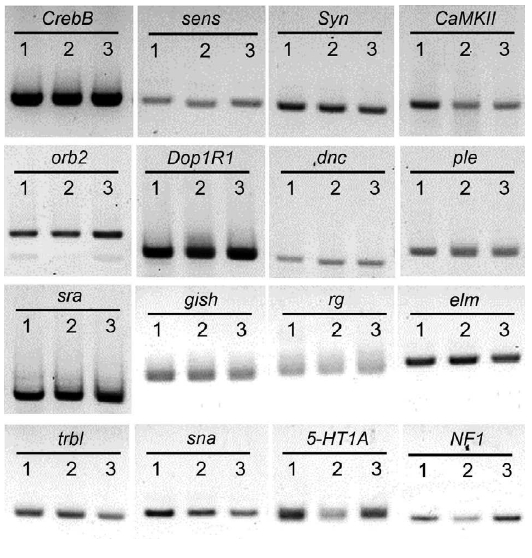
RT-PCR validation of candidate memory-related genes in A. mellifera worker at different behavioral stages. Amplicons correspond to CrebB (Cyclic-AMP response element binding protein B), sens (senseless), Syn (Synapsin), CaMKII (Ca2+/calmodulin-dependent protein kinase II), orb2 (cytoplasmic polyadenylation element-binding protein 2), Dop1R1 (dopamine receptor 1), dnc (cAMP phosphodiesterase), ple (tyrosine hydroxylase), sra (sarah), gish (gilgamesh, casein kinase 1γ), rg (rugose), elm (ethanol sensitive with low memory), trbl (tribbles), sna (snail), 5-HT1A (5-hydroxytryptamine receptor 1), and NF1 (neurofibromin 1). Lanes 1-3 represent cDNA from newly emerged bees, nurse bees, and forager bees, respectively.
2. In silico analysis of sequence-derived features
The physicochemical properties of memory-related gene orthologs identified in the A. mellifera transcriptome (Davis, 2023) were analyzed and are summarized in Table 3. Protein lengths ranged from 189 aa for elm to 3,344 aa for rg, corresponding to molecular weights of approximately 21.7-375.5 kDa. Large multi domain proteins such as NF1 and rg exhibited high molecular weights, consistent with their roles in neuronal regulation and intracellular signaling (Yohay, 2006; Volders et al., 2012). By contrast, small proteins such as elm and sra are likely to function as regulatory or adaptor proteins that fine-tune upstream signaling pathways, including calcineurin-dependent cascades (Takeo et al., 2006).
Physicochemical properties of memory-related proteins in Apis mellifera predicted using the ProtParam
The theoretical pI values ranged from 5.05 to 9.39, demonstrating diverse charge properties. Acidic proteins (sra, pale and elm) contain abundant negatively charged residues, facilitating interactions with basic protein regions or nucleic acids. Basic proteins such as Dop1R1, gish, and sens exhibited high pI values, suggesting potential nuclear localization and DNA-binding capacity. Notably, Dop1R1 and gish act as upstream regulators of transcriptional signaling, whereas sens is a DNA-binding transcription factor involved in neuronal differentiation and the regulation of memory-associated genes (Wu et al., 2025). Instability indices indicated that only CaMKII, Dop1R1 and gish were predicted to be stable (Guruprasad et al., 1990), whereas the other proteins were classified as unstable. The predominance of instability suggests that most memory-related proteins function within dynamic multi protein complexes or require stabilizing interactions with membranes or molecular chaperones. Such intrinsic instability is considered advantageous for synaptic plasticity, as it allows rapid protein turnover during memory formation and remodeling (Alvarez-Castelao and Schuman, 2015).
The aliphatic index values ranged from 56.38 (sna) to 101.14 (Dop1R1), reflecting variation in thermal stability. Dop1R1 and 5-HT1A showed particularly high aliphatic indices, indicating resilience under fluctuating temperatures. These characteristics may contribute to neuronal tolerance to environmental stress and support adaptive maintenance of memory processes under variable thermal conditions (Kagias et al., 2012). Most proteins exhibited negative GRAVY values, indicating hydrophilicity and potential solubility, except for the more hydrophobic Dop1R1, and 5-HT1A. The higher hydrophobicity of Dop1R1 aligns with its function as a membrane-bound dopamine receptor, whereas strongly hydrophilic proteins such as CrebB and orb2 are characteristic of cytosolic or nuclear regulators with broad roles in signaling and transcriptional control. Hydrophilic regulators are widely implicated in pathways governing synaptic plasticity and memory formation (Rosenberg et al., 2014).
Taken together, these physicochemical properties indicate that honey bee memory-related proteins can be broadly divided into two functional groups: large, hydrophilic, and intrinsically unstable transcriptional or signaling regulators, and smaller, relatively stable and/or more hydrophobic proteins, including receptors and kinases.
3. Protein-protein interaction network analysis
A protein-protein interaction (PPI) network was constructed using honey bee memory-related protein sequences queried against D. melanogaster orthologs in the STRING database (Fig. 2). STRING-based protein-protein interaction analysis (Szklarczyk et al., 2023) revealed a high-confidence network underlying learning and memory in the honey bee, integrating neuromodulatory signaling, second-messenger regulation, transcriptional control, and synaptic effectors (Davis, 2023). Based on this network, six genes were identified as core components linking intracellular signaling to transcriptional regulation and synaptic plasticity during memory formation. At the center of the network, dnc, NF1, CaMKII, CrebB, Dop1R1 and Syn formed a densely connected core. The hub positioning of dnc and NF1 supports a model in which tight regulation of cAMP dynamics is critical for memory-related signaling, consistent with insect learning circuits centered on mushroom body function (Georganta et al., 2021).
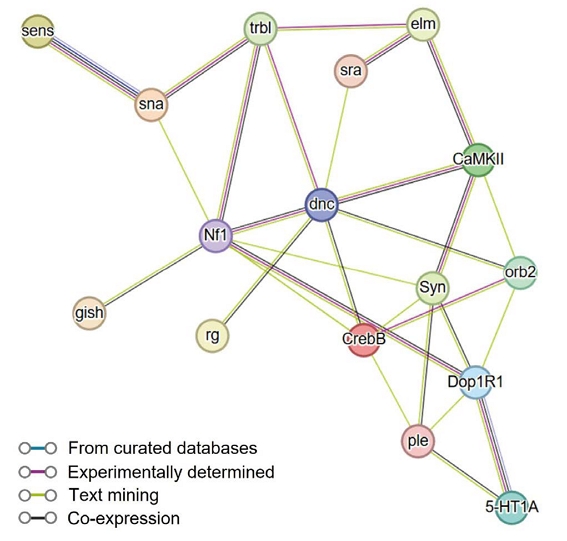
STRING-based protein-protein interaction network illustrating potential functional relationships among memory-related proteins in A. mellifera, consisting of 16 nodes classified into five functional categories-cAMP signaling regulators (blue/purple), transcriptional regulators (red), synaptic plasticity proteins (green), neuromodulatory receptors (cyan/teal), and regulatory/modulatory proteins (beige)-with edges representing functional associations defined by the STRING database and supported by both experimentally validated interactions and database-derived predictive evidence (including curated pathways, co-expression, and text mining). This network is intended as an overview and is largely inferred from orthology-based evidence derived primarily from Drosophila datasets.
The dopamine receptor Dop1R1 was embedded within this core, linking reinforcement-related neuromodulatory input to the cAMP-kinase-transcription axis. Such positioning suggests that dopaminergic signaling modulates memory formation by gating downstream intracellular pathways rather than acting as an isolated input (Schwaerzel et al., 2003; Yamazaki et al., 2023). Downstream of the signaling core, CaMKII and CrebB formed a convergence point between calcium-dependent kinase activity and transcriptional regulation, consistent with their established roles in committing transient neuronal activity to long-term molecular changes (Kandel et al., 2014; Davis, 2023). In addition, a synaptic effector submodule centered on Syn and orb2 was closely linked to the core network. Given the roles of Syn in synaptic vesicle dynamics and orb2 in post-transcriptional regulation required for LTM stabilization, this submodule likely represents the execution layer translating upstream signaling into persistent synaptic modification (Greengard et al., 1993; Kozlov et al., 2023; Stewart et al., 2024). Overall, the STRING-derived network supports a two-tiered model of honey bee memory, comprising a central regulatory core integrating neuromodulatory and second-messenger signaling and a downstream synaptic module responsible for translational and structural consolidation. The integration of multiple data types in STRING suggests that this network represents a biologically meaningful and conserved framework for insect learning and memory.
4. Structural modeling of key memory-related proteins
To further explore structural characteristics, three-dimensional models of six representative memory-related proteins (CaMKII, CrebB, Dop1R1, orb2, NF1, and Syn) were generated using SWISS-MODEL (Fig. 3). Three-dimensional structural modeling revealed distinct yet complementary architectural features underlying their functional roles in learning and memory in the honey bee. Despite differences in size and domain composition, all proteins displayed conserved structural motifs consistent with their known molecular functions in neuronal signaling, transcriptional regulation, and synaptic plasticity. Structural modeling of six core memory-related proteins in the honey bee revealed a shared structural principle in which conserved functional cores are coupled with flexible regulatory regions to support memory-related signaling and plasticity (Jumper et al., 2021). Despite their distinct molecular roles, these proteins form a structurally coordinated system that enables efficient integration of neuromodulatory input, intracellular signaling, gene regulation, and synaptic function.
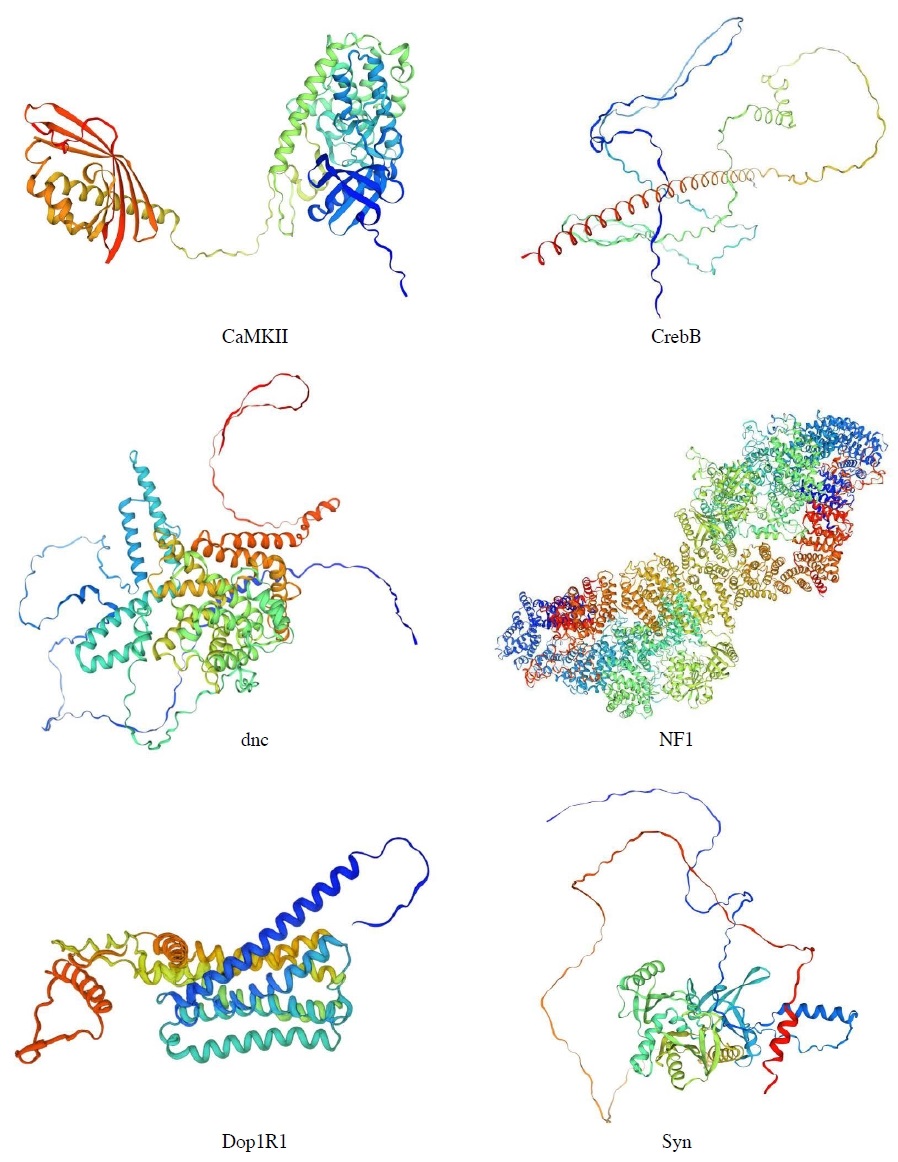
Three-dimensional structural models of memory-related proteins in A. mellifera predicted by SWISS-MODEL. Each model is color-coded from the N-terminus (Blue) to the C-terminus (Red) to indicate the directionality of the polypeptide chain. The predicted tertiary structures illustrate diverse folding patterns and domain organizations, reflecting their distinct biochemical and regulatory roles in neuronal signaling, synaptic plasticity, and memory formation processes in the honeybee brain.
CaMKII and NF1 exhibited stable globular domains optimized for enzymatic and signaling regulation, consistent with their established roles in calcium-dependent phosphorylation and Ras-cAMP pathway modulation during learning and memory (Lisman et al., 2012; Wolman et al., 2014). In contrast, CrebB and orb2 displayed pronounced structural flexibility, reflecting their functions in activity-dependent transcriptional and post-transcriptional regulation underlying LTM formation and maintenance (Yin et al., 1995; Majumdar et al., 2012). orb2 included RNA-binding domains and a low-complexity, prion-like region known to facilitate protein aggregation associated with long term memory maintenance (Si et al., 2003). Dop1R1 adopted a canonical seven-transmembrane receptor architecture, structurally suited for translating dopaminergic signals into cAMP-mediated intracellular responses essential for associative learning (Schwaerzel et al., 2003). Syn contained an ATP-binding region and coiled-coil segments implicated in synaptic vesicle docking and neurotransmitter release (Kusick et al., 2022). The predicted three-dimensional structure of Syn reveals a conserved globular core domain surrounded by extended intrinsically disordered regions. The folded core likely mediates synaptic vesicle association and structural stability, whereas the flexible terminal regions may enable activity-dependent regulation of vesicle mobilization (Bertin et al., 2023) through phosphorylation-dependent conformational changes. This modular architecture is consistent with the established role of Syn in dynamic control of presynaptic vesicle pools during neurotransmission and memory expression. Collectively, these structural features indicate that honey bee memory formation relies on a modular protein architecture in which rigidity ensures functional specificity, while flexibility enables adaptive regulation. This structure-function complementarity provides a mechanistic basis for coordinated memory processes spanning signal transduction, transcriptional control, and synaptic plasticity.
CONCLUSION
In this study, we used an integrated transcriptome-based approach to investigate conserved molecular mechanisms underlying learning and memory in the honey bee brain, focusing on short- and long-term memory-related genes. RT-PCR confirmed consistent expression of key memory genes across worker behavioral stages, indicating that core memory machinery is maintained throughout adult life. PPI and structural analyses highlighted cAMP-dependent signaling-centered on CaMKII, CrebB, dnc, Dop1R1, Nf1, and Syn-as a conserved hub linking neuromodulation, transcription, and synaptic plasticity. Overall, our results provide a concise multi-level framework for honey bee memory pathways and their evolutionary conservation with Drosophila model.
Acknowledgments
This work was supported by the National Research Foundation of Korea (NRF) grant funded by the Korean government (MSIT) (No. RS-2024-00357273) and by the Research Program for Agriculture Science and Technology Development by the Rural Development Administration (No. RS-2025-02634754).
References
-
Alvarez-Castelao, B. and E.M. Schuman. 2015. The regulation of synaptic protein turnover. J. Biol. Chem. 290: 28623-28630.
[https://doi.org/10.1074/jbc.R115.657130]

-
Badaoui, B., A. Fougeroux, F. Petit, A. Anselmo, C. Gorni, M. Cucurachi, A. Cersini, A. Granato, G. Cardeti, G. Formato, F. Mutinelli, E. Giuffra, J.L. Williams and S. Botti. 2017. RNA-sequence analysis of gene expression from honeybees (Apis mellifera) infected with Nosema ceranae. PLoS One 12: e0173438.
[https://doi.org/10.1371/journal.pone.0173438]
-
Bertin, F., J. Jara-Wilde, B. Auer, A. Köhler-Solís, C. González-Silva, U. Thomas and J. Sierralta, J. 2023. Drosophila Atlastin regulates synaptic vesicle mobilization independent of bone morphogenetic protein signaling. Biol. Res. 56: 49.
[https://doi.org/10.1186/s40659-023-00462-1]
-
Choi, D.-Y. and Y. Park. 2024. Transcriptomic analysis of honey bee, Apis mellifera, after exposure to dinotefuran residual pesticide in peppers. J. Apic. 39: 195-207.
[https://doi.org/10.17519/apiculture.2024.09.39.3.195]
-
Collett, T.S., P. Graham and V. Durier. 2003. Route learning by insects. Curr. Opin. Neurobiol. 13: 718-725.
[https://doi.org/10.1016/j.conb.2003.10.004]
-
Davis, R.L. 2023. Learning and memory using Drosophila melanogaster: a focus on advances made in the fifth decade of research. Genetics 224: iyad085.
[https://doi.org/10.1093/genetics/iyad085]
-
Dickey, M., E.M. Walsh, T.F. Shepherd, R.F. Medina, A. Tarone and J. Rangel. 2023. Transcriptomic analysis of the honey bee (Apis mellifera) queen brain reveals that gene expression is affected by pesticide exposure during development. PLoS One 18: e0284929.
[https://doi.org/10.1371/journal.pone.0284929]
-
Dyer, A.G., C. Neumeyer and L. Chittka. 2005. Honeybee (Apis mellifera) vision can discriminate between and recognise images of human faces. J. Exp. Biol. 208: 4709-4714.
[https://doi.org/10.1242/jeb.01929]
-
Gallai, N., J.-M. Salles, J. Settele and B.E. Vaissiere. 2009. Economic valuation of the vulnerability of world agriculture confronted with pollinator decline. Ecol. Econ. 68: 810-821.
[https://doi.org/10.1016/j.ecolecon.2008.06.014]
-
Gasteiger, E., C. Hoogland, A. Gattiker, S. Duvaud, M.R. Wilkins, R.D. Appel and A. Bairoch. 2005. Protein identification and analysis tools on the ExPASy server. In: Walker, J.M. (ed.), The proteomics protocols handbook. Springer Protocols Handbooks. Humana Press.
[https://doi.org/10.1385/1-59259-890-0:571]
-
Georganta, E.M., A. Moressis and E.M.C. Skoulakis. 2021. Associative learning requires neurofibromin to odulate GABAergic inputs to Drosophila mushroom bodies. J. Neurosci. 41: 5274-5286.
[https://doi.org/10.1523/JNEUROSCI.1605-20.2021]
-
Giurfa, M. 2003. Cognitive neuroethology: dissecting non-elemental learning in a honeybee brain. Curr. Opin. Neurobiol. 13: 726-735.
[https://doi.org/10.1016/j.conb.2003.10.015]
-
Gong, Z., K. Tan and J.C. Nieh. 2018. First demonstration of olfactory learning and long-term memory in honey bee queens. J. Exp. Biol. 221: jeb177303.
[https://doi.org/10.1242/jeb.177303]
- Gould, J. and C.G. Gould. 1988. Programmed learning. In the honey bee, pp. 185-190. New York: Scientific American Library.
-
Greengard, P., F. Valtorta, A.J. Czernik and F. Benfenati. 1993. Synaptic vesicle phosphoproteins and regulation of synaptic function. Science 259: 780-785.
[https://doi.org/10.1126/science.8430330]
-
Guruprasad, K., B.V. Reddy and M.W. Pandit. 1990. Correlation between stability of a protein and its dipeptide composition: a novel approach for predicting in vivo stability of a protein from its primary sequence. Protein Eng. 4: 155-161.
[https://doi.org/10.1093/protein/4.2.155]
-
Huang, J., T. Wang, Y. Qiu, A.K. Hassanyar, Z. Zhang, Q. Sun, X. Ni, K. Yu, Y. Guo, C. Yang, Y. Lü, H. Nie, Y. Lin, Z. Li and S. Su. 2023. Differential brain expression patterns of microRNAs related to olfactory performance in honey bees (Apis mellifera). Genes 14: 1000.
[https://doi.org/10.3390/genes14051000]
-
Ichikawa, N. and M. Sasaki. 2003. Importance of social stimuli for the development of learning capability in honeybees. Appl. Entomol. Zool. 38: 203-209.
[https://doi.org/10.1303/aez.2003.203]
- Ikai, A. 1980. Thermostability and a liphatic index of globular proteins. J. Biochem. 88: 1895-1898.
- IPBES. 2016. The assessment report of the intergovernmental science-policy platform on biodiversity and ecosystem services on pollinators, pollination and food production. IPBES Secretariat, Bonn, Germany.
-
Jumper, J., R. Evans, A. Pritzel, T. Green, M. Figurnov, O. Ronneberger, K. Tunyasuvunakool, R. Bates, A. Židek, A. Potapenko, A. Bridgland, C. Meyer, S.A.A. Kohl, A.J. Ballard et al. 2021. Highly accurate protein structure prediction with AlphaFold. Nature 596: 583-589.
[https://doi.org/10.1038/s41586-021-03819-2]
-
Kagias, K., C. Nehammer and R. Pocock. 2012. Neuronal responses to physiological stress. Front. Genet. 3: 222.
[https://doi.org/10.3389/fgene.2012.00222]
-
Kandel, E.R., Y. Dudai and M.R. Mayford, 2014. The molecular and systems biology of memory. Cell. 157: 163-186.
[https://doi.org/10.1016/j.cell.2014.03.001]
-
Kim, B. and J. Jung. 2025. The neuromodulatory landscape of honey bee cognition: roles of acetylcholine, glutamate, GABA, and biogenic amines. J. Apic. 40: 183-195.
[https://doi.org/10.17519/apiculture.2025.06.40.2.183]
-
Klein, A.-M., B.E. Vaissière, J.H. Cane, I. Steffan-Dewenter, S.A. Cunningham, C. Kremen and T. Tscharntke. 2007. Importance of pollinators in changing landscapes for world crops. Proc. Biol. Sci. 274: 303-313.
[https://doi.org/10.1098/rspb.2006.3721]
-
Kozlov, E.N., E.V. Tokmatcheva, A.M. Khrustaleva, E.S. Grebenshchikov, R.V. Deev, R.A. Gilmutdinov, L.A. Lebedeva, M. Zhukova, E.V. Savvateeva-Popova, P. Schedl and Y.V. Shidlovskii. 2023. Long-term memory formation in Drosophila depends on the 3̓UTR of CPEB Gene orb2. Cells 12: 318.
[https://doi.org/10.3390/cells12020318]
-
Kusick, G.F., T.H. Ogunmowo and S. Watanabe. 2022. Transient docking of synaptic vesicles: Implications and mechanisms. Curr. Opin. Neurobiol. 74: 102535.
[https://doi.org/10.1016/j.conb.2022.102535]
-
Kyte, J. and R.F. Doolittle. 1982. A simple method for displaying the hydropathic character of a protein. J. Mol. Biol. 157: 105-132.
[https://doi.org/10.1016/0022-2836(82)90515-0]
-
Lautenbach, S., R. Seppelt, J. Liebscher and C.F. Dormann. 2012. Spatial and temporal trends of global pollination benefit. PLoS One 7(4): e35954.
[https://doi.org/10.1371/journal.pone.0035954]
-
Lisman, J., R. Yasuda and S. Raghavachari. 2012. Mechanisms of CaMKII action in long-term potentiation. Nat. Rev. Neurosci. 13: 169-182.
[https://doi.org/10.1038/nrn3192]
-
Majumdar, A., W.C. Cesario, E. White-Grindley, H. Jiang, F. Ren, M.R. Khan, L. Li, E.M. Choi, K. Kannan, F. Guo, J. Unruh, B. Slaughter and K. Si. 2012. Critical role of amyloid-like oligomers of Drosophila Orb2 in the persistence of memory. Cell 148: 515-529.
[https://doi.org/10.1016/j.cell.2012.01.004]
-
Menzel, R. 2001. Searching for the memory trace in a mini-brain, the honeybee. Learn. Mem. 8: 53-62.
[https://doi.org/10.1101/lm.38801]
-
Menzel, R. and U. Müller. 1996. Learning and memory in honeybees: from behavior to neural substrates. Annu. Rev. Neurosci. 19: 379-404.
[https://doi.org/10.1146/annurev.ne.19.030196.002115]
- Moore-Ede, M.C., F.M. Sulzman and C.A. Fuller. 1982. The clocks that time us: physiology of the circadian timing system. Cambridge, MA.
-
Moore, D. 2001. Honey bee circadian clocks: behavioral control from individual workers to whole-colony rhythms. J. Insect Physiol. 47: 843-857.
[https://doi.org/10.1016/S0022-1910(01)00057-9]
-
Ollerton, J., R. Winfree and S. Tarrant. 2011. How many flowering plants are pollinated by animals. Oikos 120: 321-326.
[https://doi.org/10.1111/j.1600-0706.2010.18644.x]
-
Plath, J.A., B.V. Entler, N.H. Kirkerud, U. Schlegel, C.G. Galizia and A.B. Barron. 2017. Different roles for honey bee mushroom bodies and central complex in visual learning of colored lights in an aversive conditioning assay. 2017. Front. Behav. Neurosci. 11: 98.
[https://doi.org/10.3389/fnbeh.2017.00098]
-
Rosenberg, T., S. Gal-Ben-Ari, D.C. Dieterich, M.R. Kreutz, N.E. Ziv, E.D. Gundelfinger and K. Rosenblum. 2014. The roles of protein expression in synaptic plasticity and memory consolidation. Front. Mol. Neurosci. 7: 86.
[https://doi.org/10.3389/fnmol.2014.00086]
-
Schuurmans, S.F.M., M.H. Gorissen and G. Flik. 2008. The isoelectric point,a key to under standing a variety of biochemical problems:a mini review. Fish Physiol. Biochem. 34: 1-8.
[https://doi.org/10.1007/s10695-007-9145-6]
-
Schwaerzel, M., M. Monastirioti, H. Scholz, F. Friggi-Grelin, S. Birman and M. Heisenberg. 2003. Dopamine and octopamine differentiate between aversive and appetitive olfactory memories in Drosophila. J. Neurosci. 23: 10495-10502.
[https://doi.org/10.1523/JNEUROSCI.23-33-10495.2003]
-
Shah, K.S., E.C. Evans and M.C. Pizzormo. 2009. Localization of deformed wing virus (DWV) in the brains of the honeybee, Apis mellifera Linnaeus. Virol. J. 6: 182.
[https://doi.org/10.1186/1743-422X-6-182]
-
Si, K., M. Giustetto, A. Etkin, R. Hsu, A.M. Janisiewicz, M.C. Miniaci, J.H. Kim, H. Zhu and E.R. Kandel. 2003. A neuronal isoform of CPEB regulates local protein synthesis and stabilizes synapse-specific long-term facilitation in aplysia. Cell 115: 893-904.
[https://doi.org/10.1016/S0092-8674(03)01021-3]
-
Stewart, R.K., P. Nguyen, A. Laederach, P.C. Volkan, J.K. Sawyer and D.T. Fox. 2024. Orb2 enables rare-codon-enriched mRNA expression during Drosophila neuron differentiation. Nat. Commun. 15: 5270.
[https://doi.org/10.1038/s41467-024-48344-8]
-
Sung, K.M., W.J. Kim and J.S. Yoon. 2023. Past and present of double-stranded RNA as a Sacbrood virus inhibitor for asian honeybee, Apis cerana. J. Apic. 38: 93-101.
[https://doi.org/10.17519/apiculture.2023.04.38.1.93]
-
Szklarczyk, D., R. Kirsch, M. Koutrouli, K. Nastou, F. Mehryary, R. Hachilif, A.L. Gable, T. Fang, N.T. Doncheva, S. Pyysalo, P. Bork, L.J. Jensen and C. von Mering. 2023. The STRING database in 2023: protein-protein association networks and functional enrichment analyses for any sequenced genome of interest. Nucleic Acids Res. 51: D638-D646.
[https://doi.org/10.1093/nar/gkac1000]
-
Takeo, S., M. Tsuda, S. Akahori, T. Matsuo and T. Aigaki. 2006. The calcineurin regulator sra plays an essential role in female meiosis in Drosophila. Curr. Biol. 16: 1435-1440.
[https://doi.org/10.1016/j.cub.2006.05.058]
-
von Frisch, K. 1993. The Dance Language and Orientation of Bees. Cambridge, MA.
[https://doi.org/10.4159/harvard.9780674418776]
-
Volders, K., S. Scholz, J.R. Slabbaert, A.C. Nagel, P. Verstreken, J.W. Creemers, P. Callaerts and M. Schwärzel. 2012. Drosophila rugose is a functional homolog of mammalian neurobeachin and affects synaptic architecture, brain morphology, and associative learning. J. Neurosci. 32: 15193-15204.
[https://doi.org/10.1523/JNEUROSCI.6424-11.2012]
-
Wang, Y., M. Jorda, P.L. Jones, R. Maleszka, X. Ling, H.M. Robertson, C.A. Mizzen, M.A. Peinado and G.E. Robinson. 2006. Functional CpG methylation system in a social insect. Science 314: 645-647.
[https://doi.org/10.1126/science.1135213]
-
Waterhouse, A., M. Bertoni, S. Bienert, G. Studer, G. Tauriello, R. Gumienny, F.T. Heer, T.A.P. DeBeer, C. Rempfer, L. Bordoli, R. Lepore and T. Schwede. 2018. SWISS-MODEL: homology modelling of protein structures and complexes. Nucleic Acids Res. 46: W296-W303.
[https://doi.org/10.1093/nar/gky427]
-
Wehner, R. 2003. Desert ant navigation: how miniature brains solve complex tasks. J. Comp. Physiol. A 189: 579-588.
[https://doi.org/10.1007/s00359-003-0431-1]
- Winston, M.L. 1987. The biology of the honey bee. Cambridge, MA.
-
Wolman, M.A., E.D. de Groh, S.M. McBride, T.A. Jongens, M. Granato and J.A. Epstein. 2014. Modulation of cAMP and ras signaling pathways improves distinct behavioral deficits in a zebrafish model of neurofibromatosis type 1. Cell Rep. 8: 1265-1270.
[https://doi.org/10.1016/j.celrep.2014.07.054]
-
Wu, Q., H. Wang, R. Lin, N. Zhou and W. Bai. 2025. Identification and characterization of TCP transcription factor GmTCP670 associated with soybean development. Sci. Rep. 15: 19707.
[https://doi.org/10.1038/s41598-025-04257-0]
-
Yamazaki, D., Y. Maeyama and T. Tabata. 2023. Combinatory actions of co-transmitters in dopaminergic systems modulate Drosophila olfactory memories. J. Neurosci. 43: 8294-8305.
[https://doi.org/10.1523/JNEUROSCI.2152-22.2023]
-
Yohay, K.H. 2006. The genetic and molecular pathogenesis of NF1 and NF2. Semin. Pediatr. Neurol. 13: 21-26.
[https://doi.org/10.1016/j.spen.2006.01.007]
-
Yin, J.C., J.S. Wallach, E.L. Wilder, J. Klingensmith, D. Dang, N. Perrimon, H. Zhou, T. Tully and W.G. Quinn. 1995. A Drosophila CREB/CREM homolog encodes multiple isoforms, including a cyclic AMP-dependent protein kinase-responsive transcriptional activator and antagonist. Mol. Cell. Biol. 15: 5123-5130.
[https://doi.org/10.1128/MCB.15.9.5123]
-
Zhang, B., X. Li, Y. Jiang, J. Liu, J. Zhang and W. Ma. 2023. Comparative transcriptome analysis of adult worker bees under short-term heat stress. Front. Ecol. Evol. 11: 1099015.
[https://doi.org/10.3389/fevo.2023.1099015]
-
Zhang, S.W. and M.V. Srinivasan. 2004. Exploration of cognitive capacity in honeybees. In Complex Worlds from Simpler Nervous Systems (ed. F. R. Prete). pp. 41-74. Cambridge, MA.
[https://doi.org/10.7551/mitpress/1994.003.0009]
-
Zhang, S., S. Schwarz, M. Pahl, H. Zhy and J. Tautz. 2006. Honeybee memory: a honeybee knows what todo and when. J. Exp. Biol. 209: 4420-4428.
[https://doi.org/10.1242/jeb.02522]