
Honey and Bees in Indian Knowledge Systems: Integrating Traditional Wisdom with Modern Biology
Abstract
Indian Knowledge Systems (IKS) comprise of two complementary domains: documented knowledge and undocumented traditional knowledge. The documented component is preserved in classical texts like the Charaka Samhita, Sushruta Samhita, the Rigveda, to mention a few, where numerous references to honey (madhu) are found. These texts describe the medicinal properties of honey and even classify it into distinct types. However, many of these descriptions require systematic scientific investigation. For example, the classical categories of honey mentioned in the Sushruta Samhita may correspond to different bee species, yet their precise taxonomic identity remains uncertain and requires entomological (bee species) study. Similarly, the botanical origin (nectar source), and medicinal properties of various honey types need to be examined using modern biological methods such as molecular taxonomy, melissopalynology, and biochemical analysis. Alongside the documented tradition, IKS also contain a vast body of undocumented knowledge, preserved through oral traditions and practices of rural communities, forest dwellers, and traditional honey collectors. This knowledge includes insights into bee behavior, seasonal honey harvesting, ecological indicators, and medicinal uses of honey. Therefore, systematic documentation and scientific validation of this traditional knowledge are urgently required to preserve this heritage and integrate it with contemporary biological research.
Keywords:
Classical Indian texts, Traditional knowledge, Madhu, Melissopalynology, Medicinal propertiesINTRODUCTION
Honey has held a unique and esteemed position within the Indian Knowledge System (IKS), reflecting a synthesis of empirical observation, cultural practices, and philosophical inquiry accumulated over millennia. The study of honey within IKS encompasses both documented knowledge preserved in classical texts as well as undocumented, oral traditions passed down verbally by rural and indigenous communities. This dual perspective offers a comprehensive multidisciplinary understanding of honey, connecting traditional customs, ancient knowledge, and contemporary biological science.
The objective of the present study is to highlight the richness and scientific depth of ancient Indian knowledge related to honey and honey bees. Classical Indian scholars possessed detailed understanding regarding the entomological origin of honey, diversity of honey types, therapeutic applications, and physicochemical properties of honey. Although these concepts were documented in Sanskrit using vernacular terminology and traditional descriptive frameworks, they provide valuable insights that may still serve as important references for interpretation through modern scientific knowledge. The present paper therefore aims to demonstrate that honey was regarded as an important natural resource in ancient India and that extensive knowledge existed concerning its biological, medicinal, and cultural significance.
DOCUMENTED KNOWLEDGE OF HONEY IN CLASSICAL TEXTS
Indian classical literature provides extensive references to honey, highlighting its ritual significance, nutritional value and medicinal properties. The Vedas, among the earliest recorded bodies of knowledge, mention honey in cosmological, philosophical, and medicinal contexts. In the field of Ayurveda, texts like Charaka Samhita, Sushruta Samhita, Ashtanga Hridaya, and Bhela Samhita define honey, describe honey as a therapeutic agent, emphasizing its use in treating different diseases such as digestive disorders, respiratory ailments, wound healing, and also as a carrier for other medicinal herbs.
Therefore, ancient texts illustrated its multifunctional role in Indian society. However, classical descriptions of honey are largely qualitative. Although references to different bee types exist using the nomenclature prevalent at the time, in Sanskrit, these accounts lack direct correspondence with modern taxonomic identification (e.g., Apis cerana, Apis dorsata) and precise botanical origins, both of which are fundamental to explicating its chemical composition and therapeutic properties.
1. Honey in ancient Indian literature
Honey occupies an important place in ancient Indian philosophy, where it is more than just a natural material; it represents a profound symbol connecting cosmology, nature, and knowledge. The interconnection of the universe is metaphorically described by honey (madhu) in ancient Indian texts including the Rigveda and the Brihadaranyaka Upanishad. According to the well-known “Madhu doctrine” (Madhu Vidya), honey represents a symbol of the mutual relationship among all actualities, where the earth, plants, animals, and humans participate in a shared cosmic system. In this philosophical perspective, bees turn nectar into honey, symbolising a metamorphic process in which various components of the natural world come together to create a unified substance. This transformation mirrors the sanctified cosmology of the earth system in ancient Indian thought, where knowledge arises from witnessing the cycles and relationships within nature. Thus, honey becomes both a tangible product of ecological interaction and a philosophical representation of unity, reciprocity, and the continuous transformation of life in the universe.
मधु वाता ऋतायते मधु क्षरन्ति सिंधवः। माधवी नः सन्तवोषाधिः॥
“Madhu vātā ṛtāyate madhu kṣaranti sindhavaḥ Mādhvīr naḥ santvoṣadhīḥ.”
Translation:
“The winds blow sweetness; the rivers pour forth sweetness. May the herbs and plants be filled with sweetness for us.”
This famous hymn describes the entire universe as honey-like sweetness, symbolizing harmony between nature and cosmic order.
अयं वव लोक सर्वेषां भूतानां मधु।
“Ayaṁ vāva loko sarveṣāṁ bhūtānāṁ madhu.”
Translation:
“This world indeed is the honey of all beings.”
Here honey represents interdependence—every being nourishes every other, just as honey is the collective essence of many flowers.
मधु मे पार्थिवं रजः, मधु द्यौर अस्तु नः पिता।
“Madhu me parthivaṁ rajaḥ, madhu dyaur astu naḥ pitā.”
Translation:
“Sweet be the earthly dust for me; sweet be the sky, our father.”
The verse portrays the whole cosmos as sweet like honey, reflecting auspiciousness and prosperity.
Although honey is not a direct metaphor in a verse, traditional commentators compare the Gita’s wisdom to “madhu” — distilled sweetness gathered from many scriptures, like bees gathering nectar.
A proverb-like passage describing greed and honey:
मधु-लोभेन पतन्ति भ्रमरः।
“Madhu-lobhena patanti bhramarāḥ.”
Translation:
“Because of their desire for honey, the bees sometimes fall (into danger).”
It illustrates the danger of excessive desire.
2. Honey in Ayurveda
From Charaka Samhita (Sutra Sthana)
यस्मान नाना-रस-वीर्यादिभ्यः पुष्पेभ्यः उत्पन्नं तं मधु।
“yasmān nānā-rasa-vīryādibhyaḥ puṣpebhyaḥ utpannaṁ tan madhu.”
Translation:
“Honey is that substance which is produced by bees from flowers possessing various tastes and potencies.”
This describes honey as the essence collected from many medicinal flowers, which is why Ayurveda considers it therapeutically powerful.
According to the EU Directive, honey is defined as the natural sweet substance produced by Apis mellifera from the nectar of plants (Council Directive 2001/110/EC). Similarly, the Codex Alimentarius defines honey as a natural product resulting from the nectar of plants or from honeydew—secretions of living parts of plants or excretions of plant-sucking insects (Hemiptera) on the living parts of plants—collected by bees, typically emphasizing Apis species (CXS 12-1981). In contrast, ancient Indian knowledge recognizes honey from different insects including both stinging and stingless bees, reflecting a broader observational understanding of honey’s diversity in nature.
From Sushruta Samhita (Sutra Sthana 45)
पौत्तिकं भ्रमरं क्षौद्रं माक्षिकं छत्रमेव च। अर्घ्यं औद्दालकं दलम् इत् अष्टौ मधुजातयः ||
“pauttikaṁ bhrāmaraṁ kṣaudraṁ mākṣikaṁ chātrameva cha ārghyam auddālakaṁ dālam ity aṣṭau madhu-jātayaḥ ||”
Translation:
“Pauttika, Bhramara, Kshaudra, Makshika, Chhatra, Arghya, Auddalaka and Dala — these are the eight kinds of honey.”
Ayurveda distinguishes eight medicinal varieties of honey depending on the type of bee and source.
In the Sushruta Samhita, eight varieties of honey (madhu) are described—पौत्तिका (Pauttika), भ्रामर (Bhrāmara), क्षौद्र (Kṣaudra), मेक्सिको (Mākṣika), छात्र (Chātra), अर्घ्य (Ārghya), औद्दालक (Auddālaka), and दाल (Dāla). These categories are generally related to different types of bees, their habitats, and the floral sources from which nectar is collected, resulting in honey with distinct medicinal properties. Ancient Ayurvedic scholars observed differences in the body size of bees, their hive structure, environment, and floral sources, and used these characteristics to classify honey. For example, मेक्सिको (Mākṣika) with bees presumably similar to the A. cerana or A. florea, and भ्रामर (Bhrāmara) with larger wild bees such as the A. dorsata, while दाल (Dāla) has sometimes been compared to honey produced by small stingless bees. However, these identifications remain speculative, and the exact correspondence between the classical Ayurvedic categories and modern bee species is not conclusively known (Sandhya and Pai, 2022). Therefore, these relations should be treated cautiously, and further historical, ecological, and entomological research would be required to confirm the precise insects or bee species referred to in the classical Indian texts.
If we look at the current apicultural scenario in India, the country hosts six recognized honey bee species: Apis mellifera (introduced), Apis cerana, Apis dorsata, Apis laboriosa, Apis florea, and Apis andreniformis (Ghosh et al., 2025). Among these, Apis cerana and the introduced species Apis mellifera are the principal bees used in commercial apiculture, whereas honey from Apis dorsata is primarily collected from forest ecosystems through wild harvesting practices. Honey produced by Apis florea is available in comparatively smaller quantities, while honey from bumble bees and stingless bees remains relatively uncommon and largely underexplored in the country.
From Sushruta Samhita (45.136)
तस्माल लघुतरं पुरुषं माक्षिक प्रवरं स्मृत। म्श्वसदिषु च रोगेसु प्रस्ताव तद-विशेषः ॥
“tasmāl laghutaraṁ rūkṣaṁ mākṣikaṁ pravaraṁ smṛtam śvāsādiṣu ca rogeṣu praśastaṁ tad-viśeṣataḥ”
Translation:
“Makshika honey is considered the best, being light and dry. It is especially beneficial in diseases such as asthma.”
Ancient Ayurvedic texts recognized that honey is a biologically diverse natural product with varying medicinal properties depending on its entomological source and characteristics, illustrated in Table 1 (Kaviraj Kunja Lal Bhishagratna, 1907). In Sushruta Samhita, honey is classified into eight different types, each described with distinct physiological effects and medicinal applications. This classification reflects an early methodical understanding of honey variety and its relevance in traditional therapeutics.

Ayurvedic classification of different honey types and their associated therapeutic properties as described in Suśruta Saṃhitā
From Sushruta Samhita
तद्ययुक्तं विविधः रयोगैः र्निहन्याद् अमायन् बहुं। नाना द्रव्यात्मकत्वच्च योगवाही परम मधु॥
‘tadyuktaṁ vividhaiḥ ryogaiḥ rnihanyād āmāyān bahūn nānā dravyātmakatvācca yogavāhi paraṁ madhu’
Translation:
“When combined with various medicines, honey destroys many diseases; because it contains diverse substances, it is an excellent yogavahi (carrier that enhances the action of other medicines).”
This is why Ayurveda often uses honey as a vehicle for herbal formulations.
From Charaka Samhita
मधु मधुरं कषायनुरसं रुक्षं शीतं अग्निदीपनम्।
“Madhu madhuraṁ kaṣāyānurasaṁ rūkṣaṁ śītam agnidīpanam”
Translation:
“Honey is sweet, with an astringent aftertaste, dry in nature, cooling, and stimulates digestion.”
This describes the medicinal qualities of honey in classical Ayurveda.
Honey properties in Ayurveda are described not only by type but also by age (oldness) and stage of maturation, which are supposed to influence their therapeutic effectiveness, represented in Table 2 (Kaviraj Kunja Lal Bhishagratna, 1907). Sushruta Samhita mentiones physiological actions and medicinal value of honey based on its age (fresh, old), maturation stage (ripened, and unripened).
Ayurvedic properties of honey according to age and maturation stage as described in Suśruta Saṃhitā.
From Sushruta Samhita
बृहणीयम मधु नवं नातिस्लेश्म-हराम समम्।
‘Bṛṁhaṇīyaṁ madhu navaṁ nātiśleṣma-haraṁ samam’
Translation:
“Fresh honey nourishes the body and does not excessively reduce Kapha.”
In Ayurveda, old honey is believed to reduce fat and Kapha, whereas fresh honey is considered nourishing and strengthening to the body.
Honey (madhu) has been appreciated for its nutritional and medicinal values since ancient period. In classical Ayurvedic literature like the Charaka Samhita and the Sushruta Samhita, honey is also defined as light (लघु)ु, dry (सूखा), sweet (मधुर), and slightly astringent (कषाय) in taste. It is regarded as a yogavāhī (योगवाही), meaning it acts as an excellent carrier that enhances the effectiveness of other medicinal substances when used in herbal formulations. Ayurveda features several therapeutic properties to honey, including its ability to support digestion, help in wound healing, and alleviate respiratory disorders such as cough and asthma. Traditionally, honey has also been used in treatments for sore throat, digestive problems, and skin damages because of its soothing and antimicrobial qualities. Modern scientific studies have supported some of these traditional claims by exhibiting that honey possesses antibacterial, antioxidant, and anti-inflammatory properties, which assist wound care and general health support (Deb Mandal and Mandal, 2011; Stefanis et al., 2023).
Although the exact correspondence between classical honey categories and modern bee taxa remains uncertain, these traditional descriptions likely reflect empirical observations of differences in bee behavior, honey characteristics, and therapeutic properties. Therefore, the present study aims to scientifically contextualize ancient Indian apicultural knowledge through interdisciplinary interpretation rather than definitive taxonomic identification.
TRADITIONAL AND INDIGENOUS KNOWLEDGE OF HONEY
Parallel to documented knowledge, a huge volume of traditional ecological knowledge about honey exists in rural and indigenous (or ethnic) communities across the country. These communities have developed expertise in identifying honey bee species, locating nests, harvesting honey sustainably, and utilizing it for medicinal, nutritional, and cultural purposes. This knowledge is generally conveyed orally through observation, apprenticeship, and community practice generation by generation rather than written records, making it a fragile but invaluable resource (Varghese et al., 2015; Venkatachalapathi et al., 2018). Such indigenous practices reveal a deep understanding of biodiversity, local ecosystems, and sustainable resource management. Communities differentiate honey not only by the bee species but also by the floral source, and seasonality, indicating a rich knowledge system that complements classical textual accounts.
For instance, in the forests of the Western Ghats and the Nilgiri Hills, indigenous communities such as the Irulas, Kurumbas, Kattunaickens, and Sholigas have long traditions of harvesting wild honey and identify the presence of the giant honey bee, A. dorsata, by observing the bees’ flight patterns and their direction of movement at dawn and dusk (Thomas et al., 2009; Chhaba et al., 2025; Sebastian 2025). They also recognize that these bees prefer nesting on tall trees or cliff faces and develop sustainable harvesting process. Another important example of traditional honey harvesting is found in the Sundarbans, the world’s largest mangrove forest located in West Bengal. In this region, traditional honey collectors known as Mouli (or Moule) gather honey and beeswax from wild honey bee colonies in the mangrove forests (Samanta et al., 2014). Some communities use smoke from specific plant leaves to calm bees before collecting honey, this practice minimizes damage to the colony. In several regions, people believe that the taste, color, and medicinal properties of honey vary depending on the flowering plants visited by bees, which reflects an innate understanding of the botanical origin of honey. Rural healers also use honey as a vehicle for herbal remedies, mixing it with powdered medicinal plants to treat cough, sore throat, and digestive problems. Additionally, experienced honey collectors often follow cultural practices such as leaving a portion of the honeycomb in the hive, it allows bees to rebuild their colony (nest), demonstrating an indigenous approach to sustainable management of bees. Such knowledge systems require systematic scientific documentation and interdisciplinary study to understand their ecological and biological significance is of utmost importance. The gradual loss of this knowledge poses a risk not only to cultural heritage but also to biodiversity conservation.
SCIENTIFIC DOCUMENTATION AND INTERDISCIPLINARY APPROACHES
This conceptual illustration depicted in Fig. 1 highlights how traditional Indian knowledge systems provide foundational insights into the classification and medicinal significance of honey that can be systematically explored through modern biological disciplines. By integrating indigenous wisdom with contemporary scientific research, interdisciplinary approaches would enable the scientific validation, reinterpretation, and broader application of traditional apicultural knowledge. Integrating modern biological and chemical analyses with classical and indigenous knowledge allows researchers to:
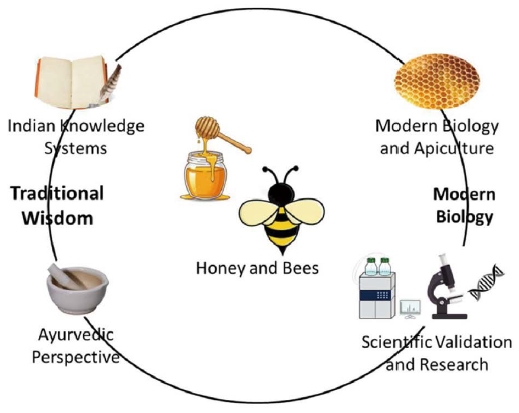
Conceptual framework illustrating the integration of traditional Indian knowledge on honey and bees with modern biological sciences, linking classical Ayurvedic classifications and therapeutic uses with contemporary approaches in taxonomy, ecology, biochemistry, and scientific validation.
Identify honeybee species and their ecological interactions- Although India hosts six recognized Apis species, a comprehensive subspecies-level or population-specific distribution map is still lacking (Ghosh et al., 2025). Both, the morphometric analysis as well as genetic tools such as haplotype mapping and SNP (single nucleotide polymorphism) analysis can address this gap: haplotype mapping helps tracing maternal lineages and evolutionary relationships, while SNP mapping provides high-resolution insights into genetic variation, population structure, and subspecies differentiation. Together, these approaches can reveal ecological interactions, local adaptations, and population connectivity, forming the basis for a precise, genetics-informed distribution map of honeybee species across India (Kitnya et al., 2022).
Determine the botanical as well as entomological origins of honey and their influence on chemical composition- Although India is rich in melliferous flora, producing honey from diverse floral (botanical) sources, there is currently no standardized system to ensure the quality or chemical characterization of honey from specific plants (for methods- Sun et al., 2024). Furthermore, honey derived from different bee species (entomological origins (for methods- Namin et al., 2023) has not been systematically studied or classified (Ghosh and Jung, 2023). Comprehensive research integrating botanical profiling, chemical composition analysis, and entomological identification is needed to standardize quality, trace origins, and understand how plant and bee diversity influence honey properties (Jang et al., 2026). This would provide a scientific basis for both authenticity and therapeutic evaluation of honey across the country.
Validate therapeutic properties using contemporary pharmacology and biochemistry- Honey has been recognized in ancient Indian literature and traditional knowledge systems as a therapeutic agent for a wide range of ailments, including respiratory disorders, digestive problems, wounds, and inflammatory conditions, as already mentioned previously. However, systematic validation using contemporary pharmacology, biochemistry, and molecular approaches should be continued (Sharaf El-Din et al., 2025). Rigorous studies on bioactive compounds, antioxidant capacity, antimicrobial activity, and immunomodulatory effects can bridge traditional wisdom with modern science, confirming the efficacy, dosage, and mechanisms of honey for specific health applications (Stefanis et al., 2023). Such research would provide evidence-based support for its therapeutic use while respecting the diverse botanical and entomological origins found in India. For example, understanding the floral and species-specific sources of honey can refine Ayurvedic formulations, enhance therapeutic efficacy, and contribute to global appreciation of India’s diverse honey varieties.
Promote sustainable harvesting and conservation strategies- Sustainable harvesting and conservation strategies should go beyond honey-centric apiculture to ensure the long-term health of bee populations and their ecosystems. Other hive products—such as propolis, royal jelly (Ghosh and Jung 2024; Ghosh et al., 2024), bee pollen (Ghosh and Jung 2016; Nicolson et al., 2018), bee venom, and bee brood (Ghosh et al., 2020, 2021)— offer significant nutritional and functional benefits, but their properties remain underexplored in the Indian context. Promoting research on these products, along with training and support for bee farmers, can diversify income sources, enhance value addition, and encourage conservation-oriented practices (Ghosh et al., 2025). Such an integrated approach ensures ecological balance while maximizing the health and economic benefits derived from bees.
CONCLUSION
Honey in the Indian Knowledge System exemplifies a convergence of ancient wisdom, traditional ecological knowledge, and modern biology. Linking these domains through an interdisciplinary approach not only preserves cultural heritage but also enhances scientific understanding and sustainable utilization of this natural resource. By documenting, validating, and integrating knowledge across these perspectives, we ensure that honey continues to serve as a symbol of India’s rich intellectual and ecological legacy.
Acknowledgments
This work was supported by the National Research Foundation of Korea (NRF), which is funded by the Ministry of Education (grant no.: NRF-2018R1A6A1A03024862).
References
- Chhaba, S. G., P. S. Joshi and C. A. Ladole. 2025. Indian knowledge systems and apiculture: Blending tradition with science. Vidyabharati Int. Interdiscip. Res. J. 20(1): 35-39.
- Council Directive 2001/110/EC of 20 December 2001 relating to honey. Official Journal of the European Communities 12.1.2002, L 10/47-L 10/52.
- CXS 12-1981. Standard for Honey, Adopted in 1981, Revised in 1987, 2001, Amended in 2019, 2022. Codex Alimentarius International Food Standard, FAO of the United Nations, World Health Organization.
-
Deb Mandal, M. and S. Mandal. 2011. Honey: its medicinal propertu and antibacterial activity. Asian Pac. J. Trop. Biomed. 1(2): 154-160.
[https://doi.org/10.1016/S2221-1691(11)60016-6]

-
Ghosh, S. and C. Jung. 2016. Nutritional value of bee-collected pollens of hardy kiwi, Actinidia arguta (Actinidiaceae) and oak, Quercus sp. (Fagaceae). J. Asia-Pac. Entomol. 20(1): 245-251.
[https://doi.org/10.1016/j.aspen.2017.01.009]
-
Ghosh, S. and C. Jung. 2023. Methodologies and characterization of Physico-chemical properties of Apis cerana honey: A short review. J. Apic. 38(2): 139-149.
[https://doi.org/10.17519/apiculture.2023.06.38.2.139]
-
Ghosh, S. and C. Jung. 2024. Chemical composition and nutritional value of royal jelly samples obtained from honey bee (Apis mellifera) hives fed on oak and rapeseed pollen patties. Insects 15(3): 141.
[https://doi.org/10.3390/insects15030141]
-
Ghosh, S., D. P. Abrol and C. Jung. 2025. The state of beekeeping in India: insights, gaps, and emerging opportunities. Entomol. Res. 55(10): e70069.
[https://doi.org/10.1111/1748-5967.70069]
-
Ghosh, S., H. Jang, S. Sun and C. Jung. 2024. Nutrient composition and quality assessment of royal jelly samples relative to feed supplements. Foods 13(12): 1942.
[https://doi.org/10.3390/foods13121942]
-
Ghosh, S., H-Y. Sohn, S.-J. Pyo, A. B. Jensen, V. B. Meyer-Rochow and C. Jung. 2020. Nutritional composition of Apis mellifera drones from Korea and Denmark as a potential sustainable alternative food source: Comparison between developmental stages. Foods 9(4): 389.
[https://doi.org/10.3390/foods9040389]
-
Ghosh, S., V. B. Meyer-Rochow and C. Jung. 2021. Honey bees and their brood: A potentially valuable resource of food, worthy of greater appreciation and scientific attention. J. Ecol. Environ. 45(1): 31.
[https://doi.org/10.1186/s41619-021-00212-y]
-
Jang, H., S. Sun, S. Jeong, S. Nam, S. Ghosh and C. Jung. 2026. Comparative physiochemical and functional properties of monofloral honeys from South Korea. Foods 15(6): 990.
[https://doi.org/10.3390/foods15060990]
- Kaviraj Kunja Lal Bhishagratna. 1907. An English Translation of the Sushruta Samhita based on original Sanskrit text (in three volumes0, Vol. I-Sutrasthanam. Wilkins Press, Calcutta, p. 571.
-
Kitnya, N., G. W. Otis, J. Chakravorty, D. R. Smith and A. Brockmann. 2022. Apis laboriosa confirmed by morphometric and genetic analyses of giant honey bees (Hymenoptera, Apidae) from sites of sympatry in Arunachal Pradesh, North East India. Apidologie 53: 47.
[https://doi.org/10.1007/s13592-022-00956-z]
-
Namin, S. M., S. Ghosh and C. Jung. 2023. Honey quality control: review of methodologies for determining entomological origin. Molecules 28(10): 4232.
[https://doi.org/10.3390/molecules28104232]
-
Nicolson, S. W., S. D. S. D. Neves, H. Human and C. W. W. Pirk. 2018. Digestibility and nutritional value of fresh and stored pollen for honey bees (Apis mellifera scutellata). J. Insect Physiol. 107: 302-308.
[https://doi.org/10.1016/j.jinsphys.2017.12.008]
- Samanta, A., K. Chakraborti, S. K. F. Alam, B. C. Das and S. Patra. 2014. Moule: honey collector of Sundarbans and their ITKS. Frontier Farming 2(2): 26-29.
-
Sandhya, K. and S. Pai. 2022. A review on honey contemplating Ayurvedic emphasis viz-a-viz source and availability. RGUHS J. AYUSH Sci. 9(2): 1-7.
[https://doi.org/10.26463/rjas.9_2_4]
-
Sebastian, A. J. 2025. Epistemological dimensions of indigenous honey collection in the Kattunaicken community of South India. Conserv. Biol. 39(4): e14441.
[https://doi.org/10.1111/cobi.14441]
-
Sharaf El-Din, M., A. F. S. Farrag, L.Wu, Y. Huang and K. Wang. 2025. Health benefits of honey: a critical review on the homology of medicine and food in traditional and modern contexts. J. Trad. Chinese Med. Sci. 12(2): 147-164.
[https://doi.org/10.1016/j.jtcms.2025.03.015]
-
Stefanis, C., E. Stavropoulou, E. Giorgi, C. Voidarou, T. C. Constantinidis, G. Vrioni and A. Tsakris. 2023. Honey’s antioxidant and antimicrobial properties: A bibliometric study. Antioxidants (Basel) 12(2): 414.
[https://doi.org/10.3390/antiox12020414]
-
Sun, S., S. M. Namin, S. Ghosh and C. Jung. 2024. Integrated identification of the botanical origins of Uzbekistan bee pollen by morphological and molecular methods. J. Apic. 39(2): 133-139.
[https://doi.org/10.17519/apiculture.2024.06.39.2.133]
- Thomas, S. G., S. M. Rehel, A. Varghese, P. Davidar and S. G. Potts. 2009. Social bees and food plant associations in the Nilgiri Biosphere Reserve, India. Trop. Ecol. 50(1): 79-88.
- Varghese, A., S. Nath, R. Leo and S. G. Thomas. 2015. The road to sustainable harvests in wild honey collection Expeiences from Nilgiri Biosphere Reserve, Western Ghats, India. In: Shackleton, C. M., A. K. Pandey, T. Ticktin (Eds.), Ecological Sustainability for Non-timber Forest Products, Routledge, London, pp. 103-115.
-
Venkatachalapathi, A., T. Sangeeth, M. A. Ali, S. S. Tamilselvi, S. Paulsamy and F. M. A. Al-Hemaidc. 2018. Ethnomedicinal assessment of Irula tribes of Walayar valley of Southern Western Ghats, India. Saudi J. Biol. Sci. 25(4): 760-775.
[https://doi.org/10.1016/j.sjbs.2016.10.011]