
이상기상과 기후변화에 대한 한국 양봉의 취약성: 총설
Abstract
Managed honey bee colonies occupy a dual position in agriculture, functioning both as livestock and as mobile providers of pollination services, yet quantitative assessments of their climate vulnerability remain scarce relative to studies of wild pollinators. This review synthesizes the peer-reviewed literature and public statistics relevant to the vulnerability of Korean apiculture to extreme weather and climate change. Two analytical distinctions are maintained throughout: climate change is treated as a long-term trend and extreme weather as a short-term shock acting on the same colony outcomes, and biological responses of bees and nectar plants are read through threshold-based indices rather than seasonal means, because queen fertility, foraging, nectar secretion and overwintering all show nonlinear, threshold-type responses. Evidence is organized across the honey bee annual life cycle, the nectar-plant pathway, global climate drivers (ENSO teleconnections and Arctic-midlatitude linkages), shifts in melliferous flora, and the multiple-stressor system in which weather plays three distinct roles: direct regulator, interaction modulator of pesticides and invasive pests, and background erosion of colony defense capacity. A 2024~2025 national study of 40 Korean apiaries reporting 69.1% overwintering success found that colonies in warmer and more stable temperature clusters survived significantly better, while mean winter temperature had no significant effect, empirically supporting the variability-centered approach. International comparison of colony losses, invasive pest frontiers, and pathogen profiles in China, the USA, Australia, and Japan shows that Korea’s condition-a dual-species burden (Apis mellifera and Apis cerana), dependence on an artificial Robinia pseudoacacia monoculture forage base, and one of the highest colony densities in the world-converges in a way that precludes direct transfer of foreign conclusions and requires independent, Korea-specific analysis. Future research priorities include diversification of flowering periods across complementary nectar trees, characterization of species-specific thermal and disease tolerance, and operational use of multi-month teleconnection lead times for apicultural preparation.
Keywords:
Climate change, Extreme weather, Overwintering, Temperature variability, Nectar plants, Apis mellifera, Apis cerana, Multiple stressors서 론
곤충에 의한 화분매개는 세계 식량 생산과 야생식물 군집의 유지에 필수적이며, 세계 주요 작물 100여 종의 약 75%가 화분매개를 필요로 하고 농작물 생산량의 상당 부분이 동물 화분매개에 의존한다 (Buchmann, 1996; Klein et al., 2007). 그중 양봉꿀벌 (Apis mellifera)은 경제적으로 가장 중요한 화분매개자이다 (Potts et al., 2010). 국내에서도 화분매개의 경제적 가치는 매우 크게 평가되어, 작물 생산액 가운데 상당 부분이 곤충 화분매개에 의존하는 것으로 분석되었다 (Jung, 2008; Jung and Shin, 2022). 봉군은 꿀, 밀랍, 화분, 로열젤리, 프로폴리스, 봉독 등 양봉산물을 생산하는 가축인 동시에 (Lee et al., 2010; Jung, 2022), 임대와 이동 배치를 통해 경관 규모에서 화분매개 서비스를 제공하는 단위이기도 하다. 따라서 봉군 폐사는 양봉가의 경제적 손실에 그치지 않고 작물과 야생식물의 화분매개 기능 저하로 이어진다.
그러나 기후변화가 화분매개자에 미치는 영향에 관한 연구는 뒤영벌, 단생벌 등 야생 화분매개자의 분포 및 출현 시기 변화에 집중되어 왔으며, 사육 봉군을 대상으로 한 정량적 기후취약성 평가는 상대적으로 부족한 실정이다. 기후변화가 꿀벌 개체군과 질병에 미치는 영향은 일찍부터 종합적으로 검토된 바 있으나 (Le Conte and Navajas, 2008; Reddy et al., 2012), 온난화 추세와 이상기상이 월동 실패, 유밀 실패, 여왕벌 손실 등 구체적 봉군 피해로 전환되는 과정에 관한 정량적 근거는 여전히 제한적이다.
우리나라에서는 2021~22년 겨울 이후 전국적으로 월동 꿀벌의 폐사와 실종이 반복적으로 보고되었다 (Jung, 2022; Jung and Bae, 2022; Kim, 2022; Kim and Lee, 2022; Lee et al., 2022). 그 원인으로는 꿀벌응애류의 높은 밀도와 약제 저항성, 살비제 남용에 따른 약해, 가을철 이상저온과 겨울철 이상고온 등 이상기상이 함께 제시되었다 (Jung and Bae, 2022; Kim and Lee, 2022; Lee et al., 2022; Kang et al., 2024). 이러한 손실은 우리나라에 국한된 현상이 아니다. 유럽을 중심으로 한 COLOSS 국제 조사에서는 참여국 간 월동 손실률에 큰 편차가 확인되었으며 (Gray et al., 2019, 2023), 미국의 전국 조사에서는 2024년 4월부터 2025년 4월까지의 연간 봉군 손실률이 약 55.6%로 보고되었고 (AIA, 2025), 같은 기간 상업 양봉의 손실은 약 62%로 추정되었다 (Project Apis m., 2025). 미국과 유럽에서 보고된 봉군붕괴 현상 (colony collapse disorder, CCD)은 기후변화, 병해충, 영양 결핍, 농약 등 여러 요인이 복합적으로 작용한 결과로 기술되었으며 (vanEngelsdorp et al., 2009; Jung and Lee, 2018), 전국 규모의 통계 분석에서도 봉군 손실은 기생응애, 농약, 이상기상의 상호작용과 연결되었다 (Insolia et al., 2022). 즉 봉군 손실은 단일 요인보다 다중 스트레스 요인의 상호작용으로 발생하며, 그 가운데 기상과 기후는 다른 요인의 작용 조건을 결정하는 배경 요인이 된다.
본 총설에서는 이상기상과 기후변화가 우리나라 양봉에 미치는 영향에 관한 국내외 문헌을 두 가지 관점에서 검토하였다. 첫째, 기후변화는 기상 요소 분포의 장기적 이동, 즉 추세 (trend)로 (IPCC, 2021), 이상기상은 그 분포에서 벗어나는 단기적 충격 (shock)으로 구분하였다. 추세에 대해서는 봉장 이전, 밀원 다변화, 내성 계통 육성과 같은 구조적 대응이, 충격에 대해서는 보온과 보충 급이 같은 단기 대응이 요구되므로 두 층위의 구분이 필요하기 때문이다. 둘째, 꿀벌과 밀원식물의 기상 반응은 임계값을 중심으로 비선형적으로 나타나므로 (Takkis et al., 2018; McAfee et al., 2020), 계절 평균보다는 임계값 초과 일수, 지속 기간, 변동성을 단위로 하는 표준화된 극한기후지수 (Zhang et al., 2011)를 기준으로 선행 연구를 검토하였다. 아울러 우리나라는 양봉꿀벌과 재래꿀벌 (Apis cerana)을 함께 사육하고 있으며 (Jung and Lee, 2018), 지역, 고도, 해안 - 내륙 간 기상 차이가 크므로 봉종과 지역에 따른 차이를 각 절에서 함께 고찰하였다. 우리나라는 여름과 겨울의 기온 차가 크고 최근 100년간 계절 의존적 온난화가 뚜렷하게 관측된 기후변화 민감 지역에 속하므로 (Choi et al., 2018), 꿀벌에게 요구되는 환경 적응력의 폭 또한 상대적으로 크다 (Jung and Bae, 2022).
기상과 꿀벌의 연중 생활사
기상 조건은 봉군의 연중 생활사 전반에 걸쳐 작용하며, 그 영향은 계절과 생활사 단계에 따라 다르게 나타난다. 꿀벌의 활동과 발육은 온도에 대해 뚜렷한 임계값 반응을 보이며, 활동 하한, 채집 하한, 최적 채집 범위, 채집 상한, 월동봉구 형성 온도 등이 각각 구분되어 보고되어 있다 (Table 1). 이러한 임계값 구조는 계절 평균기온이 정상 범위에 있더라도 단기간의 임계값 초과만으로 봉군에 피해가 발생할 수 있음을 의미한다. 본 절에서는 봄철 증식, 여름철 채집, 가을철 월동 준비, 월동의 순서로 각 단계에서 추세와 충격의 작용을 구분하여 검토하고 (Table 2), 양봉꿀벌과 재래꿀벌 간 차이를 함께 고찰하였다.

Major temperature thresholds limiting honey bee activity and development
Major meteorological factors, thresholds and colony responses by life-cycle stage
1. 봄철 증식과 생물계절 불일치
봄철 봉군 증식은 봉아 양육과 첫 주요 유밀기 간의 시기적 일치에 의존한다. 온난화에 따라 식물의 개화 시기는 앞당겨지는 반면, 봉군 발달과 식물 생물계절은 서로 다른 환경 신호의 지배를 받으므로 반드시 같은 속도로 이동하지 않는다. 두 시기가 서로 다른 속도로 변화하면 봉군과 밀원식물이 의존하는 시간적 중첩이 축소되는 생물계절 불일치 (phenological mismatch)가 발생한다 (Kudo and Ida, 2013). 이 위험은 추세와 충격이 결합된 구조를 갖는다. 개화 시기의 전진은 여러 해에 걸쳐 누적되는 추세 현상이며, 이동된 기준선 위에 발생하는 늦서리나 이상 온난 기간은 충격에 해당한다. 실제로 2018년에는 아까시나무 꽃눈 형성기 전후에 발생한 급격한 저온과 강우 증가로 화서당 꽃 수가 감소하고 정상적 개화가 저해되었으며 (Kim et al., 2021b), 이는 이동된 기준선 위에 중첩된 단기 충격이 개화량을 직접 감소시킨 사례에 해당한다. 우리나라에서는 개화 시기와 늦서리 발생이 고도 및 해안 - 내륙 간 차이에 따라 크게 달라지므로, 불일치 위험은 전국적으로 균일하지 않고 지역별로 상이하게 나타난다. 따라서 봄철 조건을 전국 평균으로 기술할 경우 이러한 지역 간 차이가 반영되지 못한다.
2. 여름철 고온과 여왕벌 수정 능력
여름철의 주요 제약은 채집 활동과 벌통 내 온도 조절에 대한 상한 열 한계이며, 그중 여왕벌의 수정 능력이 가장 뚜렷한 임계값 반응을 보인다. 실험 연구에서 여왕벌은 약 15~38℃의 안전 범위를 벗어난 온도에 노출되면 저장 정자의 생존력이 저하되었고, 열 스트레스는 여왕벌의 수정 능력과 봉군 유지 능력을 감소시키는 것으로 보고되었다 (McAfee et al., 2020). 봉군 폐사가 여왕벌 정자 생존력 저하와 연관됨은 야외 조사에서도 확인되었다 (Pettis et al., 2016). 채집 활동 역시 상한 온도의 제약을 받아 35~38℃ 부근에서 급격히 감소하며 (Southwick and Moritz, 1987), 봉아 육아권 온도는 33~36℃ 범위에서 정밀하게 조절된다 (Winston, 1987; Stabentheiner et al., 2010; Yi and Jung, 2010). 이러한 반응은 넓은 중심 범위에서는 유지되다가 한계를 초과하면 급격히 저하되는 임계값 형태이므로, 여름철 평균기온이 안전 범위 내에 있더라도 38℃를 초과하는 단기간의 고온만으로 여왕벌 손상이 발생할 수 있다. 따라서 평균기온에 기반한 분석은 이러한 피해를 포착하지 못한다. 우리나라에서는 여름철 최고기온의 상승 추세와 폭염 빈도 증가가 함께 작용하고 있으며 (Choi et al., 2018), 여름철 최고기온이 상대적으로 낮은 고지대 봉장은 이 제약에 대한 부분적 피난처가 될 수 있다.
3. 가을철 겨울벌 생산과 응애 부담
가을은 봉군이 수명이 긴 겨울세대 일벌 (겨울벌)을 생산하는 시기이며, 겨울벌의 수와 질은 월동 생존을 좌우한다 (Döke et al., 2015). 여름세대 일벌의 수명이 약 15~45일인 데 비해 겨울벌의 수명은 약 150일 이상으로 알려져 있고, 10월 중순 이후 출방한 일벌이 주로 겨울벌에 해당한다 (Mattila et al., 2001; Jung and Bae, 2022). 겨울벌은 유약호르몬 함량이 낮고 비텔로제닌과 혈림프 저장 단백질 함량이 높은 생리적 특성을 보이며 (Fluri et al., 1982; Huang and Robinson, 1995; Kunc et al., 2019), 세포성 면역이 제한되어 바이러스 감염에 상대적으로 취약하다 (Gätschenberger et al., 2013; Steinmann et al., 2015).
온난화는 이 전환을 두 방향에서 교란한다. 첫째, 따뜻한 가을은 채집기를 연장하고 여름벌에서 겨울벌로의 생리적 전환을 지연시켜, 겨울벌 집단이 늦은 시기에 적은 수와 낮은 질로 생산되게 한다 (Mattila and Otis, 2006; Döke et al., 2015). 둘째, 채집기를 연장하는 온난 조건은 기생응애의 후기 번식도 지속시킨다. 계절 온도 상승은 가을철 꿀벌응애 (Varroa destructor) 발생을 강화하는 것으로 보고되었으며 (Smoliński et al., 2021), 국내에서도 장래 기후 조건을 적용한 개체군 모의 연구에서 꿀벌응애 개체군의 증가가 예측된 바 있다 (Jung, 2015). 응애 감염은 겨울벌의 비텔로제닌 함량과 저장 물질 축적을 감소시켜 수명을 단축시키므로 (Amdam et al., 2004; van Dooremalen et al., 2012; Ramsey et al., 2019), 응애 밀도가 높은 상태로 월동에 진입한 봉군은 월동 사망률이 크게 높아진다 (Genersch et al., 2010; Guzman-Novoa et al., 2010). 아울러 우리나라를 포함한 동아시아에서는 가을철 말벌류의 포식 압력이 겨울벌 양성기와 겹쳐 봉세 확보를 직접 저해한다 (Jung et al., 2007; Jung, 2012a; Leza et al., 2019). 따라서 양봉가에게 유리하게 인식되는 따뜻한 가을이 실제로는 이듬해 봄 손실을 결정하는 시기가 될 수 있다.
4. 월동: 봉구의 연령 구조와 기온 변동성
꿀벌은 다른 월동 곤충과 달리 개체 수준의 내한성에 의존하지 않는다. 온대 지역 월동태 곤충의 과냉각점이 대체로 -23~-18℃인 데 비해 꿀벌의 과냉각점은 약 -8℃로 높아 (Qin et al., 2019; Mohammad and Jung, 2021), 봉구를 형성한 집단 수준의 체온 조절이 월동 생존의 기본 전략이 된다 (Southwick and Mugaas, 1971; Stabentheiner et al., 2010). 월동봉구는 외부 기온이 10~14℃로 낮아질 때 형성되기 시작하며, 봉구 외피는 꿀벌이 저온혼수에 빠지는 약 7℃ 부근에서 유지되는 것으로 정리되었다 (Southwick and Heldmaier, 1987; Jung and Bae, 2022). 이 구조에서 월동 성패는 봉세와 봉구의 연령 구조에 크게 좌우되며, 월동 봉세는 15,000~20,000마리 수준이 적정한 것으로 보고되었다 (Mattila et al., 2001; Döke et al., 2019).
기후 시나리오를 적용한 개체군 동태 모델 (VARROA POP) 연구에서 따뜻한 가을과 겨울은 일벌의 비행 시간을 연장하고 월동 개체군을 고령벌 중심으로 편향시켜 봄철 봉군 폐사 위험을 높이는 것으로 나타났다 (Rajagopalan et al., 2024). 이러한 인구학적 기작에 병리학적 기작이 중첩된다. 날개불구바이러스 (DWV) - 꿀벌응애 복합체는 겨울벌의 수명을 추가로 단축시키며 (Dainat et al., 2012), DWV, 급성꿀벌마비바이러스 (ABPV), 이스라엘급성마비바이러스 (IAPV) 등 응애 매개 바이러스는 대규모 월동 손실과 연관되는 것으로 보고되었다 (Lanzi et al., 2006; Berthoud et al., 2010).
국내 자료는 이 분석의 핵심적 근거를 제공한다. 2021~2022년 겨울의 대규모 폐사·실종에 대한 기상학적 분석에서는 계절 평균기온보다 일 단위 기온의 급격한 변동이 결정적인 요인으로 제시되었다 (Lee et al., 2022). 구체적으로 2021년 10월 겨울벌 생산기에 이상고온이 지속되다가 급격한 기온 강하가 이어져 겨울벌 생산에 차질이 발생하였을 가능성, 11월부터 12월 초에 평균기온 12℃ 이상이 3일 이상 지속되어 월동 봉군에서 산란이 재개되고 겨울벌 수명이 단축되었을 가능성, 2022년 1~2월의 이상고온과 한파의 교대가 외역 후 미복귀에 의한 대량 실종을 유발하였을 가능성이 함께 제시되었다 (Lee et al., 2022). 이어 2024년 11월부터 2025년 2월까지 전국 8개 권역 40개 양봉장의 10,805개 봉군을 조사한 연구에서는 평균 월동 성공률 69.1%와 평균 봉세 감소율 41.3%가 보고되었으며, 겨울 평균기온은 월동 성공이나 봉세와 유의한 관계를 보이지 않은 반면, 기온이 높고 변동성이 낮은 기온 군집에 속한 봉군의 월동 성공률이 유의하게 높았고 (66.7% 대 70.9%, p=0.033) 기온 변동성 증가는 월동 성공과 부 (-)의 연관을 보였다 (Son et al., 2026). 이는 월동 성패를 좌우하는 기후 변수가 겨울철의 평균적 온난함이 아니라 봉구를 이완시키는 온난 기간과 한파가 교대하는 변동의 크기임을 국내 자료로 확인한 결과로서, 평균이 아닌 임계값과 변동성 중심의 분석이 월동 연구에 적합함을 실증한다.
한편 국내 월동 실패는 기상 요인만으로 설명되지 않는다. 2011~2013년 조사에서 국내 평균 월동 성공률은 82.6% (75.1~91.5%)였으며 실패 원인으로 약한 봉세 38%, 응애와 노제마 등 병해충 25.6%, 관리 부족 25.2%, 먹이 부족 11.2%가 제시되었다 (Jeong et al., 2016). 2023년 전국 439호를 대상으로 한 설문 분석에서는 2022년 월동 실패율이 평균 36%였고 제주 67.7%, 충남 22.6%로 지역 간 편차가 컸으며, 실패 증상 중 망실에 의한 빈 벌통이 63.3%로 가장 높았다 (Kang et al., 2024). 이 연구에서 월동 실패율은 날개불구바이러스 병징 수준, 중국가시응애 (Tropilaelaps mercedesae) 피해 정도, 말벌 피해 정도, 응애 방제 횟수와 모두 유의한 양의 상관을 보였으며, 모든 요인이 함께 작용할 때 설명력이 가장 높았다 (Table 3). 특히 응애 방제 횟수가 월동 실패율과 양의 상관을 보인 결과는 과도한 살비제 사용이 오히려 봉군 건강을 해칠 수 있음을 시사하며 (Mullin et al., 2010; Dai et al., 2018; Wu et al., 2022), 국내에서 확산 중인 플루발리네이트 저항성 문제와 함께 종합적 응애 관리의 필요성을 뒷받침한다 (Kim and Lee, 2022; Oh et al., 2024).
Correlations between overwintering failure rate and associated factors based on a questionnaire survey of Korean beekeepers
5. 봉종 간 차이
양봉꿀벌과 재래꿀벌은 체온 조절 행동, 월동 전략, 질병 감수성에서 차이를 보이므로, 동일한 이상기상 사건이나 온난화 조건이 같은 지역에서 사육되는 두 봉종에 서로 다르게 작용할 수 있다. 재래꿀벌은 고구려 초기에 도입된 것으로 기록되어 있고 양봉꿀벌은 1900년대 초에 도입되어 (Jung, 2014; Jung and Cho, 2015), 두 봉종이 병존하는 사육 구조가 오래 유지되어 왔다. 두 봉종은 병원체 감수성에서도 뚜렷이 구분되어, 낭충봉아부패바이러스 (SBV)는 국내 재래꿀벌 개체군을 심각하게 감소시킨 반면 (Choi et al., 2010) 양봉꿀벌에서는 그러한 피해가 보고되지 않았다. 이러한 봉종 간 차이는 야외 폐사율에서도 확인되는 실질적 차이로, 국제 비교 절에서 중국의 대규모 손실 자료를 통해 검토하였다. 따라서 기상 영향에 대응하는 관리 방안은 봉종을 구분하지 않은 일반적 지침이 아니라 봉종별로 제시될 필요가 있다.
기상과 밀원식물: 화밀 분비의 온도·수분 반응
기상은 꿀벌에 직접 작용하는 경로 외에, 밀원식물을 매개로 화밀 자원의 양, 질, 시기에 영향을 미치는 간접 경로를 갖는다 (Corbet, 1990). 간접 경로는 효과가 시공간적으로 지연되어 나타나기 때문에 과소평가되기 쉬우나, 조건에 따라서는 직접 경로보다 더 큰 영향을 미칠 수 있다 (Table 4).
Major studies on the effects of meteorological and climatic factors on melliferous plants and honey harvest
1. 온도와 가뭄에 대한 화밀 분비 반응
화밀 분비는 식물의 온도와 수분 조건 모두에 민감하다. 온도와 소화 연령에 따른 화밀 분비 변화는 일찍이 실험적으로 확인되었으며 (Jakobsen and Kristjansson, 1994; Burquez and Corbet, 1998), 온난화 처리는 지중해 식물의 화밀 분비를 감소시켰고 그 효과는 조기 개화종과 만기 개화종 간에 다르게 나타났다 (Takkis et al., 2015, 2018). 따라서 온난화 추세는 유밀기의 시기를 이동시킬 뿐 아니라 화밀량 자체를 감소시킬 수 있으며, 밀원 기반을 구성하는 종에 따라 그 정도가 달라질 수 있다. 수분 조건의 측면에서 가뭄은 화분매개자가 이용할 수 있는 화밀·화분 자원을 군집 규모에서 감소시켜 꽃의 풍부도와 다양성을 모두 저하시키는 것으로 보고되었다 (Phillips et al., 2018). 지중해성 기후 지역에서 벌통 무게를 원격 계측한 연구에서도 개화기의 가뭄과 기온 상승이 봉군 발달과 봉산물 생산을 함께 저해하는 것으로 나타났다 (Flores et al., 2019).
2. 강수 극단의 비선형·비대칭 효과
강수의 영향은 추세 - 충격 구분의 필요성을 가장 뚜렷하게 보여준다. IPCC 강수 시나리오를 모사한 호박 (Cucurbita pepo) 실험에서 폭우 처리는 경작지 규모의 화밀 열량 공급량을 대조구 대비 약 74% 증가시킨 반면, 강수 감소 처리는 약 34~37%, 극심한 가뭄 처리는 최대 95~98%까지 감소시켰다 (Frigero et al., 2025). 이러한 반응의 크기와 비대칭성은 평균 강수량 분석으로는 파악되지 않는다. 총강수량이 동일하더라도 강수가 고르게 분포한 계절과 폭우와 가뭄이 교대한 계절은 계절 평균으로는 구별되지 않지만, 화밀 생산량에서는 큰 차이를 보인다.
강수는 화밀 분비뿐만 아니라 꿀벌의 채집 활동 시간을 직접 제약한다. 기상 요인이 채집 활동과 봉군 증체에 미치는 영향은 오래전부터 정량적으로 보고되었으며 (Gary, 1967; Szabo, 1980), 풍속 역시 채밀량에 유의한 영향을 미친다 (Kang and Lee, 2018). 국내 연구에서는 기온 20℃ 이상 시간과 강우 시간, 풍속 3 m/s 이상 시간을 제외한 꿀벌 최적 활동 시간 (optimal activity time) 지표가 제안되었고, 아까시나무 개화기의 지역 평균 최적 활동 시간은 2018년 4.6±1.7시간, 2019년 6.4±0.6시간, 2020년 3.9±1.0시간으로 산출되어 최적 활동 시간이 가장 길었던 2019년에 벌꿀 생산량이 가장 많았다 (Kim et al., 2021b). 주요 유밀기가 짧은 기간에 집중된 우리나라 양봉에서는 개화기의 폭우나 유밀기의 가뭄과 같은 단일 강수 극단이 그 해 전체의 채밀 성적을 좌우할 수 있으며, 실제로 2018년과 2020년 천연꿀 생산량은 평년 (18,068톤) 대비 각각 19.1%, 12.9% 수준으로 급감하였다 (Kim et al., 2021b).
3. 생물계절 디커플링과 2차 멸종 위험
밀원식물의 개화와 화분매개자의 활동 시기가 온난화 조건에서 서로 다른 속도로 이동하면 상리공생 관계가 어긋나며, 그 영향은 꿀벌의 식량 공급을 넘어 식물의 번식에까지 미친다. 북미 동부의 제비꽃속 (Viola) 식물과 단생벌 표본 약 15,000점의 120년 자료를 분석한 연구에서는 기후변화가 식물 - 화분매개자 생물계절 불일치를 통해 화분매개 의존 식물의 2차 국지 멸종 위험을 높이며, 그 위험이 고위도로 갈수록 증가하는 것으로 나타났다 (Peng et al., 2025). 이는 밀원 기반이 고정된 배경 조건이 아니라 봉군에 작용하는 것과 동일한 기후 구동인자의 영향을 받는 동적 요소임을 의미한다. 즉 봉군은 자체 생리에 대한 직접적 위협과 식량 기반에 대한 간접적 위협에 동시에 노출되어 있으며, 장기적으로는 밀원종의 지역적 소실 가능성까지 고려할 필요가 있다.
전 지구 기후 구동인자와 한반도의 지역 기상
우리나라의 밀원식물과 봉군에 작용하는 지역 기상의 상당 부분은 국지적으로 형성되기보다 원거리의 행성 규모 변동으로부터 대기와 해양을 통해 한반도로 전달된다. 이러한 원격상관 (teleconnection) 구동인자 분석의 실용적 의의는 예측 가능성에 있다. 지역 기상을 수개월 앞서 부분적으로 예측할 수 있다면 기후 정보를 양봉 관리 준비에 활용할 수 있기 때문이다.
1. 엘니뇨 - 남방진동 (ENSO)과 강수 예측
엘니뇨 - 남방진동 (El Niño - Southern Oscillation, ENSO)은 경년 기후 변동성의 지배적 양식으로, 전 세계 주요 작물의 수확량에까지 영향을 미친다 (Iizumi et al., 2014). 우리나라 강수에 대한 원격상관 분석에서는 주요 강수 패턴이 열대 태평양 해수면 온도로부터 최대 5개월의 선행 시간을 두고 예측 가능하며, 내륙 강수가 해안 강수보다 기후지수와 더 강한 상관을 보이는 것으로 나타났다 (Lee and Julien, 2016). 5개월의 선행 시간은 유밀기 이전에 그 해의 강수 체제를 부분적으로 예측할 수 있음을 의미하며, 이는 보충 급이 시기, 봉군 배치, 채밀 계획 수립을 지원하는 예측 기반 양봉관리 도구로 활용될 가능성이 있다. 다만 이러한 활용은 아직 실제 양봉 관리에서 검증된 것은 아니며, 강수 원격상관 분석에 근거한 제안 단계의 가능성으로 이해되어야 한다. 또한 해양의 완충 효과로 인해 강수 원격상관이 해안에서는 약하고 내륙에서는 강하게 나타나므로, 강수 변동성에 가장 크게 노출된 내륙 봉장에서 계절 예보의 신뢰도가 가장 높다. 이는 예측 기반 관리가 어느 지역에서 가장 효과적일 수 있는지에 대한 시사점을 제공한다. 현재의 ENSO 상태와 전망은 지속적으로 갱신되므로 미국 해양대기청 기후예측센터의 최신 발표를 참조할 필요가 있다 (NOAA/CPC, 2026).
2. 북극 온난화, 성층권 극소용돌이와 한파
겨울철 전반의 온난화 추세에도 불구하고 중위도의 극한 한파는 지속적으로 발생하고 있다. 이는 북극이 전 지구 평균보다 빠르게 온난화되는 북극 증폭 조건에서 약화되거나 변형된 성층권 극소용돌이와 고위도 블로킹이 한파를 중위도로 유도할 수 있다는 북극 - 중위도 연결로 설명된다 (Cohen et al., 2014). 우리나라의 월동 조건에서 이는 전형적인 충격 기작에 해당한다. 즉 북극 온난화라는 느린 전 지구 규모의 추세가 지표 부근 급성 한파 사건의 발생 확률을 조절하는 것이다. 그 충격은 국내 월동 자료에서 확인된 바와 같이 계절 평균이 아니라 기온 변동성을 통해 나타나며 (Lee et al., 2022; Son et al., 2026), 대체로 온화한 겨울 중에 발생하는 단일한 강한 한파가 월동 성패를 좌우하는 고변동성 사건이 된다. 동아시아 겨울의 강도는 여기에 시베리아 고기압과 관련 순환의 강도 및 위치가 중첩되어 결정되며, ENSO 위상과 극소용돌이 상태가 대륙 기단의 거동에 함께 작용하므로, 단일 지수보다는 구동인자 간 상호작용을 종합적으로 고려한 분석이 요구된다.
기후변화에 따른 밀원식물상의 재편
밀원 기반의 구조는 두 축으로 구분할 수 있다. 생활형 축은 밀원을 목본과 초본으로 나누며, 두 유형은 기후변화에 대한 반응 속도가 근본적으로 다르다. 인위성 축은 자연 식생과 인위적 조성 식생을 구분한다. 우리나라에서 밀원식물로 보고된 종은 최대 625종에 이르고 (Kim et al., 2022), 「양봉산업의 육성 및 지원에 관한 법률」은 목본 25종과 초본 15종을 밀원식물로 명시하고 있으나, 실제로는 아까시나무 (Robinia pseudoacacia) 중심의 목본·인위적 단작에 집중되어 있다. 1980년대까지 약 32만 ha에 아까시나무가 조림되었으나 노령화, 자연적 쇠퇴, 조림 기피 등으로 분포 면적은 약 2만 1천 ha 수준으로 감소하였으며, 벌꿀 생산량의 70% 이상이 여전히 이 단일 밀원에 의존하고 있다 (Kim et al., 2022). 그 결과 국내 봉군당 꿀 생산량은 12.9 kg으로 베트남 (59.7 kg), 캐나다 (57.1 kg), 중국 (54.9 kg) 등에 비해 현저히 낮다 (Kim et al., 2022).
1. 분포의 상향 이동
온난화에 따라 식물 분포는 적합한 기후 조건을 따라 고도 상으로 이동한다. 서유럽 산림에서 식물 종의 최적 고도는 20세기 동안 10년당 평균 29 m 상승한 것으로 보고되었다 (Lenoir et al., 2008). 이 속도는 10년 단위로는 작으나 산림 임분의 수명에 걸쳐 누적된다. 산악 지형에서는 고도가 높아질수록 해당 고도대의 면적이 감소하므로, 분포의 상향 이동은 주요 밀원수가 생산적으로 개화할 수 있는 지대를 이동시키는 동시에 해당 지대를 축소한다. 또한 밀원수는 생산적 성숙에 수년 이상이 소요되므로, 현재 식재되는 나무는 식재 당시와는 다른 기후 조건에서 성숙기를 맞게 된다.
2. 목본과 초본의 반응 속도 차이
캘리포니아 식물구계의 장기 관측·실험 자료를 종합한 분석에서, 수명이 짧고 거대기후에 직접 노출되는 초지 군집은 기후변화 속도에 상응하는 속도로 온난·건조 조건에 적합한 종 중심으로 구성이 변화한 반면, 장수명 개체가 변화를 완충하는 산림은 뚜렷하게 지연된 반응을 보였다 (Zhu et al., 2024). 이 대비는 양봉에 이중적 함의를 지닌다. 초본 밀원은 빠르게 저하될 수 있으나 회복 역시 빠른 반면, 목본 밀원은 조정이 느리므로 빠르게 변화하는 기후와 느리게 반응하는 임관 사이의 지속적 불일치에 노출된다. 장수명 밀원수를 중심으로 구축된 우리나라의 밀원 기반은 온난화 추세에 뒤처지기 가장 쉬운 유형이며, 분포의 상향 이동과 목본의 느린 반응은 상쇄되지 않고 중첩된다.
3. 개화기 다변화
목본 밀원 기반이 상향 이동하는 동시에 느리게 반응한다는 점을 고려하면, 전략적 대응 방향은 개화기의 다변화이다. 국내에서 수행된 밀원수종별 정량 평가에 따르면 단위면적당 꿀 잠재생산량은 수종 간에 수십 배의 차이를 보이며, 개화 시기 또한 5월부터 6월 하순까지 분산되어 있다 (Table 5). 광나무와 아왜나무는 아까시나무 개화 이후, 헛개나무와 밤나무 개화 이전인 6월 초·중순에 개화하여 채밀 기간을 연장하는 데 기여할 수 있는 것으로 평가되었다 (Kim et al., 2022). 개화기를 상보적 종에 걸쳐 분산하는 것은 두 기후 층위에 대한 동시적 완충 수단이 된다. 단일 우점종에 의존하는 유밀은 온난화 추세에 따른 시기 이탈과 단기 강수·기온 충격 모두에 최대로 노출되는 반면, 서로 다른 시기와 고도에서 개화하는 종들로 구성된 밀원 기반은 두 노출을 동시에 완화한다. 다만 화밀 분비량과 본당 개화량은 기상 요인과 생육 상황에 따라 변동하므로, 기관 생산량 수치는 인용 시점에 1차 출처를 재확인할 필요가 있다.
Flowering period and potential honey yield per unit area of major melliferous tree species
복합 스트레스 시스템에서 기상의 세 가지 역할
봉군 손실이 다중 스트레스 요인의 상호작용에서 발생한다는 점을 (vanEngelsdorp et al., 2009; Insolia et al., 2022; Kang et al., 2024) 전제하면, 그 복합 체계 안에서 기상이 수행하는 역할을 구체화할 필요가 있다. 기상의 역할은 세 가지로 구분되며, 각 역할은 분석적으로 구별되고 서로 다른 관리 대응을 요구한다. 첫째, 직접 조절자로서 봉군의 생리적·행동적 활동 범위를 설정한다. 둘째, 상호작용 조절자로서 농약, 침입 해충 등 다른 스트레스 요인의 작용 양상을 변화시킨다. 셋째, 배경 조건으로서 봉군이 잠재적 부담을 견디는 방어 역량을 점진적으로 저하시킨다 (Table 6, Fig. 1).
Three roles of weather within the multiple-stressor system and their management implications
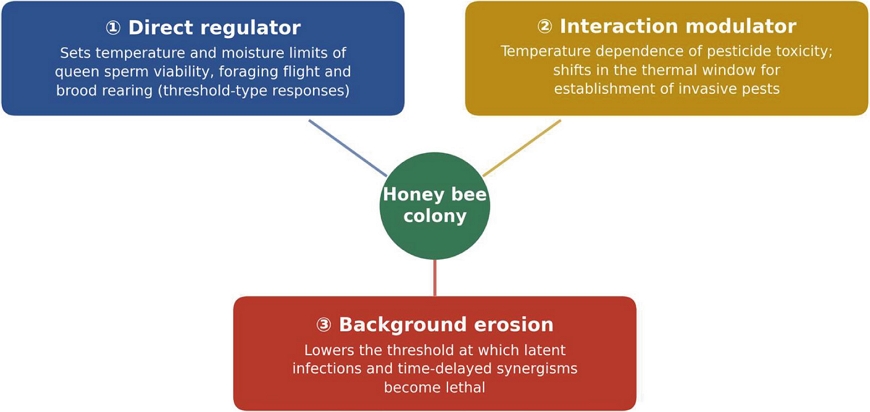
Three roles of weather within the multiple-stressor system. The three roles act on the colony through different pathways and therefore require different management measures.
1. 직접 조절자로서의 기상
첫 번째 역할에서 기상은 다른 스트레스 요인의 매개 없이 꿀벌의 생리에 직접 영향을 미친다. 여왕벌 수정 능력의 온도 한계 (McAfee et al., 2020), 채집 비행의 상·하한 온도 (Southwick and Heldmaier, 1987; Southwick and Moritz, 1987; Esch, 1988), 봉아 온도 조절이 유지될 수 있는 범위 (Winston, 1987; Stabentheiner et al., 2010; Yi and Jung, 2010)가 이에 해당한다 (Table 1). 이 역할에 대해서는 물리적 개입에 의한 관리가 가장 효과적이다. 벌통 보온, 고온과 저온을 함께 고려한 봉장 입지 선정, 여름철 차광과 환기, 급수, 국지 극값을 완화하는 고도와 사면 방향의 선택 등이 임계값 초과 사건에 대한 직접적 완충 수단이 된다. 국내에서도 저온창고를 이용한 시설 월동과 디지털 센서 기반 월동 감시 기술이 검토되고 있다 (Kim et al., 2021a; Park et al., 2021).
2. 침입 해충 정착의 온도 창
기상 조건은 침입 해충의 정착 가능 여부에도 영향을 미친다. 작은벌집밑빠진벌레 (Aethina tumida)는 생활사의 결정적 단계인 번데기 시기를 토양에서 보내므로 토양 온도와 수분의 직접적 지배를 받는다. 온난하고 습한 사질 토양 (약 24.6±1.3℃)에서 번데기 발육은 약 23일에 완료되고 사망률은 약 8.5%에 그친 반면 (Neumann et al., 2016), 토양 유형과 수분은 번데기 발육 성공을 강하게 조절하여 건조한 토양에서는 성충 우화율이 크게 감소하였다 (Ellis et al., 2004). 우리나라에서의 관건은 월동 가능 여부이다. 국내 연구에서는 저온 순응 (acclimation)이 방랑 유충과 번데기의 저온 생존율을 실질적으로 향상시키며, 이러한 표현형 가소성이 온대 기후인 우리나라에서의 월동과 분포 확장을 뒷받침할 수 있는 것으로 나타났다 (Noor-ul-Ane and Jung, 2021). 겨울철 토양 온도를 높이는 온난화 추세는 정착 조건을 완화하는 방향으로 작용하므로, 기후의 양적 변화가 해충상의 질적 변화로 이어질 수 있다.
동일한 논리가 이미 정착한 침입종에도 적용된다. 등검은말벌 (Vespa velutina nigrithorax)은 2003년 국내 침입 이후 분포를 빠르게 확대하여 말벌류 중 우점종이 되었으며 (Choi et al., 2012, 2013; Jung, 2012a, 2012b; Sim et al., 2014), 귀소하는 외역벌의 포식을 통해 봉군을 직접 압박하고 산화 스트레스를 증가시켜 수명을 단축시킨다 (Leza et al., 2019). 기생응애에서도 남방계인 중국가시응애 (Tropilaelaps mercedesae)의 감염 수준이 온난화와 함께 상승할 가능성이 지적되어 왔으며 (Jung et al., 2000; Lee et al., 2005; Jung, 2015), 최근에는 그 밀도가 꿀벌응애를 상회한다는 보고도 제시되었다 (Choi et al., 2014; Oh et al., 2024). 이는 온도 조건의 변화가 해충 군집의 구성 자체를 바꿀 수 있음을 보여준다.
3. 농약 독성의 온도 의존성
상호작용 조절자 역할의 대표적 사례는 농약 독성의 온도 의존성이다. 생리적 최적 온도보다 낮거나 높은 온도는 모두 살충제 독성을 가중시킨다. 26℃와 38℃에서 유지된 꿀벌은 최적 온도인 32℃에서 유지된 꿀벌보다 이미다클로프리드 노출 시 유의하게 높은 사망률을 보였으며, 관련 유전자 발현 조절에도 변화가 나타났다 (Alburaki et al., 2023). 온도 의존성의 방향은 행동 항목에 따라 역전되기도 한다. 뒤영벌 대상 통제 실험에서 네오니코티노이드는 둥지 관련 행동에는 저온에서 더 강하게 작용한 반면, 비행 거리에 대한 영향은 고온에서 가장 컸다 (Kenna et al., 2023). 다만 이 결과는 뒤영벌에서 얻어진 것으로 꿀벌에 직접 일반화하기는 어렵다. 한편 네오니코티노이드 아치사 용량의 급성 노출이 꿀벌의 임계 최고온도 (CTMax)와 급성 열 스트레스 생존율을 오히려 높였다는 상반된 결과도 보고되었다 (Gonzalez et al., 2022). 이처럼 상호작용의 방향이 조건에 따라 달라진다는 점을 고려하면 농약 독성은 노출 온도와 분리하여 평가될 수 없으며, 국내 조건의 농약 위험 평가는 단일 실험 온도가 아니라 관련 온도 범위 전반에서 수행될 필요가 있다. 아울러 봉군 관리에 사용되는 살비제 역시 화분, 꿀, 밀랍에 잔류하여 유충 발육과 성충의 비행·학습 능력에 부정적 영향을 미칠 수 있으므로 (Mullin et al., 2010; Frost et al., 2013; Dai et al., 2018; Wu et al., 2022), 봉군 내부의 화학적 부담 역시 동일한 관점에서 평가되어야 한다.
4. 봉군 밀도와 표류
봉장의 공간 배치는 기상이 매개하는 질병 전파와 상호작용한다. 야외 실험에서 봉장 밀도를 낮추고 벌통을 시각적으로 구별되게 배치한 처리는 봉군 간 표류 (drifting)를 약 25%에서 7.5%로 감소시켰으며, 이에 따라 기생충 부담과 월동 폐사가 감소하고 꿀 생산이 증가하였다 (Dynes et al., 2019). 표류는 응애와 응애 매개 바이러스가 봉군 간에 전파되는 주요 경로이며 (Sammataro et al., 2000; Rosenkranz et al., 2010), 그 비율은 봉군 배치의 밀도와 구별 가능성에 의해 결정된다. 우리나라의 단위면적당 사육 봉군 수는 30년 평균 약 11.67통/km2로 다른 국가보다 3.8~130배 높은 것으로 분석되었으며 (Jeong et al., 2016; Sampat and Jung, 2016), 2022년 기준 26,805호의 양봉농가가 약 250만 봉군을 사육하고 있다 (MAFRA, 2022). 이러한 고밀도 조건은 표류 기작이 높은 기준선에서 작동함을 의미하며, 응애 활동기를 연장하는 온난화 추세의 영향은 이 조건에서 증폭된다. 봉군 밀도의 하향 조정과 벌통 간 시각적 구별성 확보는 기후 자체가 아니라 국가적 밀도 구조에서 비롯되는 취약성을 직접 겨냥하는 구조적 개입 수단이다.
5. 방어 역량의 배경 침식
세 번째 역할에서 기상은 봉군의 방어 역량을 서서히 저하시켜 잠재적 부담이 치명적으로 전환되는 임계값을 낮추는 배경 조건으로 작동한다. 면역 역량 모델은 봉군 붕괴를, 다수의 건강한 봉군에 저수준으로 존재하는 잠복 감염 (특히 DWV)이 다중 스트레스에 의해 잠복 상태에서 치명적 상태로 전환되는 과정으로 해석한다 (Nazzi and Pennacchio, 2018). 겨울벌에서 세포성 면역 반응이 제한되고 면역 관련 유전자 발현이 낮아진다는 점은 이러한 전환이 월동기에 집중될 수 있음을 뒷받침한다 (Gätschenberger et al., 2013; Steinmann et al., 2015). 이 틀에서 농약 - 바이러스 상호작용은 봉군 건강에 가산적 또는 상승적으로 작용할 수 있으며 (Harwood and Dolezal, 2020), 꿀벌응애와 네오니코티노이드 간의 시간 지연 상승작용은 살충제 단독으로는 검출 가능한 효과가 없는 조건에서도 겨울벌의 생존을 유의하게 감소시켰다 (Straub et al., 2019). 피해가 급성 노출이 아니라 누적된 부담의 지연된 상호작용에서 발생하여 겨울벌에서 뒤늦게 나타나는 이러한 양상은 충격보다는 기후 추세가 손실로 이어지는 특징적 경로이다. 이에 대한 관리 방향은 만성적 배경 부담의 완화, 즉 봉군 밀도와 밀원의 관리, 누적 스트레스 노출의 체계적 감소, 봉군의 영양 및 면역 상태의 유지이다.
국제 비교와 우리나라 양봉의 3중 취약성
우리나라 양봉을 국제 비교의 맥락에서 검토하는 목적은 두 가지이다. 첫째, 각국의 손실률, 병원체 양상, 침입 해충 동향과 비교하여 국내 사례의 상대적 심각도를 평가하는 것이다. 둘째, 지배적 병원체, 종별 손실 패턴, 해충 침입 경과가 인접국 간에도 실질적으로 다르므로, 따라서 국외 결론을 그대로 적용할 수 없음을 확인하는 것이다.
1. 봉군 손실 패턴과 봉종 간 차이
현재까지 수행된 최대 규모의 봉군 손실 조사는 2009~2021년 중국 21개 성에서 13,704명의 양봉가가 관리한 1,744,324개 봉군을 대상으로 하였다. 전체 월동 손실률은 9.84%로 비교적 낮았으나, 재래꿀벌 봉군이 양봉꿀벌 봉군보다 유의하게 높은 손실을 보였다 (Tang et al., 2023). 최대 규모 자료에서 확인된 이 봉종 간 차이는 두 봉종을 모두 사육하는 우리나라와 직접 관련되며, 두 봉종이 생리적 특성뿐 아니라 야외 조건의 실제 폐사율에서도 다름을 보여준다. 한편 미국의 최근 연간 손실률인 전국 약 55.6%, 상업 양봉 약 62% (AIA, 2025; Project Apis m., 2025)는 중국의 월동 손실률과 큰 격차를 보이며, 유럽을 중심으로 한 COLOSS 조사에서도 참여국 간 손실률의 편차가 크고 사육 규모, 이동 양봉 여부, 여왕벌 교체 등 관리 요인이 손실률에 유의하게 작용하는 것으로 나타났다 (Gray et al., 2019, 2023). 이는 손실률이 국가 간에 이전 가능한 상수가 아니라 봉종 구성, 관리 체계, 국지적 스트레스 양상, 기후 체제의 함수임을 의미하며, 따라서 우리나라의 손실률은 국내 자료로 측정되어야 한다 (Table 7).
Comparison of colony loss rates and survey scales among major countries
2. 침입 해충의 확산: 호주 사례
꿀벌응애의 전 지구적 확산 과정에서 최근 호주의 사례는 침입 해충 정착 속도를 보여주는 대표적인 연대표를 제공한다. 꿀벌응애는 2022년 6월 뉴캐슬항에서 처음 검출되었고, 2023년 9월 박멸 불가 판정이 내려졌으며, 2026년 2월 국가 관리 전환 (T2M) 프로그램이 종료되어 토착화가 공식적으로 수용되었다 (Australian Government, 2026). 마지막 주요 무응애 양봉국에서 최초 침입부터 토착화 수용까지 4년이 소요되지 않은 이 경과는 침입 해충의 정착 속도와 함께 차단이 가능한 시간적 창이 매우 제한적임을 보여준다. 꿀벌응애가 1970년대 이후 재래꿀벌에서 양봉꿀벌로 기주 전환을 이룬 이래 (Roth et al., 2020) 전 세계 양봉의 최대 위해 요인이 되었다는 점을 고려하면, 이는 우리나라에도 직접적 시사점을 갖는다. 작은벌집밑 빠진벌레의 정착 여부가 미성숙 단계의 내한성과 온난화에 따라 상승하는 겨울철 토양 온도에 달려 있기 때문이다. 침입에서 불가역적 정착까지의 기간이 수년 단위로 측정되므로, 신규 침입 해충을 월동 성공 이전에 탐지·대응하는 조기 경보 체계가 토착화 이후의 어떤 조치보다 효과적이다.
3. 병원체 양상과 독립적 분석의 근거
병원체와 바이러스 양상은 동아시아 인접국 간에도 뚜렷이 다르며, 이 차이는 국외 결론의 직접 적용이 부적절함을 보여주는 가장 강력한 근거이다. 일본에서 만성벌마비바이러스 (CBPV)의 양봉꿀벌 봉군 유병률은 약 5.6%로 낮게 보고되었고 재래꿀벌 아종에서는 검출되지 않았다 (Morimoto et al., 2012). 국내에서 봉군 대량 실종 이후 수행된 메타게놈 바이롬 분석에서는 다수의 바이러스가 국내 최초로 기록되었으며, 인접국에서 보고된 신종 바이러스와 신계통이 국내에서는 거의 조사되지 않았다는 자료 공백이 지적되었다 (Kwon et al., 2023). 이어 2020~2023년 1,378개 봉장의 3,707개 이상 봉군을 대상으로 한 전국 병원체 조사에서는 흑색여왕벌방바이러스 (BQCV)가 가장 높은 유병률을 보여 2023년 83.3%에 이르고 계절과 무관하게 연중 높게 유지된 반면, 날개불구바이러스 (DWV, 48.7%)와 이스라엘급성마비바이러스 (IAPV, 41.3%)는 10~12월에 정점을 보였다 (Heo et al., 2025). 이러한 계절적 정점 구조는 중요한 의미를 갖는다. DWV와 IAPV의 겨울철 집중이 기온 변동성이 지배하는 월동 스트레스와 시기적으로 일치하므로, 질병 부담과 기상 부담이 같은 계절에 중첩되기 때문이다. 또한 재래꿀벌에서 낭충봉아부패바이러스가 국내 개체군을 심각하게 감소시킨 사례 (Choi et al., 2010)는 봉종에 따라 지배적 병원체가 달라짐을 보여준다. 지배적 병원체, 계절적 정점, 계통 구성이 모두 국내 특이적이므로 국내 봉군의 질병 노출은 국내 자료에 근거해 규명되어야 한다.
4. 3중 취약성의 수렴
이상의 비교 결과는 하나의 결론으로 수렴한다. 우리나라 양봉은 세 가지 취약성을 동시에 안고 있으며, 개별 취약성보다 그 수렴이 국내 사례의 특수성을 규정한다. 첫째는 이중 봉종 부담이다. 우리나라는 열 내성과 질병 감수성이 서로 다른 두 봉종을 모두 사육하므로 국가 수준의 봉군 취약성은 두 봉종 특이적 취약성의 중첩이며, 중국의 봉종별 손실 자료 (Tang et al., 2023)와 국내 재래꿀벌의 낭충봉아부패바이러스 피해 (Choi et al., 2010)가 이를 뒷받침한다. 둘째는 아까시나무 중심의 인위적 단작 밀원 기반에 대한 의존이다. 이는 온난화 추세에 가장 뒤처지기 쉬운 목본의 느린 반응 특성을 가지며, 조림 면적이 32만 ha에서 약 2만 1천 ha로 감소한 구조적 변화 위에 (Kim et al., 2022) 시기적으로 압축된 단일 유밀이 강수·기온 충격에 최대로 노출되는 형태이다. 셋째는 세계 최고 수준의 봉군 밀도로, 30년 평균 11.67통/km2에 이르는 밀도가 (Jeong et al., 2016; Sampat and Jung, 2016; MAFRA, 2022) 밀도 - 표류 기작 (Dynes et al., 2019)을 통해 봉군 간 질병 전파율을 구조적으로 높인다. 세 취약성은 각각으로는 우리나라의 고유한 현상이 아니나, 단일 양봉 시스템 내에서의 수렴이 국내 사례를 구별한다. 이중 봉종 부담은 봉종 특이적 병원체와, 단작 밀원은 강수 충격과, 고밀도는 온난화로 연장된 응애 활동기와 각각 상호작용하므로 그 효과는 가산적이기보다 상승적이며, 따라서 우리나라의 기후취약성은 독립적 분석 대상으로 다루어져야 한다 (Fig. 2).
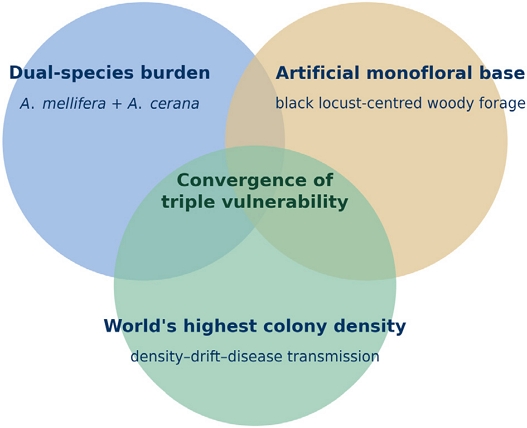
Convergence of the triple vulnerability of Korean apiculture. Each vulnerability is not unique to Korea, but their convergence within a single system is, which limits the direct application of conclusions drawn from studies conducted abroad.
결론 및 향후 연구 방향
본 총설의 결론은 다음 네 가지로 요약된다. 첫째, 추세와 충격은 구분되어야 한다. 동일한 봉군 결과가 장기 기후 추세, 급성 기상 충격, 또는 양자의 상호작용에서 비롯될 수 있으며, 추세에는 구조적 조정이, 충격에는 완충과 신속 대응이 요구된다. 겨울 평균기온이 아니라 기온의 안정성이 월동 성공과 연관됨을 보여준 국내 월동 자료 (Lee et al., 2022; Son et al., 2026)는 충격 층위가 추세 분석으로 대체될 수 없음을 보여주는 직접적 증거이다. 둘째, 임계값 기반 기상지수가 적절한 분석 틀이다. 꿀벌과 밀원식물의 반응이 임계값 형태를 보이므로 (Table 1) 평균값 분석은 위험을 체계적으로 과소평가한다. 동일한 논리가 계절 총량이 아니라 분포가 유밀을 좌우하는 강수 (Kim et al., 2021b; Frigero et al., 2025)와, 열적 생존 임계값이 정착 여부를 결정하는 침입 해충 (Noor-ul-Ane and Jung, 2021)에도 적용된다. 셋째, 다중 스트레스 체계에서 기상은 직접 조절자, 상호작용 조절자, 방어 역량의 배경 침식이라는 세 가지 역할을 하며, 각 역할은 서로 다른 관리 수단을 요구한다. 어느 한 역할만을 대상으로 하는 개입은 나머지 경로를 방치하는 결과를 초래한다. 넷째, 우리나라 양봉의 취약성은 독립적 분석을 요구한다. 이중 봉종 부담, 인위적 단작 밀원 기반, 세계 최고 수준의 봉군 밀도가 수렴하는 국내 조건에서는 국외에서 확립된 손실률, 병원체 양상, 해충 동향을 그대로 적용할 수 없다.
향후 연구의 우선순위는 다음과 같다. 첫째, 두 기후층위를 동시에 완충하기 위한 상보적 밀원수 중심의 개화기 다변화이다. 밀원수종별 개화기와 단위면적당 생산성에 대한 정량 평가가 축적되고 있으므로 (국립산림과학원, 2022; Kim et al., 2022), 이를 권역별 밀원단지 설계에 연결하는 연구가 요구된다. 둘째, 국내 조건에서 양봉꿀벌과 재래꿀벌의 봉종 특이적 열 내성과 질병 내성을 규명하여 봉종별 관리 기준을 수립하는 것이다. 셋째, 강수 변동성에 가장 노출된 내륙 지역에서 계절 예보의 신뢰도가 가장 높다는 점을 활용하여 수개월의 원격상관 선행 시간을 실제 양봉 관리에 적용할 수 있는지 검증하는 것이다 (Lee and Julien, 2016). 넷째, 겨울벌 생산을 유발하는 온도와 일장 조건, 겨울철 기온 변동이 봉군 행동과 산란에 미치는 영향을 에너지 대사 측면에서 규명하는 연구이다 (Jung and Bae, 2022). 이러한 연구가 축적되면 국내 양봉 연구는 과거 손실의 사후 설명에서 미래 손실의 예측과 예방으로 전환될 수 있을 것으로 판단된다. 한편 본문에 인용된 시점 민감 기관 수치, 즉 국립산림과학원의 밀원수 생산량, NOAA/CPC의 ENSO 현황, 농림축산식품부의 축산통계 (MAFRA)는 자료 갱신에 따라 변동하므로 출판 시점에 1차 출처에서 재확인할 필요가 있다.
적 요
본 총설에서는 이상기상과 기후변화가 우리나라 양봉에 미치는 영향에 관한 국내외 문헌을 종합하였다. 주요 내용은 다음과 같다. 1) 기후변화 (장기 추세)와 이상기상 (단기 충격)은 동일한 봉군 결과에 함께 작용하므로 구분하여 분석되어야 하며, 겨울 평균기온이 아니라 기온의 안정성이 월동 성공과 연관됨을 보인 2024~2025년 전국 40개 양봉장 월동 자료가 이를 뒷받침한다. 2) 여왕벌 수정 능력, 채집 비행, 월동봉구 형성, 화밀 분비, 침입 해충의 정착 등 꿀벌과 밀원식물의 반응이 임계값 형태를 보이므로, 계절 평균이 아니라 임계값 초과와 변동성을 분석 단위로 하는 임계값 기반 기상지수가 위험 평가에 적합하다. 3) 다중 스트레스 체계에서 기상은 직접 조절자, 상호작용 조절자 (농약 독성과 침입 해충 정착의 온도 의존성), 방어 역량의 배경 침식이라는 세 가지 역할을 하며, 각 역할은 서로 다른 관리 수단을 요구한다. 4) 이중 봉종 부담 (양봉꿀벌과 재래꿀벌), 아까시나무 중심의 인위적 단작 밀원 기반, 세계 최고 수준의 봉군 밀도가 수렴하는 국내 조건에서는 중국, 일본, 미국 등의 연구 결론을 직접 적용하기 어려우며, 우리나라 양봉의 취약성은 국내 자료에 근거한 독립적 분석을 요구한다. 향후 연구는 개화기 다변화, 봉종 특이적 내성의 규명, 원격상관 선행 시간의 활용, 겨울벌 생산 기작의 규명을 우선순위로 삼을 필요가 있다.
Acknowledgments
본 연구는 농촌진흥청 사업 (과제번호: RS-2025-002303308)의 지원으로 수행되었다.
References
- 국립산림과학원 (NIFoS, National Institute of Forest Science). 2022. 밀원자원 발굴 및 가치평가 연구: 주요 밀원수종의 ha당 꿀 잠재생산량 및 개화기 평가. 산림청 국립산림과학원.
- AIA (Apiary Inspectors of America). 2025. 2024-2025 U.S. beekeeping survey results: national colony loss estimates. Available at: https://apiaryinspectors.org/US-beekeeping-survey-24-25, .
-
Alburaki, M., S. Madella and S. C. Cook. 2023. Non-optimal ambient temperatures aggravate insecticide toxicity and affect honey bees Apis mellifera L. gene regulation. Sci. Rep. 13: 3931.
[https://doi.org/10.1038/s41598-023-30264-0]

-
Amdam, G. V., K. Hartfelder, K. Norberg, A. Hagen and S. W. Omholt. 2004. Altered physiology in worker honey bees (Hymenoptera: Apidae) infested with the mite Varroa destructor (Acari: Varroidae): a factor in colony loss during overwintering. J. Econ. Entomol. 97: 741-747.
[https://doi.org/10.1093/jee/97.3.741]
- Australian Government. 2026. Varroa mite (Varroa destructor): current outbreak information. Outbreak.gov.au, . Available at: https://www.outbreak.gov.au/current-outbreaks/varroa-mite, .
-
Berthoud, H., A. Imdorf, M. Haueter, S. Radloff and P. Neumann. 2010. Virus infections and winter losses of honey bee colonies (Apis mellifera). J. Apic. Res. 49: 60-65.
[https://doi.org/10.3896/IBRA.1.49.1.08]
- Buchmann, S. L. 1996. Competition between honey bees and native bees in the Sonoran Desert and global bee conservation issues. pp. 125-142. in The conservation of bees, eds. by A. Matheson, S. L. Buchmann, C. O’Toole, P. Westrich and I. H. Williams. Academic Press, London.
- Burquez, A. and S. A. Corbet. 1998. Dynamics of production and exploitation of nectar: lessons from Impatiens glandulifera Royle. pp. 130-152. in Nectary biology, ed. by B. Bahadur. Dattsons, Nagpur.
-
Choi, M. B., K. K. Jeong and J. W. Lee. 2013. Checklist and distribution of Korean Vespidae revisited. Korean J. Appl. Entomol. 52: 85-91.
[https://doi.org/10.5656/KSAE.2013.02.1.072]
-
Choi, M. B., S. J. Martin and J. W. Lee. 2012. Distribution, spread, and impact of the invasive hornet Vespa velutina in South Korea. J. Asia-Pac. Entomol. 15: 473-477.
[https://doi.org/10.1016/j.aspen.2011.11.004]
-
Choi, W., C. H. Ho, M. K. Kim, J. Kim, H. D. Yoo, J. G. Jhun and J. H. Jeong. 2018. Season-dependent warming characteristics observed at 12 stations in South Korea over the recent 100 years. Int. J. Climatol. 38: 4092-4101.
[https://doi.org/10.1002/joc.5554]
-
Choi, Y. S., M. L. Lee, H. S. Lee, H. K. Kim, K. H. Byeon, M. Y. Yoon, A. R. Kang, T. V. Toan, I. P. Hong and S. O. Woo. 2014. Morphological analysis and determination of interference competition between two honeybee mites: Varroa destructor and Tropilaelaps clareae (Acari: Varroidae and Laelapidae). J. Apic. 29: 327-332.
[https://doi.org/10.17519/apiculture.2014.11.29.4.327]
- Choi, Y. S., M. Y. Lee, I. P. Hong, N. S. Kim, H. K. Kim, K. G. Lee and M. L. Lee. 2010. Occurrence of sacbrood virus in Korean apiaries from Apis cerana (Hymenoptera: Apidae). J. Apic. 25: 187-191.
-
Cohen, J., J. A. Screen, J. C. Furtado, M. Barlow, D. Whittleston, D. Coumou, J. Francis, K. Dethloff, D. Entekhabi, J. Overland and J. Jones. 2014. Recent Arctic amplification and extreme mid-latitude weather. Nat. Geosci. 7: 627-637.
[https://doi.org/10.1038/ngeo2234]
- Corbet, S. A. 1990. Pollination and the weather. Isr. J. Bot. 39: 13-30.
-
Dai, P., C. J. Jack, A. N. Mortensen, T. A. Bustamante and J. D. Ellis. 2018. Chronic toxicity of amitraz, coumaphos and fluvalinate to Apis mellifera L. larvae reared in vitro. Sci. Rep. 8: 5635.
[https://doi.org/10.1038/s41598-018-24045-3]
-
Dainat, B., J. D. Evans, Y. P. Chen, L. Gauthier and P. Neumann. 2012. Dead or alive: deformed wing virus and Varroa destructor reduce the life span of winter honeybees. Appl. Environ. Microbiol. 78: 981-987.
[https://doi.org/10.1128/AEM.06537-11]
-
Döke, M. A., C. M. McGrady, M. Otieno, C. M. Grozinger and M. Frazier. 2019. Colony size, rather than geographic origin of stocks, predicts overwintering success in honey bees (Hymenoptera: Apidae) in the northeastern United States. J. Econ. Entomol. 112: 525-533.
[https://doi.org/10.1093/jee/toy377]
-
Döke, M. A., M. Frazier and C. M. Grozinger. 2015. Overwintering honey bees: biology and management. Curr. Opin. Insect Sci. 10: 185-193.
[https://doi.org/10.1016/j.cois.2015.05.014]
-
Dynes, T. L., J. A. Berry, K. S. Delaplane, B. J. Brosi and J. C. de Roode. 2019. Reduced density and visually complex apiaries reduce parasite load and promote honey production and overwintering survival in honey bees. PLoS ONE 14: e0216286.
[https://doi.org/10.1371/journal.pone.0216286]
-
Ellis, J. D., H. R. Hepburn, B. Luckman and P. J. Elzen. 2004. Effects of soil type, moisture, and density on pupation success of Aethina tumida (Coleoptera: Nitidulidae). Environ. Entomol. 33: 794-798.
[https://doi.org/10.1603/0046-225X-33.4.794]
-
Esch, H. 1988. The effects of temperature on flight muscle potentials in honeybees and cuculiinid winter moths. J. Exp. Biol. 135: 109-117.
[https://doi.org/10.1242/jeb.135.1.109]
-
Flores, J. M., S. Gil-Lebrero, V. Gámiz, M. I. Rodríguez, M. A. Ortiz and F. J. Quiles. 2019. Effect of the climate change on honey bee colonies in a temperate Mediterranean zone assessed through remote hive weight monitoring system in conjunction with exhaustive colonies assessment. Sci. Total Environ. 653: 1111-1119.
[https://doi.org/10.1016/j.scitotenv.2018.11.004]
-
Fluri, P., M. Lüscher, H. Wille and L. Gerig. 1982. Changes in weight of the pharyngeal gland and haemolymph titres of juvenile hormone, protein and vitellogenin in worker honey bees. J. Insect Physiol. 28: 61-68.
[https://doi.org/10.1016/0022-1910(82)90023-3]
-
Frigero, M. L. P., C. S. F. Boaro, L. Galetto, P. Tunes and E. Guimarães. 2025. Extreme events induced by climate change alter nectar offer to pollinators in cross pollination-dependent crops. Sci. Rep. 15: 10852.
[https://doi.org/10.1038/s41598-025-94565-2]
-
Frost, E. H., D. Shutler and N. K. Hillier. 2013. Effects of fluvalinate on honey bee learning, memory, responsiveness to sucrose, and survival. J. Exp. Biol. 216: 2931-2938.
[https://doi.org/10.1242/jeb.086538]
-
Gary, N. E. 1967. Diurnal variations in the intensity of flight activity from honeybee colonies. J. Apic. Res. 6: 65-68.
[https://doi.org/10.1080/00218839.1967.11100162]
-
Gätschenberger, H., K. Azzami, J. Tautz and H. Beier. 2013. Antibacterial immune competence of honey bees (Apis mellifera) is adapted to different life stages and environmental risks. PLoS ONE 8: 1-14.
[https://doi.org/10.1371/journal.pone.0066415]
-
Genersch, E., W. von der Ohe, H. Kaatz, A. Schroeder, C. Otten, R. Büchler, S. Berg, W. Ritter, W. Mühlen, S. Gisder, M. Meixner, G. Liebig and P. Rosenkranz. 2010. The German bee monitoring project: a long term study to understand periodically high winter losses of honey bee colonies. Apidologie 41: 332-352.
[https://doi.org/10.1051/apido/2010014]
-
Gonzalez, V. H., J. M. Hranitz, M. B. McGonigle, R. E. Manweiler, D. R. Smith and J. F. Barthell. 2022. Acute exposure to sublethal doses of neonicotinoid insecticides increases heat tolerance in honey bees. PLoS ONE 17: e0240950.
[https://doi.org/10.1371/journal.pone.0240950]
-
Gray, A., N. Adjlane, A. Arab, A. Ballis, V. Brusbardis, A. Bugeja Douglas, L. Cadahía, J.-D. Charrière, R. Chlebo, M. F. Coffey, B. Cornelissen, C. A. da Costa, E. Danneels, J. Danihlík, C. Dobrescu, G. Evans, M. Fedoriak, I. Forsythe, A. Gregorc, I. I. Arakelyan, J. Johannesen, L. Kauko, P. Kristiansen, M. Martikkala, R. Martín-Hernández, E. Mazur, C. A. Medina-Flores, F. Mutinelli, E. M. Omar, S. Patalano, A. Raudmets, G. San Martin, V. Soroker, P. Stahlmann-Brown, J. Stevanovic, A. Uzunov, F. Vejsnaes, A. Williams and R. Brodschneider. 2023. Honey bee colony loss rates in 37 countries using the COLOSS survey for winter 2019-2020: the combined effects of operation size, migration and queen replacement. J. Apic. Res. 62: 204-210.
[https://doi.org/10.1080/00218839.2022.2113329]
-
Gray, A., R. Brodschneider, N. Adjlane, A. Ballis, V. Brusbardis, J. D. Charrière, R. Chlebo, M. F. Coffey, B. Cornelissen, C. A. da Costa, T. Csáki, B. Dahle, J. Danihlík, M. M. Dražić, G. Evans, M. Fedoriak, I. Forsythe, D. de Graaf, A. Gregorc, J. Johannesen, L. Kauko, P. Kristiansen, M. Martikkala, R. Martín-Hernández, C. A. Medina-Flores, F. Mutinelli, S. Patalano, P. Petrov, A. Raudmets, V. A. Ryzhikov, N. Simon-Delso, J. Stevanovic, G. Topolska, A. Uzunov, F. Vejsnaes, A. Williams, M. Zammit-Mangion and V. Soroker. 2019. Loss rates of honey bee colonies during winter 2017/18 in 36 countries participating in the COLOSS survey, inc luding effects of forage sources. J. Apic. Res. 58: 479-485.
[https://doi.org/10.1080/00218839.2019.1615661]
-
Guzman-Novoa, E., L. Eccles, Y. Calvete, J. McGowan, P. G. Kelly and A. Correa-Benitez. 2010. Varroa destructor is the main culprit for the death and reduced populations of overwintered honey bee (Apis mellifera) colonies in Ontario, Canada. Apidologie 41: 443-450.
[https://doi.org/10.1051/apido/2009076]
-
Harwood, G. P. and A. G. Dolezal. 2020. Pesticide-virus interactions in honey bees: challenges and opportunities for understanding drivers of bee declines. Viruses 12: 566.
[https://doi.org/10.3390/v12050566]
-
Heo, J., D.-S. Yoo, D.-S. Cheon, Y. Kim and D.-Y. Kim. 2025. Prevalence of pathogens in abnormal honey bees in South Korea, 2020-2023. J. Vet. Diagn. Invest. 37 (2).
[https://doi.org/10.1177/10406387241299868]
-
Huang, Z.-Y. and G. E. Robinson. 1995. Seasonal changes in juvenile hormone titers and rates of biosynthesis in honey bees. J. Comp. Physiol. B 165: 18-28.
[https://doi.org/10.1007/BF00264682]
-
Iizumi, T., J.-J. Luo, A. J. Challinor, G. Sakurai, M. Yokozawa, H. Sakuma, M. E. Brown and T. Yamagata. 2014. Impacts of El Niño Southern Oscillation on the global yields of major crops. Nat. Commun. 5: 3712.
[https://doi.org/10.1038/ncomms4712]
-
Insolia, L., R. Molinari, S. R. Rogers, G. R. Williams, F. Chiaromonte and M. Calovi. 2022. Honey bee colony loss linked to parasites, pesticides and extreme weather across the United States. Sci. Rep. 12: 20787.
[https://doi.org/10.1038/s41598-022-24946-4]
- IPCC. 2021. Climate change 2021: the physical science basis. Contribution of Working Group I to the Sixth Assessment Report of the Intergovernmental Panel on Climate Change, Annex VII: Glossary. Cambridge University Press, Cambridge.
-
Jakobsen, H. B. and K. Kristjansson. 1994. Influence of temperature and floret age on nectar secretion in Trifolium repens L. Ann. Bot. 74: 327-334.
[https://doi.org/10.1006/anbo.1994.1125]
-
Jeong, S., C. Lee, D. Kim and C. Jung. 2016. Questionnaire study on the overwintering success and pest management of honeybee and damage assessment of Vespa hornets in Korea. J. Apic. 31: 201-210.
[https://doi.org/10.17519/apiculture.2016.09.31.3.201]
- Jung, C. 2008. Economic value of honeybee pollination on major fruit and vegetable crops in Korea. J. Apic. 23: 147-152.
- Jung, C. 2012a. Initial stage risk assessment of an invasive hornet, Vespa velutina nigrithorax Buysson (Hymenoptera: Vespidae) in Korea. J. Apic. 27: 95-104.
- Jung, C. 2012b. Spatial expansion of an invasive hornet, Vespa velutina nigrithorax Buysson (Hymenoptera: Vespidae) in Korea. J. Apic. 27: 87-93.
- Jung, C. 2014. A note on the early publication of beekeeping of western honeybee, Apis mellifera in Korea: Yangbong Yoji (Abriss Bienenzucht) by P. Canisius Kugelgen. J. Apic. 29: 73-77.
-
Jung, C. 2015. Simulation study of Varroa population under the future climate conditions. J. Apic. 30: 349-358.
[https://doi.org/10.17519/apiculture.2015.11.30.4.349]
- Jung, C. 2022. Multi-functionality of honey bees for eco-friendly food production. Food Sci. Ind. 55: 166-175.
- Jung, C. and J. H. Shin. 2022. Evaluation of crop production increase through insect pollination service in Korean agriculture. Korean J. Appl. Entomol. 61: 229-238.
-
Jung, C. and M. L. Lee. 2018. Beekeeping in Korea: past, present, nd future challenges. pp. 175-197. in Asian beekeeping in the 21st century, eds. by P. Chantawannakul, G. Williams and P. Neumann. Springer, Singapore.
[https://doi.org/10.1007/978-981-10-8222-1_8]
-
Jung, C. and S.-K. Cho. 2015. Relationship between honeybee population and honey production in Korea: a historical trend analysis. J. Apic. 30: 7-12.
[https://doi.org/10.17519/apiculture.2015.04.30.1.7]
-
Jung, C. and Y. H. Bae. 2022. Production and characteristics of winter generation honey bees, Apis mellifera: discussion with overwintering failure. J. Apic. 37: 265-274.
[https://doi.org/10.17519/apiculture.2022.09.37.3.265]
- Jung, C., M. S. Kang, D. Kim and H. S. Lee. 2007. Vespid wasps (Hymenoptera) occurring around apiaries in Andong, Korea I. Taxonomy and life history. J. Apic. 22: 53-62.
- Jung, J. K., M. Y. Lee and Y. I. Mah. 2000. Infestation of Varroa jacobsoni and Tropilaelaps clareae in some apiaries during spring and fall seasons, 1999-2000 in South Korea. J. Apic. 15: 141-145.
-
Kang, C. H. and H. S. Lee. 2018. A study on the effect of wind speed on the production of honey. J. Apic. 33: 63-70.
[https://doi.org/10.17519/apiculture.2018.04.33.1.63]
-
Kang, Y., S.-H. Kwon and C. Jung. 2024. Correlation analysis between honeybee pest occurrences and winter failure based on the questionnaire from beekeepers in Korea. J. Apic. 39: 185-193.
[https://doi.org/10.17519/apiculture.2024.09.39.3.185]
-
Kenna, D., P. Graystock and R. J. Gill. 2023. Toxic temperatures: bee behaviours exhibit divergent pesticide toxicity relationships with warming. Glob. Change Biol. 29: 2981-2998.
[https://doi.org/10.1111/gcb.16671]
-
Kim, G., B. S. Park, J. G. Kim, E. J. Kang, Y. S. Choi, M. Y. Lee and D. Kim. 2021a. Analysis of the honey bee, Apis mellifera, wintering ability and immune-related genes expression depending on the thermal conditions of the warehouse. J. Apic. 36: 89-96.
[https://doi.org/10.17519/apiculture.2021.09.36.3.89]
-
Kim, H. K. 2022. The effect of honey bee mites on the winter colony losses. J. Apic. 37: 291-299.
[https://doi.org/10.17519/apiculture.2022.09.37.3.291]
-
Kim, K., M. Y. Lee, Y. S. Choi, E. J. Kang, H. G. Park, B. S. Park, O. Frunze, J. G. Kim, S. M. Han, S. O. Woo, S. G. Kim, H. Y. Kim, S. K. Kim and D. Kim. 2021b. Status and environmental factors of the annual production of acacia honey from the false acacia (Robinia pseudoacacia) in South Korea. J. Apic. 36: 11-16.
[https://doi.org/10.17519/apiculture.2021.04.36.1.11]
-
Kim, Y. K., S. J. Na, H. Y. Kwon and W. G. Park. 2022. Evaluation of honey production of Ligustrum japonicum and Viburnum odoratissimum var. awabuki in the southern part of Korea. J. Apic. 37: 35-44.
[https://doi.org/10.17519/apiculture.2022.04.37.1.35]
-
Kim, Y. H. and S. K. Lee. 2022. Current status of fluvalinate resistance in Varroa destructor in Korea and suggestion for possible solution. J. Apic. 37: 301-313.
[https://doi.org/10.17519/apiculture.2022.09.37.3.301]
-
Klein, A.-M., B. E. Vaissière, J. H. Cane, I. Steffan-Dewenter, S. A. Cunningham, C. Kremen and T. Tscharntke. 2007. Importance of pollinators in changing landscapes for world crops. Proc. R. Soc. B 274: 303-313.
[https://doi.org/10.1098/rspb.2006.3721]
-
Kudo, G. and T. Y. Ida. 2013. Early onset of spring increases the phenological mismatch between plants and pollinators. Ecology 94: 2311-2320.
[https://doi.org/10.1890/12-2003.1]
-
Kunc, M., P. Dobeš, J. Hurychová, L. Vojtek, S. B. Poiani, J. Danihlík, J. Havlík, D. Titěra and P. Hyršl. 2019. The year of the honey bee (Apis mellifera L.) with respect to its physiology and immunity: a search for biochemical markers of longevity. Insects 10: 1-16.
[https://doi.org/10.3390/insects10080244]
-
Kwon, M., C. Jung and E.-J. Kil. 2023. Metagenomic analysis of viromes in honey bee colonies (Apis mellifera; Hymenoptera: Apidae) after mass disappearance in Korea. Front. Cell. Infect. Microbiol. 13: 1124596.
[https://doi.org/10.3389/fcimb.2023.1124596]
-
Lanzi, G., J. R. de Miranda, M. B. Boniotti, C. E. Cameron, A. Lavazza, L. Capucci, S. M. Camazine and C. Rossi. 2006. Molecular and biological characterization of deformed wing virus of honeybees (Apis mellifera L.). J. Virol. 80: 4998-5009.
[https://doi.org/10.1128/JVI.80.10.4998-5009.2006]
-
Le Conte, Y. and M. Navajas. 2008. Climate change: impact on honey bee populations and diseases. Rev. Sci. Tech. 27: 499-510.
[https://doi.org/10.20506/rst.27.2.1819]
-
Lee, J. H. and P. Y. Julien. 2016. Teleconnections of the ENSO and South Korean precipitation patterns. J. Hydrol. 534: 237-250.
[https://doi.org/10.1016/j.jhydrol.2016.01.011]
- Lee, M. L., Y. M. Park, M. Y. Lee, Y. S. Kim and H. K. Kim. 2005. Density distribution of parasitic mites, Varroa destructor Anderson and Trueman and Tropilaelaps clareae Delfinado and Baker, on honeybee pupae (Apis mellifera L.) in autumn season in Korea. J. Apic. 20: 103-108.
- Lee, M. Y., I. P. Hong, Y. S. Choi, N. S. Kim, H. K. Kim, K. G. Lee and M. L. Lee. 2010. Present status of Korean beekeeping industry. J. Apic. 25: 137-144.
-
Lee, S., S. Kim, J. Lee, J. Kang, S. Lee, H. J. Park, J. Nam and Jung. 2022. Impact of ambient temperature variability on the overwintering failure of honeybees in South Korea. J. Apic. 37: 331-347.
[https://doi.org/10.17519/apiculture.2022.09.37.3.331]
-
Lenoir, J., J. C. Gégout, P. A. Marquet, P. de Ruffray and H. Brisse. 2008. A significant upward shift in plant species optimum elevation during the 20th century. Science 320: 1768-1771.
[https://doi.org/10.1126/science.1156831]
-
Leza, M., C. Herrera, A. Marques, P. Roca, J. Sastre Serra and D. G. Pons. 2019. The impact of the invasive species Vespa velutina on honeybees: a new approach based on oxidative stress. Sci. Total Environ. 689: 709-715.
[https://doi.org/10.1016/j.scitotenv.2019.06.511]
- MAFRA (Ministry of Agriculture, Food and Rural Affairs). 2022. Domestic animals statistics. pp. 44-46. MAFRA, Sejong.
-
Mattila, H. R. and G. W. Otis. 2006. Influence of pollen diet in spring on development of honey bee (Hymenoptera: Apidae) colonies. J. Econ. Entomol. 99: 604-613.
[https://doi.org/10.1093/jee/99.3.604]
-
Mattila, H. R., J. L. Harris and G. W. Otis. 2001. Timing of production of winter bees in honey bee (Apis mellifera) colonies. Insectes Soc. 48: 88-93.
[https://doi.org/10.1007/PL00001764]
-
McAfee, A., A. Chapman, H. Higo, R. Underwood, J. Milone, L. J. Foster, M. M. Guarna, D. R. Tarpy and J. S. Pettis. 2020. Vulnerability of honey bee queens to heat-induced loss of fertility. Nat. Sustain. 3: 367-376.
[https://doi.org/10.1038/s41893-020-0493-x]
-
Mohammad, N. and C. Jung. 2021. Supercooling points (SCPs) of social hymenopterans, Apis mellifera (Hymenoptera: Apidae) and Vespa velutina (Hymenoptera: Vespidae). J. Apic. 36: 71-76.
[https://doi.org/10.17519/apiculture.2021.06.36.2.71]
-
Morimoto, T., Y. Kojima, M. Yoshiyama, K. Kimura, B. Yang and T. Kadowaki. 2012. Molecular identification of chronic bee paralysis virus infection in Apis mellifera colonies in Japan. Viruses 4: 1093-1103.
[https://doi.org/10.3390/v4071093]
-
Mullin, C. A., M. Frazier, J. L. Frazier, S. Ashcraft, R. Simonds, D. vanEngelsdorp and J. S. Pettis. 2010. High levels of miticides and agrochemicals in North American apiaries: implications for honey bee health. PLoS ONE 5: e9754.
[https://doi.org/10.1371/journal.pone.0009754]
-
Nazzi, F. and F. Pennacchio. 2018. Honey bee antiviral immune barriers as affected by multiple stress factors: a novel paradigm to interpret colony health decline and collapse. Viruses 10: 159.
[https://doi.org/10.3390/v10040159]
-
Neumann, P., J. S. Pettis and M. O. Schäfer. 2016. Quo vadis Aethina tumida? Biology and control of small hive beetles. Apidologie 47: 427-466.
[https://doi.org/10.1007/s13592-016-0426-x]
- NOAA/CPC (National Oceanic and Atmospheric Administration, Climate Prediction Center). 2026. El Niño/Southern Oscillation (ENSO) diagnostic discussion. Available at: https://www.cpc.ncep.noaa.gov, .
-
Noor-ul-Ane, M. and C. Jung. 2021. Characterization of cold tolerance of immature stages of small hive beetle, Aethina tumida Murray (Coleoptera: Nitidulidae). J. Asia-Pac. Entomol. 24: 1180-1186.
[https://doi.org/10.1016/j.aspen.2021.10.005]
-
Oh, H., T. Begna and C. Jung. 2024. Evaluating the efficacy of registered acaricides on Varroa destructor and Tropilaelaps mercedesae in Apis mellifera colonies. J. Apic. 39: 21-30.
[https://doi.org/10.17519/apiculture.2024.04.39.1.21]
-
Park, B. S., G. Kim, J. G. Kim, D. Kim, Y. S. Choi, M. Y. Lee and E. J. Kang. 2021. Analysis of termination timing of over-wintering in honey bee (Apis mellifera) using digital sensors. J. Apic. 36: 97-104.
[https://doi.org/10.17519/apiculture.2021.09.36.3.97]
-
Peng, S., A. M. Ellison and C. C. Davis. 2025. Climate change intensifies plant-pollinator mismatch and increases secondary extinction risk for plants in northern latitudes. Proc. Natl. Acad. Sci. USA 122: e2506265122.
[https://doi.org/10.1073/pnas.2506265122]
-
Pettis, J. S., N. Rice, K. Joselow, D. vanEngelsdorp and V. Chaimanee. 2016. Colony failure linked to low sperm viability in honey bee (Apis mellifera) queens and an exploration of potential causative factors. PLoS ONE 11: e0147220.
[https://doi.org/10.1371/journal.pone.0147220]
-
Phillips, B. B., R. F. Shaw, M. J. Holland, E. L. Fry, R. D. Bardgett, J. M. Bullock and J. L. Osborne. 2018. Drought reduces floral resources for pollinators. Glob. Change Biol. 24: 3226-3235.
[https://doi.org/10.1111/gcb.14130]
-
Potts, S. G., J. C. Biesmeijer, C. Kremen, P. Neumann, O. Schweiger and W. E. Kunin. 2010. Global pollinator declines: trends, impacts and drivers. Trends Ecol. Evol. 25: 345-353.
[https://doi.org/10.1016/j.tree.2010.01.007]
- Project Apis m. 2025. Colony loss survey 2024-2025: commercial beekeeper losses June 2024-March 2025. Available at: https://www.projectapism.org, .
-
Qin, M., H. Wang, Z. Liu, Y. Wang, W. Zhang and B. Xu. 2019. Changes in cold tolerance during the overwintering period in Apis mellifera ligustica. J. Apic. Res. 58: 702-709.
[https://doi.org/10.1080/00218839.2019.1634461]
-
Rajagopalan, K., G. DeGrandi-Hoffman, M. Pruett, V. P. Jones, V. Corby-Harris, J. Pireaud, R. Curry, B. Hopkins and T. D. Northfield. 2024. Warmer autumns and winters could reduce honey bee overwintering survival with potential risks for pollination services. Sci. Rep. 14: 5410.
[https://doi.org/10.1038/s41598-024-55327-8]
-
Ramsey, S. D., R. Ochoa, G. Bauchan, C. Gulbronson, J. D. Mowery, A. Cohen and D. vanEngelsdorp. 2019. Varroa destructor feeds primarily on honey bee fat body tissue and not hemolymph. Proc. Natl. Acad. Sci. USA 116: 1792-1801.
[https://doi.org/10.1073/pnas.1818371116]
- Reddy, P. V. R., A. Verghese and V. V. Rajan. 2012. Potential impact of climate change on honeybees (Apis spp.) and their pollination services. Pest Manag. Hortic. Ecosyst. 18: 121-127.
-
Rosenkranz, P., P. Aumeier and B. Ziegelmann. 2010. Biology and control of Varroa destructor. J. Invertebr. Pathol. 103: S96-S119.
[https://doi.org/10.1016/j.jip.2009.07.016]
-
Roth, M. A., J. M. Wilson, K. R. Tignor and A. D. Gross. 2020. Biology and management of Varroa destructor (Mesostigmata: Varroidae) in Apis mellifera (Hymenoptera: Apidae) colonies. J. Integr. Pest Manag. 11: 1.
[https://doi.org/10.1093/jipm/pmz036]
-
Sammataro, D., U. Gerson and G. Needham. 2000. Parasitic mites of honey bees: life history, implications, and impact. Annu. Rev. Entomol. 45: 519-548.
[https://doi.org/10.1146/annurev.ento.45.1.519]
-
Sampat, G. and C. Jung. 2016. Global honeybee colony trends is positively related to crop yields of medium pollination dependence. J. Apic. 31: 85-95.
[https://doi.org/10.17519/apiculture.2016.04.31.1.85]
-
Seeley, T. D. and P. K. Visscher. 1985. Survival of honeybees in cold climates: the critical timing of colony growth and reproduction. Ecol. Entomol. 10: 81-88.
[https://doi.org/10.1111/j.1365-2311.1985.tb00537.x]
-
Sim, H., M. L. Lee, Y. S. Choi, H. K. Kim, I. P. Hong, S. O. Woo, K. H. Byeon and M. L. Lee. 2014. Pattern of emergence of Vespa velutina nigrithorax Buysson (Hymenoptera: Vespidae) in spring in southern Korea. J. Apic. 29: 353-358.
[https://doi.org/10.17519/apiculture.2014.11.29.4.353]
-
Smoliński, S., A. Langowska and A. Glazaczow. 2021. Raised seasonal temperatures reinforce autumn Varroa destructor infestation in honey bee colonies. Sci. Rep. 11: 22256.
[https://doi.org/10.1038/s41598-021-01369-1]
-
Son, M., H. Kim, D. H. Lee, S. H. Min, S. J. Lee, S. Kim, Y. Jo, K. Y. Lee, Y.-B. Lee and B. Park. 2026. Temperature-driven influence on overwintering performance of honey bee (Apis mellifera) colonies in South Korea. Apidologie 57: 34.
[https://doi.org/10.1007/s13592-026-01266-4]
-
Southwick, E. E. and G. Heldmaier. 1987. Temperature control in honey bee colonies. BioScience 37: 395-399.
[https://doi.org/10.2307/1310562]
-
Southwick, E. E. and J. N. Mugaas. 1971. A hypothetical homeotherm: the honey bee hive. Comp. Biochem. Physiol. 40A: 935-944.
[https://doi.org/10.1016/0300-9629(71)90282-9]
-
Southwick, E. E. and R. F. A. Moritz. 1987. Social control of air ventilation in colonies of honey bees, Apis mellifera. J. Insect Physiol. 33: 623-626.
[https://doi.org/10.1016/0022-1910(87)90130-2]
-
Stabentheiner, A., H. Kovac and R. Brodschneider. 2010. Honeybee colony thermoregulation: regulatory mechanisms and contribution of individuals in dependence on age, location and thermal stress. PLoS ONE 5: 1-13.
[https://doi.org/10.1371/journal.pone.0008967]
-
Steinmann, N., M. Corona, P. Neumann and B. Dainat. 2015. Overwintering is associated with reduced expression of immune genes and higher susceptibility to virus infection in honey bees. PLoS ONE 10: 1-18.
[https://doi.org/10.1371/journal.pone.0129956]
-
Straub, L., G. R. Williams, B. Vidondo, K. Khongphinitbunjong, G. Retschnig, A. Schneeberger, P. Chantawannakul, V. Dietemann and P. Neumann. 2019. Neonicotinoids and ectoparasitic mites synergistically impact honeybees. Sci. Rep. 9: 8159.
[https://doi.org/10.1038/s41598-019-44207-1]
-
Szabo, T. I. 1980. Effect of weather factors on honeybee flight activity and colony weight gain. J. Apic. Res. 19: 164-171.
[https://doi.org/10.1080/00218839.1980.11100017]
-
Takkis, K., T. Tscheulin and T. Petanidou. 2018. Differential effects of climate warming on the nectar secretion of earlyand late-flowering Mediterranean plants. Front. Plant Sci. 9: 874.
[https://doi.org/10.3389/fpls.2018.00874]
-
Takkis, K., T. Tscheulin, P. Tsalkatis and T. Petanidou. 2015. Climate change reduces nectar secretion in two common Mediterranean plants. AoB PLANTS 7: plv111.
[https://doi.org/10.1093/aobpla/plv111]
-
Tang, J., C. Ji, W. Shi, S. Su, Y. Xue, J. Xu, X. Chen, Y. Zhao and C. Chen. 2023. Survey results of honey bee colony losses in winter in China (2009-2021). Insects 14: 554.
[https://doi.org/10.3390/insects14060554]
-
van Dooremalen, C., L. Gerritsen, B. Cornelissen, J. J. M. van der Steen, F. van Langevelde and T. Blacquière. 2012. Winter survival of individual honey bees and honey bee colonies depends on level of Varroa destructor infestation. PLoS ONE 7: 1-8.
[https://doi.org/10.1371/journal.pone.0036285]
-
vanEngelsdorp, D., J. D. Evans, C. Saegerman, C. Mullin, E. Haubruge, B. K. Nguyen, M. Frazier, J. Frazier, D. CoxFoster, Y. Chen, R. Underwood, D. R. Tarpy and J. S. Pettis. 2009. Colony collapse disorder: a descriptive study. PLoS ONE 4: e6481.
[https://doi.org/10.1371/journal.pone.0006481]
- Winston, M. L. 1987. The biology of the honey bee. Harvard University Press, Cambridge, Mass.
-
Wu, X., C. Liao, X. He, L. Zhang, W. Yan and Z. Zeng. 2022. Sublethal fluvalinate negatively affects the development and flight capacity of honeybee (Apis mellifera L.) workers. Environ. Res. 203: 111836.
[https://doi.org/10.1016/j.envres.2021.111836]
- Yi, H. B. and C. Jung. 2010. Colony temperature regulation by the European honeybee (Apis mellifera L.) in late summer in temperate region. J. Apic. 25: 1-7.
-
Zhang, X., L. Alexander, G. C. Hegerl, P. Jones, A. K. Tank, T. C. Peterson, B. Trewin and F. W. Zwiers. 2011. Indices for monitoring changes in extremes based on daily temperature and precipitation data. WIREs Clim. Change 2: 851-870.
[https://doi.org/10.1002/wcc.147]
-
Zhu, K., Y. Song, J. C. Lesage, J. C. Luong, J. W. Bartolome, N. R. Chiariello, J. Dudney, C. B. Field, L. M. Hallett, M. Hammond, S. P. Harrison, G. F. Hayes, R. J. Hobbs, K. D. Holl, P. Hopkinson, L. Larios, M. E. Loik and L. R. Prugh. 2024. Rapid shifts in grassland communities driven by climate change. Nat. Ecol. Evol. 8: 2252-2264.
[https://doi.org/10.1038/s41559-024-02552-z]