
시설 망고(Mangifera indica L. cv. Irwin)에서 식재 밀도와 환경 요인이 양봉꿀벌 (Apis mellifera)의 화분매개 특성과 착과율에 미치는 영향
Abstract
This study compared the effects of environmental factors and planting density on the foraging activity of the honeybee (Apis mellifera) in greenhouse-cultivated mango (Mangifera indica L. cv. Irwin). The experiment was conducted in three plastic greenhouses planted with 175, 232, and 206 trees, respectively. Four colonies of A. mellifera (approximately 7,500 bees per colony, equivalent to three combs of bees) were introduced into each greenhouse. Generalized Additive Mixed Model (GAMM) analysis showed that internal greenhouse temperature (p<0.001), hive internal temperature (p<0.001), illuminance (p= 0.0002), and ultraviolet intensity (p= 0.0005) were significantly and positively correlated with bee activity. Hourly foraging counts started with an average of 8.2±18.1 bees at 07:00, peaked at 12:00 (250±126 bees) and 13:00 (270±109 bees), and declined sharply thereafter, with no activity observed after 18:00. Among planting density treatments, the 40-tree treatment showed the highest pollination activity (3.02±3.01 visits per branch) and fruit set rate (75.0±27.7%), which were significantly greater (p<0.05) than those of the 50-tree (57.8±26.0%) and 60-tree treatments (58.0±26.7%). These results indicate that honeybee activity and pollination efficiency in greenhouse mango are strongly influenced by the interaction between environmental conditions and planting density, and that under the same colony input, lower planting density enhances pollination efficiency.
Keywords:
Pollinator, Environment, Subtropical fruit, Cultivation서 론
전 세계적인 기온 상승이 지속될 경우, 기후변화 시나리오 (RCP 등)에 따르면 우리나라 대부분 지역은 아열대 기후로 전환될 것으로 전망된다 (Kim, 2021; Bang, 2022). 기후변화는 생태계, 산업·경제 등 다양한 분야에 영향을 미치며, 그중에서도 농업에 가장 큰 영향을 준다 (Kim et al., 2019). 국내에서는 벼, 사과, 한라봉, 감귤 등 주요 농작물의 주산지가 점차 북상함에 따라 망고, 바나나, 구아바 등과 같은 다양한 종류의 아열대 과일 재배가 가능해지면서 2000년대 초부터 아열대 과일의 재배 면적이 꾸준히 증가하였다 (Lee, 2014).
망고 (Mangifera indica L.)는 동남아시아와 인도 등 열대 및 아열대 지역에서 주로 재배되는 대표적인 과일로, 우리나라에서는 껍질색이 붉고, 당도가 높은 애플망고 (Mangifera indica L. cv. Irwin)가 주로 생산된다 (Jung et al., 2016; Ku et al., 2023). 농림축산식품부의 자료에 따르면, 국내 망고 재배 면적은 2018년 52.72 ha에서 2024년 138.07 ha로 꾸준히 증가하였다 (MAFRA, 2025). 초기에는 제주도에서 망고 재배가 집중되었으나, 내륙지역에서 망고 재배면적이 2018년 13.05 ha (24.75%)에서 2024년 64.3 ha (46.57%)로 확대되면서 내륙지역의 망고 재배 비중이 점차 증가하고 있는 추세다 (Jeong and Kim, 2021). 국내 애플망고 재배는 개화 및 수확 시기에 따라 조기가온형 (10월 가온 시작, 4월 수확), 보통가온형 (12월 가온 시작, 6월 수확), 후기가온형 (2월 이후 가온 시작, 8월 이후 수확)의 세 가지로 구분되며, 각 작형은 가온 시기와 기간, 난방 및 광조건 관리 조건에서 차이를 보인다 (NIHHS, 2014).
전 세계 식량자원의 약 75%는 화분매개에 의존하며 토마토, 딸기, 수박, 참외, 고추 등 다양한 작물에서 화분매개곤충을 활용하면 생산성과 상업적 가치가 향상된다 (Potts et al., 2010; Bartomeus et al., 2014; IPBES, 2016; Kim et al., 2024). 망고는 자가 수분 및 자연 수분 꽃은 과일 수확량이 낮기 때문에 일부 망고 품종은 곤충의 수분에 전적으로 의존한다고 보고하였다 (Huda et al., 2015). 다만, 시설하우스 내부는 곤충 유입이 제한되어 열매 수와 품질 모두 낮기 때문에 일본 같은 경우에서는 망고 시설하우스에서 파리를 주요 화분매개자로 활용하여 수정률과 수확량을 높이고 있다 (Alqarni et al., 2017). 이에 따라, 초기에는 제주도에서 검정뺨금파리 (Chrysomyia megacephala)를 화분매개곤충으로 이용하였으나, 배설물에 의한 오염과 병해 발생 가능성, 필요 시기 개체 수 확보의 어려움 등으로 인해 사육과 관리가 용이한 양봉꿀벌 (Apis mellifera)이 대안으로 해외 및 국내에서 주목받고 있다 (Kiill and Medeiros, 2006; Fajardo et al., 2008; Jeon et al., 2013; Park et al., 2014). 선행 연구에 따르면, 제주도 시설재배 망고에서 2013년 2월 7일부터 7월 30일까지 검정뺨금파리, 양봉꿀벌, 서양뒤영벌 (Bombus terrestris)의 화분매개 효율을 비교한 결과, 양봉꿀벌이 착과율 2.1%로 가장 높았으며, 서양뒤영벌과 검정뺨금파리는 각각 1.5%로 유사한 수준을 보였다. 기형과율은 양봉꿀벌 처리구에서 21.9%로 가장 높았고, 서양뒤영벌과 검정뺨금파리는 각각 12.1%와 13.2%였다 (Park et al., 2014). 이러한 결과와 검정뺨금파리의 활용 한계를 고려하여, 파리를 대체할 수 있는 화분매개곤충으로 양봉꿀벌과 서양뒤영벌이 선발되었으며, 이는 시설재배 망고에서의 안정적인 수정률 확보와 수확량 증대를 목표로 한 것이다. 다만 양봉꿀벌이 우수한 화분매개 능력을 보이지만, 시설재배 망고에서의 적정 방사량은 아직 확립되지 않았다. 또한 기존 연구는 2013년 2월부터 7월까지 제주도 시설하우스에서 수행되어, 내륙 지역 시설재배 망고의 화분매개 실태 조사와 환경요인에 따른 양봉꿀벌 활동성 분석은 여전히 미흡하다.
반면 본 연구는 일반적으로 딸기 시설하우스에서 양봉꿀벌이 화분매개 목적으로 집중 활용되는 시기와 동일한 주요 개화기인 12~2월에 조기가온형으로 실시되었다. 따라서 국내 시설재배 망고에서 양봉꿀벌을 화분매개자로 활용할 때의 효과를 다각적으로 평가하였다. 첫째, 시설 내부의 온도, 습도, 광조건 등 환경요인이 양봉꿀벌의 활동성에 미치는 영향을 분석하였다. 둘째, 양봉꿀벌 밀도에 따른 화분매개 활동량과 망고 착과율을 조사하여, 시설재배 망고에서의 양봉꿀벌 화분매개 효율을 종합적으로 평가하였다.
재료 및 방법
1. 실험 장소 및 공시 재료
본 연구는 2019년 12월 16일부터 2020년 3월 3일까지 전라남도 함평군 (35°10ʹ44ʺN, 126°36ʹ45ʺE)에 위치한 망고 재배 시설하우스에서 수행하였다. 조사 대상 시설은 면적 1,320 m2의 가온 비닐하우스 3동으로 구성되어 있으며, 각 하우스에는 각각 175주, 206주, 232주가 식재된 망고를 대상으로 실험하였다. 실험에 사용된 품종은 망고인 9년생 어윈 (Mangifera indica L. cv. Irwin)이었다. 화분매개곤충으로 활용할 양봉꿀벌 벌통은 실험 시작 2개월 전에 경남 하남 지역의 화분매개 생산농가에서 구입하였고, 투입 전에 군세를 소비 3매 (약 7,500마리)로 조정하여 하우스당 4통씩 배치하였다. 벌통은 각 하우스 입구에서 약 20 m 후방의 중앙부에 첫 번째 벌통을 설치하고, 나머지 3통은 첫 번째 벌통 뒤로 3 m 간격으로 일렬 배치하였다. 각 벌통은 플라스틱 박스 위에 올려 바닥에서 약 50 cm 높이를 유지하였으며, 벌문 (입구) 방향은 하우스 입구의 반대편 끝, 즉 북측을 향하도록 고정하였다. 각 하우스의 식재 밀도는 약 44주당 1통, 약 52주당 1통, 약 58주당 1통이었으며, 본 연구에서는 편의상 이를 각각 40주 처리구, 50주 처리구, 60주 처리구로 명명하였다.
2. 양봉꿀벌 활동량 및 환경요인 측정
각 하우스에서 입구로부터 두 번째 벌통을 표준 관측 벌통으로 지정하여, 해당 벌통의 내부 및 외부 온도를 데이터 로거 Testo 176 T4 (Testo SE & Co., Germany)로 2019년 12월 20일 14시부터 2020년 1월 14일 16시까지 15분 간격으로 기록하였다. 양봉꿀벌 활동량 측정장치 (Lee et al., 2020) 역시 동일한 위치인 하우스 입구 기준 두 번째 벌통에 설치하여, 같은 기간 동안 1분 간격으로 자료를 수집하고 시간당 총 소문 출입량 (bee traffic)으로 산출하였다. 산출한 데이터를 7시부터 18시까지 시간대별 합계로 집계하였다. 모든 처리구는 시설 규모 및 벌통을 동일하게 투입하여 독립 집단으로 비교하지 않고 동일 조건의 반복으로 간주하여, 동일 시각의 양봉꿀벌의 활동량을 평균값을 확보하였다. 두 번째 하우스에서만 환경요인 (온도, 상대습도, 조도, 자외선량)을 측정하였으며, 데이터 로거 T&D TR-74Ui (T&D Corporation, Japan)를 입구 기준 두 번째 벌통 근처에 세운 약 1 m 높이의 지주대 상단에 부착하여 2019년 12월 20일 14:00부터 2020년 1월 14일 16:00까지 15분 간격으로 수집하였다.
3. 양봉꿀벌의 화분매개 조사 및 착과율 조사
화분매개 활동량 조사는 2020년 1월 14일에 실시하였으며, 10시부터 16시 동안 시간대별로 수행하였다. 각 시간대마다 무작위추출로 12그루를 선정하여, 나무당 양봉꿀벌이 꽃에서 화분매개하는 개체수를 즉시 계수하고 해당 시간대의 화분매개 활동량으로 산출하였다. 착과율 조사는 2020년 3월 13일에 실시하였고, 조사지점은 하우스 입구로부터 60 m 이후 구간으로 한정하였다. 각 하우스에서 단순 무작위로 15그루를 선정하고 각 나무에서 3개의 가지를 조사하였다. 착과 판정은 과실 지름 5 cm 이상으로 하였으며, 처리구별로 가지 길이와 꽃대 등 구조적 차이를 반영한 가지당 기준 과실수 (40주 처리구: 3개, 50주 처리구: 4개, 60주 처리구: 10개)를 100%로 두고 착과율을 산정하였다.
4. 통계분석
모든 통계 분석은 R 버전 4.5.0 (R Core Team, 2024)을 사용하여 수행하였다. 일반화 가법 혼합모형 (Generalized Additive Mixed Model, GAMM)을 활용하여 양봉꿀벌 활동량과 환경 요인 간의 관계를 분석하였다. 양봉꿀벌의 입소량과 출소량을 합산한 총 활동량을 반응변수로 설정하였으며, 환경요인을 설명변수로 지정하였다. 이 중 하우스 내부 온도 표준편차, 분산, 조도, 자외선량, 벌통 내부 온도 표준편차, 분산은 분포가 비대칭이거나 특정 구간에 값이 집중되는 특성을 보여, 정규성 확보를 위해 로그 변환을 적용하였다. 날짜와 시간은 랜덤 요인으로 지정하였다 (Table 1). 본 분석에서 GAMM은 모든 설명변수를 하나의 모형에 포함하여, 다른 변수들의 영향을 통제한 상태에서 각 환경 요인과 양봉꿀벌 활동량 간의 선형 또는 비선형 관계를 추정하며 상호작용 효과를 평가하였다. GAMM 분석의 모형 적합도는 Akaike Information Criterion (AIC)을 사용하여 평가하였고, Nakagawa and Schielzeth (2013)의 방법에 따라 고정 효과의 설명력을 평가하기 위해 marginal R2, 전체 모형인 고정 효과 및 랜덤효과의 설명력을 평가하기 위해 conditional R2 값을 각각 산출하였다. 또한, 모든 설명변수는 표준화하여 회귀계수 (β)와 95% 신뢰구간을 산출하여 양봉꿀벌 활동량에 미치는 상대적 영향의 크기와 방향을 평가하였고, 모형 적합도는 AIC, 설명력은 R2 및 Adjusted R2로 제시하였다. 양봉꿀벌 총활동량은 시간 효과를 스무딩 함수로 모델링하고, 날짜를 임의절편으로 포함하였으며, 동일 날짜 내 잔차는 AR (1) 자기상관 구조로 가정하였다. 모형 적합도는 AIC로 평가하고, 모델 설명력은 marginal R²와 conditional R2로 평가하였다. 시간대 간 평균 차이는 보조적으로 일원분산분석으로 검정하고, 유의 시 Tukey’s HSD로 사후 비교를 수행하였다. 하우스 간 나무당 화분매개 양봉꿀벌 수와 착과율의 차이는 일원분산분석으로 검정하였고, 유의한 경우 Tukey’s HSD 사후검정을 통해 집단 간 차이를 평가하였다

Description of parameter and their effect types in the generalized additive mixed model
결 과
1. 환경 요인과 양봉꿀벌 활동량의 관계
GAMM을 활용하여 양봉꿀벌의 활동량에 영향을 주는 환경요인을 분석한 결과, 하우스 내부 평균온도 (p<0.001), 벌통 내부 평균온도 (p<0.001), 자외선량 (p=0.0005) 및 조도 (p=0.0002)는 높은 유의성을 보였다 (Fig. 1, Table 2; Model fit: AIC=3362, marginal R2=0.702, conditional R2=1.000). 본 모형은 환경요인만으로도 활동성 변동의 70.2%를 설명하였으며, 여기에 날짜와 시간을 랜덤 효과로 포함하였을 때는 전체 변동의 100%를 설명할 수 있음을 보여준다.
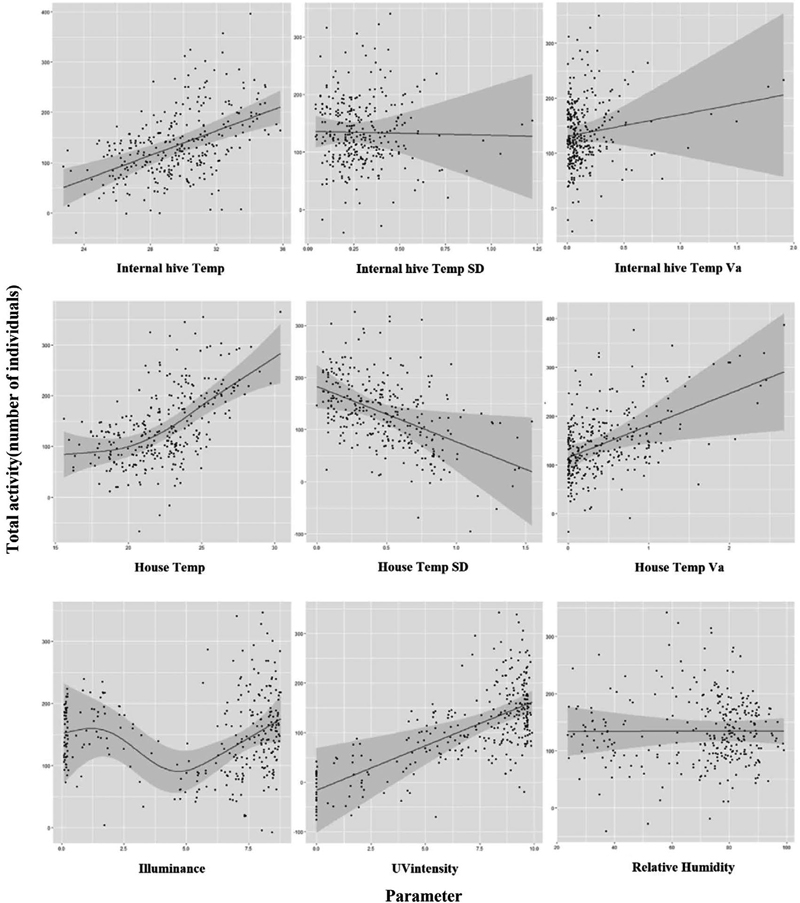
Multivariate effects of environmental factors on total activity under greenhouse conditions, estimated using the generalized additive mixed model. The plots illustrate the partial effects of each environmental variable on total activity while accounting for the simultaneous influence of other covariates in the model, rather than simple pairwise relationships. Scatter points represent observed values, and the blue curves depict fitted relationships, which may be linear (edf≈1) or nonlinear (edf>1) depending on the variable’s effect. The shaded grey areas indicate 95% confidence intervals for the fitted values. Model fit: AIC=3362.26; marginal R2=0.702; conditional R2=1.000.
Generalized additive mixed model for the effects of environmental factors on total activity in greenhouse conditions
하우스 내부 온도 표준편차 (p=0.0130)와 하우스 내부 온도 분산 (p=0.0226)은 유의미한 선형 관계를 나타냈다. 변수별 edf 분석에서 하우스 내부 평균온도 (edf=2.779)와 조도 (edf=3.917)는 비선형 패턴을 보였다. 하우스 내부 평균온도의 경우 20°C 이하에서는 활동량 변화가 크지 않았으나, 약 25°C를 기점으로 30°C까지 증가하는 경향을 보였다. 조도의 경우 약 2 log scale 지점에서 감소 경향을 보였으며, 이후 5 log scale 이상에서는 다시 증가하는 양상을 나타냈다. 반면, 하우스 내부 온도 표준편차, 하우스 내부 온도 분산, 자외선량, 벌통 내부 평균온도는 edf=1로 선형 관계에 가까웠다. 이 중 벌통 내부 평균온도, 자외선량 및 하우스 내부 온도 분산은 증가함에 따라 활동량이 증가하는 경향을 보였으나, 하우스 내부 온도 표준편차는 반대로 감소하는 경향을 보였다. 상대습도 (p=0.9872), 벌통 내부 온도 표준편차 (p=0.9015), 벌통 내부 온도 분산 (p=0.3506)은 양봉꿀벌 활동량과 유의한 관계를 보이지 않았다.
추가적으로, 변수를 표준화한 회귀분석을 통해 각 요인이 활동성에 미치는 상대적 영향력을 비교한 결과, 조도 (p<0.001), 하우스 온도 (p<0.001), 벌통 내부 온도(p<0.001) 및 자외선량 (p<0.001)이 양봉꿀벌의 활동량과의 유의미한 양의 관계를 나타났다 (Fig. 2, Table 3; Model fit: AIC=501.30, R2=0.714, Adjusted R2=0.705). 본 회귀모형은 활동량 변동의 약 71%를 설명하였으며, 이는 환경요인이 양봉꿀벌 활동성 변화에 높은 설명력을 가지는 것을 보여준다.
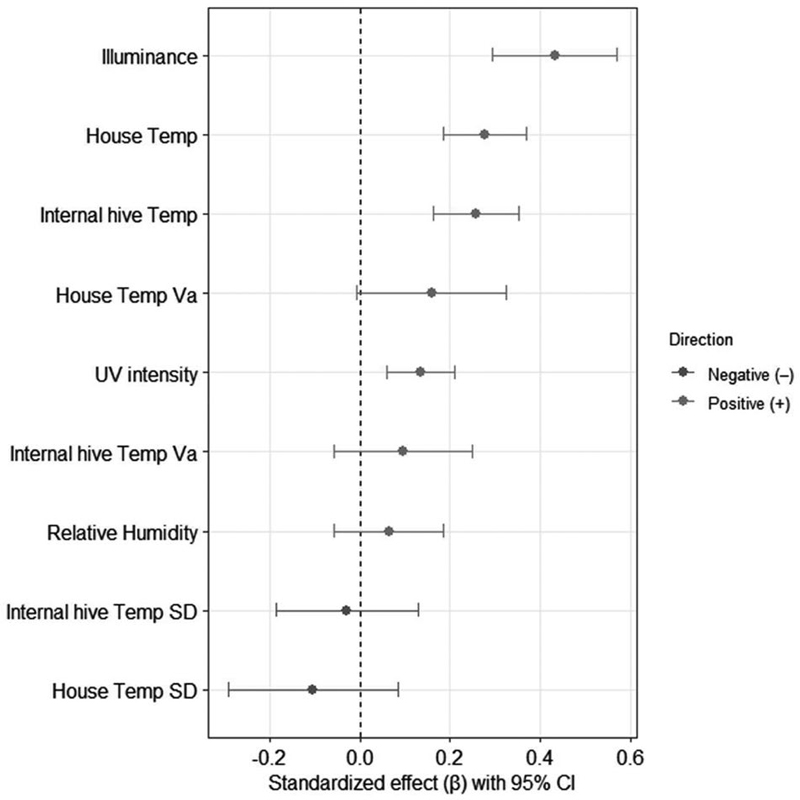
Standardized multivariate regression coefficients of environmental factors on total activity under greenhouse conditions, with 95% confidence intervals. Orange bars represent a positive relationship between total activity and the corresponding environmental variable, while blue bars represent a negative relationship. Model fit: AIC=501.30, R²=0.714, Adjusted R²=0.705.
Standardized multivariate regression coefficients of environmental factors influencing total activity under greenhouse conditions
2. 시간대별 양봉꿀벌의 총활동량
7시부터 18시까지의 양봉꿀벌의 소문 입출입을 통해 활동량을 관찰한 결과, 시간대에 따른 활동량 차이는 통계적으로 유의하게 나타났다 (p<0.05) (Table 4). 오전 7시에는 평균 8.16±18.1마리로 가장 낮은 수준에서 활동을 시작하였으며, 이후 점차 활동량이 증가하여 12시 (250±126마리)와 13시 (270±109마리)에 가장 높은 활동량을 보이며 다른 시간대와 뚜렷하게 유의한 차이를 보였다 (p<0.05). 14시 이후에는 점차 감소하여 17시에는 27.7±27마리 수준으로 급격히 줄었고, 18시에는 활동이 관찰되지 않았다. 모형 적합 결과에서도 이러한 경향이 확인되었으며, 활동량은 정오 전후에 정점을 이루고 이후 감소하는 종형 패턴을 보였다 (Fig. 3; Model fit: AIC=10267.58; marginal R2=0.467; conditional R2=0.935). 시간만으로는 활동성 변화의 46.7%를 설명하였으나, 날짜를 함께 고려했을 때는 전체 변동의 93.5%를 설명할 수 있었다.
Total activity of Apis mellifera by observation time from 20 December 2019 to 14 January 2020
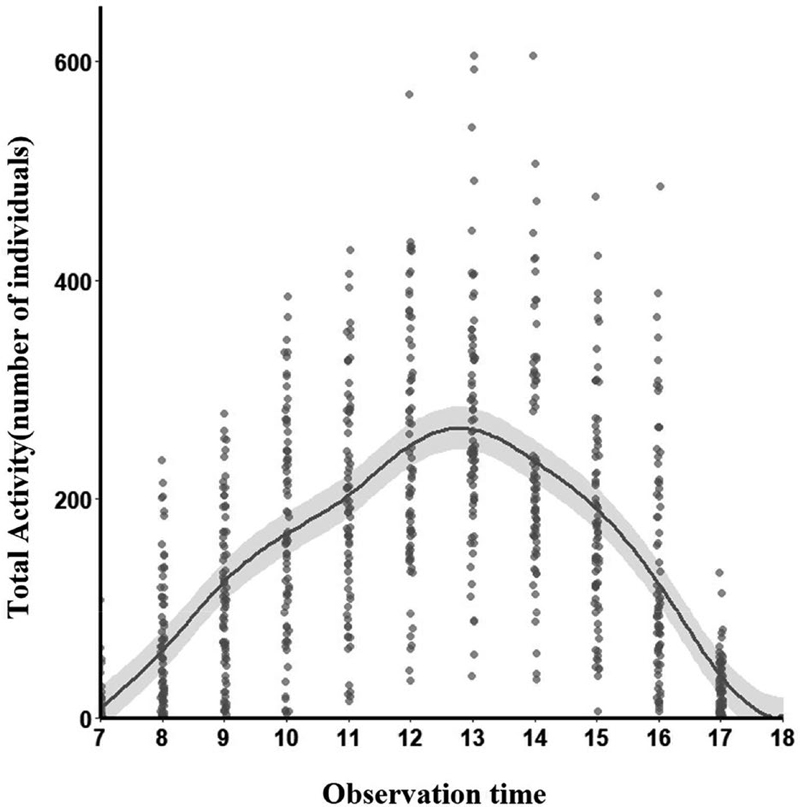
Variation in total activity by observation time in three greenhouses from 20 December 2019 to 14 January 2020. Total activity was defined as the sum of bee ingress and egress at hive entrances per hour. Data were recorded hourly for each greenhouse. Shaded areas represent 95% confidence intervals. Model fit: AIC=10267.58; marginal R²=0.467; conditional R²=0.935.
3. 주수별 화분매개 활동량 및 착과율 비교
하우스별 화분매개 활동량은 40주 처리구에서 평균 3.02±3.01회로 가장 높았으며, 50주 처리구 (1.67±0.80회)와 60주 처리구 (1.85±2.48회)는 유사한 수준을 보였다. 통계 분석 결과, 40주 처리구의 화분매개 활동량은 50주 처리구와 60주 처리구보다 유의하게 높았으며 (p<0.05), 50주 처리구와 60주 처리구 간에는 유의한 차이가 없었다 (p>0.05) (Fig. 4, Table 5). 착과율은 40주 처리구에서 평균 75.0±27.7%로 가장 높았고, 50주 처리구 (57.8±26.0%)와 60주 처리구 (58.0±26.7%)는 유사한 수준을 나타냈다 (Fig. 5, Table 5). 통계적으로도 40주 처리구가 다른 두 하우스에 비해 유의하게 높은 착과율을 보였으며 (p<0.05), 50주 처리구와 60주 처리구 간의 차이는 유의하지 않았다 (p>0.05). 본 연구에서는 화분매개 활동량과 착과율이 모두 40주 처리구에서 다른 하우스보다 높게 나타나, 동일한 양봉꿀벌을 투입했을 때 식재량이 적을수록 나무당 평균 방문수가 증가하여 생산성 향상으로 이어질 가능성을 시사한다.
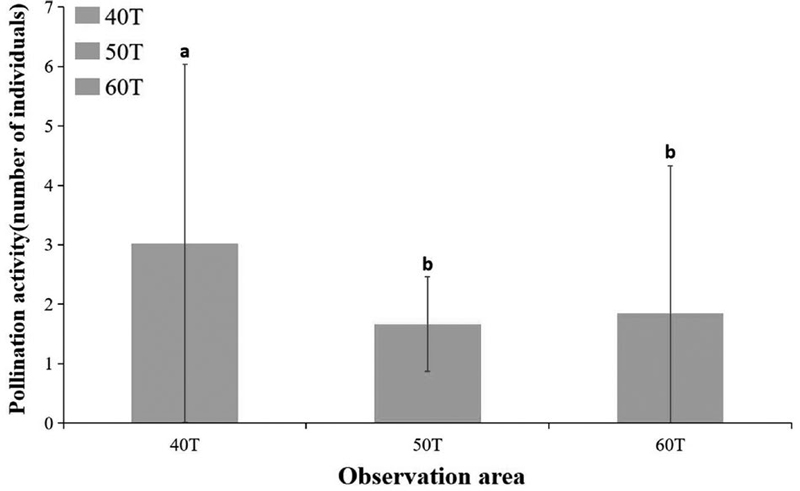
Comparison of mean Apis mellifera pollination activity per tree across treatments in Mangifera indica L. cv. Irwin. Oneway ANOVA indicated significant differences among observation areas, and Tukey’s HSD test was used for post hoc comparisons. Different letters above the bars indicate groups that are significantly different (p<0.05). Bars represent mean values, and error bars indicate standard deviations. 40T: 40 trees per hive treatment; 50T: 50 trees per hive treatment; 60T: 60 trees per hive treatment.
Pollination activity, and fruit set rate of Apis mellifera in three greenhouses
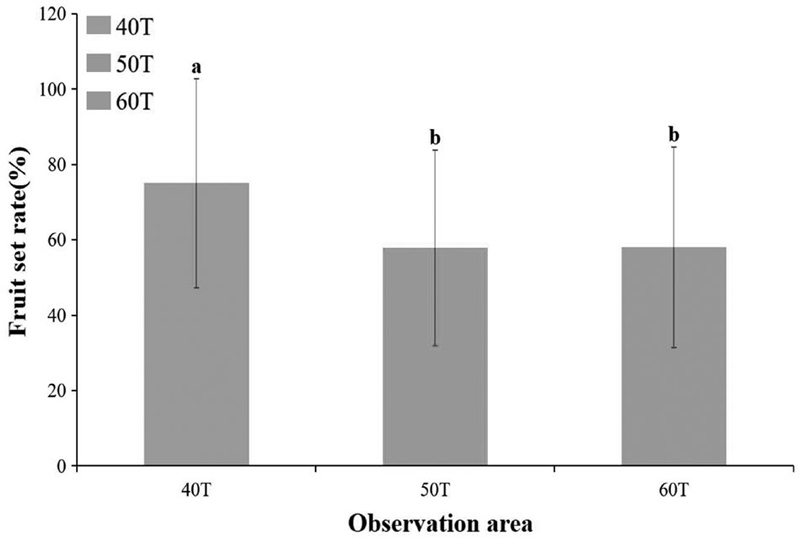
Comparison of mean fruit set rate per branch across treatments in Mangifera indica L. cv. Irwin. One-way ANOVA indicated significant differences among observation areas, and Tukey’s HSD test was used for post hoc comparisons. Different letters above the bars indicate groups that are significantly different (p<0.05). Bars represent mean values, and error bars indicate standard deviations. 40T: 40 trees per hive treatment; 50T: 50 trees per hive treatment; 60T: 60 trees per hive treatment. Fruit set rate was calculated as (fruits set on a branch ÷ treatment-specific branch set capacity) ×100% (conditions: branch set capacity 40T: 3 fruits, 50T: 4 fruits, 60T: 10 fruits; fruit counted as set at diameter ≥5 cm).
고 찰
본 연구의 결과에서 양봉꿀벌의 활동량은 조도, 자외선량, 온도, 봉군 내부 온도 간에는 높은 상관성이 나타났다. 이는 일중 시간대 변화에 따라 조도가 상승하면 자외선량과 하우스 내부 온도가 동반 상승하고, 그 결과 봉군 내부 온도 역시 함께 변화하여 단일 요인보다는 복합적인 환경 패턴이 활동성에 영향을 준 것으로 추정된다. 이는 노지 조건에서 수행된 선행연구 (Mattos et al., 2018; Czekońska et al., 2023)에서 보고된 바와 같이 온도와 일조량 및 일조시간의 증가가 양봉꿀벌 활동을 촉진한다는 결과와 유사한 경향을 보인다. 특히, 본 연구에서 관찰된 양봉꿀벌 활동성과 온도의 관계는 Giovanetti et al. (2022)이 노지 조건에서 보고한 결과와도 일치한다. 이들은 온도가 약 20~25°C 구간에서 상승할 때 꽃 방문률이 증가한다고 하였으며, 본 연구에서도 활동량이 20°C 전후부터 증가하기 시작하여 25°C 이상에서 뚜렷한 증가세를 보였다. 그러나 이러한 패턴적 일관성이 확인되었음에도 불구하고, 시설하우스 환경은 보온 효과와 온·습도의 상대적 안정성이 존재하므로 양봉꿀벌 활동에 미치는 환경요인의 작용 양상은 노지와 완전히 동일하지 않기 때문에 활동량의 범위와 시간적 변화 양상에서 차이가 발생할 수 있다. 국내 동일 시기의 시설재배 연구와 비교하면, 망고, 파프리카, 수박 및 딸기를 대상으로 시설하우스 내 화분매개 활동이 조사된 바 있다 (Lee et al., 2008; Park et al., 2014; Lee et al., 2018, 2020). 선행연구 결과에 따르면, 양봉꿀벌의 활동은 온도, 조도 및 자외선과 유의한 양의 상관관계를 보였으나, 작물별 활동 패턴에는 차이가 존재하였다. 그 결과, 파프리카 (24.2마리), 망고 (211마리) 및 딸기 (약 350마리)에서는 오후 13시경에 최고 활동량을 보였으며 이후 활동량이 감소하였는데, 이는 본 연구에서 확인된 13시 (270±109마리)에서 가장 높은 활동량을 보여주며 감소하는 경향과 유사하였다. 반면, 수박은 오전 10시경에 113.3±1.9마리로 최고치를 기록하였고, 이후 활동량이 감소하는 경향을 보였다. 이러한 차이는 하우스의 측창 개폐 및 환기 방식, 내부 온·습도 관리와 같은 미세 환경 요인과 맞물려 양봉꿀벌의 활동 패턴을 달리 형성하는 것으로 추정된다. 따라서 동일한 계절 및 시기에 실험하더라도 작물의 생장 특성 및 재배 관리 조건에 따라 양봉꿀벌의 활동성은 변동될 수 있으며, 온도, 습도, 조도, 자외선량 등 다양한 환경 요인과 함께 주변 경관, 병해충 발생 여부 등이 복합적으로 작용할 가능성을 보여준다. 이러한 점에서 양봉꿀벌의 화분매개 효율을 높이기 위해서는 개별 요인뿐만 아니라 이들 간의 상호작용 구조를 함께 고려해야 할 것이다. 특히, 본 연구와 같이 시설하우스라는 한정된 공간에서는 환경 요인을 일정 부분 제어·관리할 수 있으므로, 노지 환경에서보다 더 안정적으로 양봉꿀벌의 화분매개와 활동성 유지·향상을 위한 관리 방안을 수립할 수 있을 것으로 사료된다.
또한, 3동의 시설하우스의 식재 밀도 비교에서는 40주 처리구에서 화분매개 활동량, 착과율이 모두 유의하게 높았다. 동일한 시간대별 활동 패턴을 공유했음에도 불구하고 처리구 간 차이가 나타난 것은, 같은 봉군 수가 투입되었을 때 낮은 식재 밀도일수록 꽃 자원 접근성이 향상되고 개체 간 간섭이 줄어들어 나무당 방문 효율이 증가했기 때문으로 사료된다. Essenberg (2013)의 연구에 따르면, 꽃 밀도와 배치가 양봉꿀벌의 탐색 경로와 에너지 비용에 직접적으로 영향을 주어, 낮은 식재 밀도에서 꽃의 방문 빈도 및 꽃 간 이동거리가 짧아져 방문율이 증가할 수 있다고 보고하였다. Cao et al. (2023)은 딸기 온실에서 양봉꿀벌의 밀도가 약 9,000마리 (식물당 1마리)를 초과할 경우 과실 품질이 유의하게 개선되지 않는 포화 효과가 나타난다고 보고하였다. Rollin and Garibaldi (2019)는 다양한 농작물을 대상으로 한 메타분석을 통해 양봉꿀벌 방문률이 증가할수록 수분 성공률과 생산성이 향상되지만, 일정 수준 (8~10회) 이상에서는 한계 효과가 나타나며 꽃당 방문 횟수가 약 22회를 초과할 경우 과다방문 시 오히려 부정적 영향을 줄 수 있음을 제시하였다. 따라서 본 연구 결과는 이러한 선행연구들과 맥을 같이하며, 낮은 식재 밀도가 망고 시설재배에서 화분매개 효율을 향상시킬 수 있는 잠재적 조건임을 시사하며, 식재 밀도의 차이가 양봉꿀벌 탐색 행동과 활동성에 직접적으로 작용하여 수분 효율과 착과율 변동에 중요한 영향을 미칠 수 있음을 뒷받침한다.
이러한 결과를 종합하면, 조도, 자외선량, 하우스 내부 온도, 봉군 내부 온도가 양봉꿀벌의 활동량에 밀접한 영향을 주는 것으로 확인되었다. 본 연구는 국내의 내륙 시설재배 망고에서 처음으로 식재 밀도에 따른 양봉꿀벌의 활동성과 화분매개 효율을 체계적으로 분석하였다는 점에서 의의가 크다. 특히 동일한 봉군 수 조건에서 40주 처리구에서 화분매개 활동과 착과율이 가장 높았다는 결과는, 낮은 식재 밀도가 꽃 자원 접근성을 높이고 개체 간 간섭을 줄여 수분 효율을 향상시킨다는 점을 실험적으로 뒷받침한다. 다만 이번 실험은 처리구당 단일 하우스에서만 수행되어 반복성이 부족하고, 조사 표본 수도 제한적이어서 40주 처리구를 최적 밀도로 단정하기에는 한계가 있다. 또한 화분매개 활동과 착과율 조사가 동일 개체에서 이루어지지 않아 두 변수 간 직접적 상관성을 입증하지 못했다는 점도 보완이 요구된다. 따라서 향후 연구에서는 반복수와 표본 수를 확대하고, 동일 개체에서 활동량과 착과율을 동시 조사하는 방식으로 상관성을 명확히 규명해야 한다. 더 나아가 본 연구 결과가 농가 현장에서 실제로 활용되기 위해서는 경제성 분석과 과실 품질 평가를 병행하여 최적 식재 밀도와 봉군 수를 제시해야 하며, 작형별 (조기·보통·후기가온형) 환경 특성과 계절·시설 조건을 포함한 다양한 조합을 검증하는 것이 바람직 하다. 이를 통해 시설 망고 재배에서 꿀벌의 화분매개 효율과 착과율을 극대화할 수 있는 과학적 기준과 봉군 관리 지침을 마련할 수 있을 것이다.
적 요
국내 시설재배 망고에서 양봉꿀벌의 활동성에 영향을 미치는 환경 요인과 식재 밀도 효과를 비교하였다. 양봉꿀벌의 활동량과 환경요인간의 GAMM 분석 결과, 하우스 내부 평균온도 (p<0.001), 벌통 내부 평균온도 (p<0.001), 조도 (p=0.0002), 자외선량 (p=0.0005)이 활동성과 유의한 양의 상관관계를 나타냈다. 양봉꿀벌의 시간대별 활동량은 오전 7시에 평균 8.2±18.1마리에서 시작하여 12시 (250±126마리)와 13시 (270±109마리)에 최고치를 보였고 이후 급격히 감소하여 18시 이후에는 활동이 관찰되지 않았다. 식재 밀도 비교에서 40주 처리구는 평균 화분매개 활동량 3.02±3.01회, 착과율 75.0±27.7%로, 50주 처리구 (57.8±26.0%)와 60주 처리구 (58.0±26.7%)보다 유의하게 높았다 (p<0.05). 이러한 결과를 종합하면, 국내 망고 시설재배에서 양봉꿀벌의 활동성과 화분매개 효율은 환경 요인과 식재 밀도의 상호작용에 의해 달라지며, 동일한 봉군 수 조건에서는 낮은 식재 밀도에서 수분 효율이 향상될 수 있음을 확인하였다.
Acknowledgments
본 연구는 2024년도 농촌진흥청 국립농업과학원 전문 연구원 과정 지원사업 및 농촌진흥청 연구사업 (주관과제 명: 주요 과채류에 대한 화분매개곤충 기술 적용 및 실증, 세부과제번호: RS2021-RD009627)을 수행하는 과정에서 얻은 결과를 바탕으로 작성되었습니다.
References
-
Alqarni, A. S., K. N. Ahmed, M. A. Hannan, G. K. Ghose and J. L. Munshi. 2017. Flies for the pollination of greenhouse mango (Mangifera indica L., Anacardiaceae) in the subtropical Iriomote Island, Japan. J. Asiat. Soc. Bangladesh, Sci. 43: 135-141.
[https://doi.org/10.3329/jasbs.v43i1.46252]

- Bang, K. W. 2022. Research Trend of Subtropical Crops due to Climate Change. J. Korean Soc. Food Sci. Nutr. 27: 20-26.
-
Bartomeus, I., S. G. Potts, I. Steffan-Dewenter, B. E. Vaissière, M. Wojciechowski, K. M. Krewenka, T. Tscheulin, S. P. M. Roberts, H. Szentgyörgyi, C. Westphal and R. Bommarco. 2014. Contribution of insect pollinators to crop yield and quality varies with agricultural intensification. PeerJ 2: e328.
[https://doi.org/10.7717/peerj.328]
-
Cao, Z., G. He, S. Mu and H. Qu. 2023. Effects of bee density and hive distribution on pollination efficiency for greenhouse strawberries: A simulation study. Agronomy 13: 731.
[https://doi.org/10.3390/agronomy13030731]
-
Czekońska, K., S. Łopuch and S. Miścicki. 2023. The effect of meteorological and environmental variables on food collection by honey bees (Apis mellifera). Ecol. Indic. 156: 111140.
[https://doi.org/10.1016/j.ecolind.2023.111140]
-
Essenberg, C. J. 2013. Explaining the effects of floral density on flower visitor species composition. Am. Nat. 181: 35-50.
[https://doi.org/10.1086/669157]
- Fajardo, A. C., R. J. Medina, O. S. Opina and C. R. Cervancia. 2008. Insect pollinators and floral visitors of mango (Mangifera indica L. cv. Carabao). Philipp. Agric. Sci. 91: 372-382.
-
Giovanetti, M., S. Malabusini, M. Zugno and D. Lupi. 2022. Influence of flowering characteristics, local environment, and daily temperature on the visits paid by Apis mellifera to the exotic crop Phacelia tanacetifolia. Sustainability 14: 10186.
[https://doi.org/10.3390/su141610186]
-
Huda, A. N., M. R. Che Salmah, A. Hassan, A. Hamdan and M. N. Abdul Razak. 2015. Pollination services of mango flower pollinators. J. Insect Sci. 15: 113.
[https://doi.org/10.1093/jisesa/iev090]
- Intergovernmental Science-Policy Platform on Biodiversity and Ecosystem Services (IPBES). 2016. Summary for policymakers of the assessment report of the intergovernmental science-policy platform on biodiversity and ecosystem services on pollinators, pollination and food production. IPBES. (deliverable 3(a)) of the 2014-2018 work programme.
- Jeon, S. J., J. H. Park, S. C. Kim, E. Y. Song, J. H. Choi, K. S. Choi, C. K. Lim and M. S. Kim. 2013. Guide book of agricul tural technology for mango 177. Rural Development Administration (RDA) 177: 125-126.
-
Jeong, U. S. and S. S. Kim. 2021. Economic Evaluations of Facility Farms by the Introduction of Mango Ultra-High Density Pot Cultivation. JKAIS 21: 279-290.
[https://doi.org/10.5762/KAIS.2021.22.3.279]
-
Jung, D. H., Y. Y. Cho, J. G. Lee and J. E. Son. 2016. Estimation of leaf area, leaf fresh weight, and leaf dry weight of Irwin mango grown in greenhouse using leaf length, leaf width, petiole length, and SPAD value. J. Bio. Env. Con. 25: 146-152.
[https://doi.org/10.12791/KSBEC.2016.25.3.146]
- Kiill, L. H. P. and K. M. S. Medeiros. 2006. Diagnóstico de polinizadores no Vale do São Francisco: estratégias de manejo de polinizadores de fruteiras no Submédio do Vale do São Francisco. Petrolina: Embrapa Semiárido; PROBIO. CD-ROM.
-
Kim, C. Y., Y. H. Kim, S. H. Han and H. C. Ko. 2019. Current Situations and Prospects on the Cultivation Program of Tropical and Subtropical Crops in Korea. Korean J. Plant Res. 32: 45-52.
[https://doi.org/10.7732/kjpr.2019.32.1.045]
-
Kim, H., M. Son, D. H. Lee, S. H. Min, B. S. Park, S. J. Lee, S. B. Kim, K. W. Kwak, Y. B. Lee and K. Y. Lee. 2024. Pollination Effect of Bumblebee (Bombus terrestris L.) with a Ventilation System in High-Temperature Greenhouse Cultivation of Cherry Tomatoes. J. Apicult. 39: 209-216.
[https://doi.org/10.17519/apiculture.2024.09.39.3.209]
- Kim, J. Y. 2021. The effect of climate change on the diversification of fruit production in Jeju Island. Master's Thesis. Department of Agricultural Economics, Jeju National University, Korea.
-
Ku, H. B., K. M. Park, M. G. Cheon, S. W. Choi and G. N. Kim. 2023. Whitening effect of thinned immature apple mango (Mangifera indica L. Irwin) extract. Asian J. Beauty Cosmetol. 21: 675-685.
[https://doi.org/10.20402/ajbc.2023.0089]
- Lee, K. S. 2014. Effects of climate change on the crops growing environment. Master’s Thesis. Department of Agricultural Development, Graduate School of Industry Technology, Chonnam National University, Korea.
-
Lee, K. Y., J. Lim, H. J. Yoon and H. J. Ko. 2018. Effect of climatic conditions on pollination behavior of honeybees (Apis mellifera L.) in the greenhouse cultivation of watermelon (Citrullus lanatus L.). J. Apicult. 33: 239-250.
[https://doi.org/10.17519/apiculture.2018.11.33.4.239]
-
Lee, K. Y., S. Choi, J. Lee and H. J. Yoon. 2020. Development of imaging-based honeybee traffic measurement system and its application to crop pollination. J. Apicult. 35: 233-243.
[https://doi.org/10.17519/apiculture.2020.11.35.4.233]
-
Lee, S. B., N. G. Ha, H. J. Yoon, I. G. Park, K. Y. Lee, H. S. Kang and S. J. Hwang. 2008. Effect on the pollinating activities of honeybee, Apis mellifera L. (Hymenoptera: Apidae) and bumblebee, Bombus terrestris L. in paprika vinyl-houses. Korean J. Appl. Entomol. 47: 293-298.
[https://doi.org/10.5656/KSAE.2008.47.3.293]
-
Mattos, I. M. de, J. Souza and A. E. E. Soares. 2018. Analysis of the effects of climate variables on Apis mellifera pollen foraging performance. Arquivo Brasileiro de Medicina Veterinária e Zootecnia 70: 1301-1308.
[https://doi.org/10.1590/1678-4162-9373]
- Ministry of Agriculture, Food and Rural Affairs (MAFRA). 2025. Farm Business Registration Information Status Service: Crop cultivation status-by item. https://uni.agrix.go.kr/docs7/biOlap/fixType.do?reportId=eqpt_oudor_item, Accessed 9 Jun. 2025.
-
Nakagawa, S. and H. Schielzeth. 2013. A general and simple method for obtaining R2 from generalized linear mixed-effects models. Methods Ecol. Evol. 4: 133-142.
[https://doi.org/10.1111/j.2041-210x.2012.00261.x]
-
National Institute of Horticultural and Herbal Science (NIHHS). 2014. Collection, evaluation and cultural measure on subtropical fruit trees in subtropical region. Rural Development Administration (RDA).
[https://doi.org/10.23000/TRKO201400011007]
-
Park, I. G., H. J. Yoon, M. A. Kim, K. Y. Lee, H. C. Park and S. H. Kim. 2014. Effect on pollinating activities on mango flower by bumblebee (Bombus terrestris), honeybee (Apis mellifera) and oriental latrine fly (Chrysomyia megacephala) in green house. J. Apicult. 29: 235-243.
[https://doi.org/10.17519/apiculture.2014.11.29.4.235]
-
Potts, S. G., J. C. Biesmeijer, C. Kremen, P. Neumann, O. Schweiger and W. E. Kunin. 2010. Global pollinator declines: trends, impacts and drivers. Trends Ecol. Evol. 25: 345-353.
[https://doi.org/10.1016/j.tree.2010.01.007]
-
Rollin, O. and L. A. Garibaldi. 2019. Impacts of honeybee density on crop yield: A meta-analysis. J. Appl. Ecol. 56: 1152-1163.
[https://doi.org/10.1111/1365-2664.13355]