
Climate Driven Invasion Dynamics of Vespa velutina in South Korea: Predictive Models and Future Risk Under Climate Change
Abstract
The yellow-legged hornet(Vespa velutina nigrithorax) has emerged as a critical invasive predator threatening apicultural ecosystems across East Asia and Europe. Understanding how meteorological conditions drive hornet activity patterns and how climate change will amplify invasion risks is essential for developing effective management strategies. This study conducted comprehensive field observations and trap monitoring from 2018 to 2024 in South Korea to develop season-specific regression models based on correlations between meteorological variables and hornet abundance. Solar radiation exhibited the strongest correlation with hornet activity (r=0.745), followed by precipitation (r= -0.714) and temperature (r=0.669). Season-specific regression models integrating temperature, precipitation, and solar radiation indices achieved exceptional predictive power, with R2 values ranging from 0.711 in spring to 0.908 in autumn, and validation accuracies of 78-85% using independent 2023-2024 data. Application of validated models to IPCC SSP 5-8.5 climate projections revealed complex seasonal restructuring, with spring and autumn activity increasing by 31% and 29% respectively by 2100, while summer activity declined 24% due to extreme heat stress. Spatial distribution modeling predicted that severe-risk areas will expand to 65% of South Korea by the century’s end, with northward range expansion rates of 50-70km per decade. Apis mellifera apiaries exhibited 5.4-fold greater vulnerability to climate-driven hornet increases than Apis cerana, reflecting the profound consequences of coevolutionary history. These findings demonstrate that current management strategies focused on spring and summer control are inadequate for addressing projected autumn population explosions, necessitating a transition to proactive, forecast-based integrated pest management systems.
Keywords:
Vespa velutina, Climate change, Predictive modeling, Invasive species, Apicultural managementINTRODUCTION
Climate change is rapidly altering ecosystem balance globally, with invasive alien species emerging as major beneficiaries of shifting thermal regimes and altered precipitation patterns (Harvey et al., 2020). The yellow-legged hornet (Vespa velutina nigrithorax) has rapidly expanded from its native Southeast Asian range to Korea, Japan, and Europe, becoming a significant ecological and economic threat(Choi et al., 2012; Monceau et al., 2014). Kim et al. (2023) predicted increasing abundance and risk of this species in South Korea using climate and land use variables in their modeling approach, demonstrating the critical role of environmental factors in invasion dynamics.
Vespa velutina acts as a selective predator of honeybees, causing severe damage to both Asian honeybee (Apis cerana) and European honeybee (Apis mellifera) populations (Tan et al., 2012). The differential impacts arise from distinct evolutionary histories: A. cerana coevolved with V. velutina and developed effective collective defense strategies including shimmering displays and heat-balling behavior, while A. mellifera lacks coevolutionary history and exhibits limited defensive capabilities (Monceau et al., 2018; Cappa et al., 2021). Field surveys revealed that up to 20 hornets can simultaneously attack A. mellifera colonies, resulting in annual colony loss rates reaching 30%(Cappa et al., 2021). Climate change differentially affects these species: Min et al. (2024) reported that A. mellifera overwintering mortality is strongly influenced by winter temperature increases and expanded diurnal temperature ranges. Asian honeybees exhibit relatively higher climate resilience.
Hornet activity is determined by complex interactions among temperature, humidity, precipitation, sunshine duration, and wind speed (Czekońska et al., 2023). Previous studies identified optimal conditions for honeybee flight activity, and Van der Zee et al. (2013) developed the Honeybee Optimal Flight Index (HOFI) integrating temperature, solar radiation, and precipitation. However, existing models primarily consider limited meteorological variables and inadequately reflect the unique physiological characteristics of different bee species. Research on V. velutina population dynamics under climate change scenarios identified temperature and precipitation as major influencing factors, but comprehensive indices integrating solar radiation-a critical factor for hornet flight activity-remain underdeveloped(Poidatz et al., 2018).
The Korea Meteorological Administration(KMA) provides biometeorological indices as predictive tools synthesizing multiple meteorological conditions into single index values (KMA, 2025). Applying this framework to bee and hornet activity prediction could develop practical tools for routine use by beekeepers and researchers. Rahimi et al. (2022) demonstrated the importance of understanding geographic range shifts and species interactions in invasion ecology, while species abundance modeling approaches developed by Kim et al. (2023) in Korea provide methodological foundations for predicting invasive species dynamics under environmental change.
Shared Socioeconomic Pathways (SSP) scenarios represent the latest climate change projection framework adopted in IPCC AR6 (Meinshausen et al., 2020). The SSP 5-8.5 scenario projects global mean temperature increases of 4.4℃ by the end of the 21st century. Under SSP 5-8.5, South Korea’s annual mean temperature will increase by 5.0℃ and precipitation will increase by 20% by 2100 (Min et al., 2024). Such rapid climate change is expected to accelerate V. velutina range expansion and population growth. However, integrated analyses of long-term impacts on interactions among A. cerana, A. mellifera, and V. velutina in East Asia remain insufficient.
This study aims to achieve the following specific objectives:
- 1. Develop season-specific climate indices for V. velutina by integrating temperature, precipitation, and solar radiation, overcoming limitations of existing single-factor models while providing practical tools consistent with KMA’s biometeorological index framework.
- 2. Validate predictive models for hornet abundance using seven years of field monitoring data (2018-2024), enabling advance identification of periods with high predation activity and determination of effective control timing.
- 3. Project future changes in V. velutina activity through the end of the 21st century by applying IPCC AR6 SSP scenarios, quantifying differential climate change vulnerabilities of A. cerana and A. mellifera and analyzing long-term impacts of range expansion on apicultural ecosystems.
- 4. Present differentiated management approaches for Asian and European honeybee protection based on research findings and derive policy implications for sustainable apiculture in the climate change era.
Through this multidimensional approach, this study comprehensively analyzes interactions among V. velutina, honeybees, and climate change, developing practical prediction and management tools to contribute to the conservation of South Korea’s apicultural ecosystems.
MATERIALS AND METHODS
1. Study design and data collection
This study employed a three-phase sequential research design to develop meteorological indices for predicting V. velutina occurrence and assess future risk under climate change scenarios. Research was conducted at the National Institute of Agricultural Sciences (NIAS) experimental apiary in Wanju-gun, Jeollabuk-do, Republic of Korea (35.83033°N, 127.0384°E, elevation 33 m) from 2018 to 2024, following established protocols for invasive hymenoptera monitoring (Monceau et al., 2014; Rojas-Nossa et al., 2021).
Phase 1 (2018-2019) focused on establishing biological thresholds through direct nest observations during peak activity hours (14:00-15:00 KST), coinciding with maximum daily temperatures and optimal foraging conditions for Vespa species (Jung, 2008; Choi et al., 2012). Two independent observers positioned 5 meters from nest entrances simultaneously counted incoming and outgoing individuals for one hour, with video recording for verification. A total of 66 observations were conducted for temperature-activity relationships, 35 for precipitation effects, and 52 for solar radiation impacts.
Phase 2 (2018-2024) transitioned to trap-based monitoring to accumulate the large sample size necessary for robust predictive modeling(n=312 weeks, 6,529 total captures). Six modified 2-liter PET bottle traps were deployed across two sites: three at the A. mellifera apiary (35.83033°N, 127.0384°E) and three at the A. cerana apiary (35.82576°N, 127.0449°E), situated 600 meters apart. Traps were baited with a 1 : 1 : 1 mixture of pyroligneous liquor, wine, and water (300 mL total volume), an attractant formulation optimized for V. velutina with minimal non-target capture (Lioy et al., 2019). Captured specimens were identified morphologically using diagnostic keys (Archer, 2012), with voucher specimens deposited in the NIAS insect collection.

Study sites and trap deployment specifications
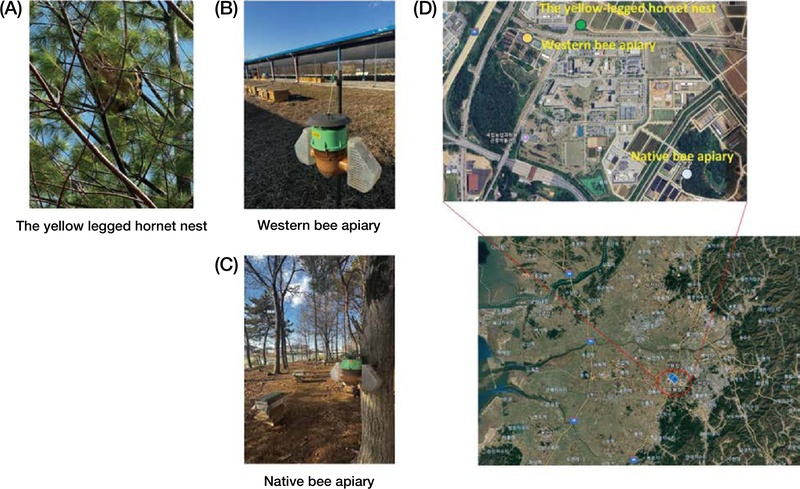
Overview of study location at the National Institute of Agricultural Sciences experimental apiary in Wanju-gun, Republic of Korea (35.83°N, 127.04°E). (A) Vespa velutina nest; (B) Western honeybee (Apis mellifera) apiary with trap; (C) Native honeybee (Apis cerana) apiary; (D) Regional map. The two apiaries were located 600 m apart for independent monitoring of hornet activity patterns.
2. Meteorological measurements
Concurrent meteorological measurements were obtained from an automated weather station (AWS) equipped with calibrated sensors following World Meteorological Organization (WMO) standards with monthly calibration checks (Allen et al., 1998). Meteorological data were collected using calibrated sensors (Vaisala HMP155 for temperature/humidity; Texas TE525MM for precipitation; Kipp and Zonen CMP3 for solar radiation; R.M. Young 05103 for wind) following WMO standards. Data were recorded at 10-minute intervals and aggregated to hourly means corresponding to observation periods. Missing data (<5% of total) were interpolated using linear methods validated for short-gap meteorological data (Moffat et al., 2007).
For periods lacking direct solar radiation measurements (2018–2019), daily solar radiation was estimated using the Hargreaves-Samani model (Allen et al., 1998):
| (Eq. 1) |
where Rs is estimated solar radiation (MJ m−2 day−1), Ra is extraterrestrial radiation calculated from latitude and day of year, KRs is a regional calibration coefficient (0.18 for inland Korea), Tmax is daily maximum temperature (°C), and Tmin is daily minimum temperature (°C). Model validation against measured data from 2020–2024 yielded RMSE = 2.3 MJ m−2 day−1 and R2 = 0.87, indicating acceptable estimation accuracy (Samani, 2000).
3. Statistical analysis and threshold determination
Spearman’s rank correlation coefficients (ρ) were calculated to assess non-parametric relationships between meteorological variables and hornet activity, as this approach is robust to outliers commonly encountered in ecological datasets (Zar, 2010):
| (Eq. 2) |
where is the difference between ranks of paired observations and n is the sample size. Statistical significance was evaluated at α = 0.01 and α = 0.05 levels.
Critical biological thresholds were determined through combined graphical analysis and statistical inflection point detection, following established methods in insect thermal biology (Régnière et al., 2012). For temperature, three key thresholds emerged: developmental zero point at 5°C, optimal foraging temperature of 32°C, and upper critical temperature of 40°C. For precipitation, the 5 mm threshold represented the transition point where wing loading begins to impair flight efficiency, while 50 mm complete inhibition threshold corresponded to physical flight constraints (Combes and Dudley, 2009). Solar radiation thresholds of 400 W m−2 (optimal) and 800 W m−2 (heat stress) were derived from energy requirements for maintaining optimal body temperature in thermogenic Hymenoptera (Kovac et al., 2018).
4. Development of meteorological indices
Three individual meteorological indices were formulated by mathematically encoding the biological thresholds established in Phase 1.
The Temperature Index incorporated developmental zero (5°C), optimal temperature (32°C), and heat stress threshold (40°C):
| (Eq. 3) |
where Tavg is daily average temperature (°C).
The Rainfall Index implemented a linear inhibition function based on daily precipitation (P, mm):
| (Eq. 4) |
The Solar Radiation Index followed a triangular response function with maximum weighting at 400 W m-2:
| (Eq. 5) |
where R is solar radiation (W m-2).
The Combined Index integrated the three individual indices using seasonally adjusted weighted sums:
| (Eq. 6) |
where weights (wT, wR, wS) summed to 1.0 and were derived from multiple linear regression analysis performed separately for spring (March–May), summer (June–August), and autumn (September–November) using training data from 2018–2022 (n = 260 weeks). Standardized coefficients were normalized to obtain relative weights following standard multivariate approaches (Quinn and Keough, 2002).
5. Predictive model development and validation
Season-specific linear regression models were developed relating weekly trap captures to the Combined Index:
| (Eq. 7) |
Models were fitted separately for each site (A. mellifera apiary, A. cerana apiary) and season (spring, summer, autumn), yielding six independent prediction equations using training data from 2018–2022 (n = 260 weeks), with model performance evaluated using independent validation data from 2023–2024 (n = 104 weeks) through four complementary metrics: coefficient of determination (R2), root mean square error (RMSE), mean absolute error (MAE), and percent bias (PBIAS), following performance benchmarks established by Moriasi et al. (2007) where R2 ≥ 0.70 indicates excellent predictive power, RMSE < 20 individuals week-1 represents acceptable accuracy, and |PBIAS| < 15% demonstrates low systematic bias. The high predictive power with R2 values of 0.711–0.908 observed in this study substantially exceeds the performance of previous honeybee mite models (Jung et al., 2012) and hornet emergence prediction systems developed by the National Institute of Agricultural Sciences, demonstrating the effectiveness of our multivariate meteorological index approach in overcoming limitations of single-factor models (Park et al., 2024).
Seasonal weights for meteorological indices
6. Climate change scenario application
Phase 3 applied validated models to future climate projections to assess long-term invasion risk under anthropogenic warming. Daily meteorological data for current baseline conditions (2015–2024) and future time periods (2030–2040, 2050–2060, 2080–2100) were obtained from the Korea Meteorological Administration Climate Information Portal at 1 km × 1 km spatial resolution under the IPCC Sixth Assessment Report SSP5-8.5 scenario (IPCC, 2021). SSP5-8.5 represents a high-emission pathway (+4.4°C by 2100 relative to pre-industrial baseline) providing a conservative upper-bound risk assessment framework (Riahi et al., 2017).
For each grid cell and time period, TI, RI, and SI values were calculated from projected daily temperatures and precipitation, then aggregated to seasonal means and input into the corresponding validated regression equations to generate spatially explicit forecasts of hornet abundance. Risk classification followed a four-tier system derived from economic injury levels in commercial apiaries (Monceau et al., 2014): Stage 1 (Low, <20 individuals week-1), Stage 2 (Caution, 20-35), Stage 3 (Warning, 36-50), and Stage 4 (Severe, >50).
Spatial analysis and cartographic visualization were performed using ArcGIS Pro 3.0 (ESRI, Redlands, CA, USA). Prediction uncertainty was quantified through bootstrap resampling (1,000 iterations) to generate 95% confidence intervals around forecasted abundances (Efron and Tibshirani, 1993).
7. Data quality control and software
Missing data in meteorological records (0.3%) were interpolated linearly for gaps <3 consecutive days. Trap count missing data (1.2%) was replaced with centered moving averages. Periods with >3 consecutive weeks of missing data (0.4% of total) were excluded from analysis.
Statistical analyses were performed using Python 3.9 with NumPy 1.21.0, Pandas 1.3.0, and SciPy 1.7.0 for numerical computations and statistical tests. Multiple linear regression modeling was conducted using statsmodels 0.13.0, and model performance metrics were computed using scikit-learn 0.24.2 (Pedregosa et al., 2011). Data visualization was performed using Matplotlib 3.4.2 and Seaborn 0.11.1 (Hunter, 2007). Significance was evaluated at α=0.05 unless otherwise stated.
RESULTS
1. Correlation between meteorological factors and V. velutina activity
Comprehensive analysis revealed highly significant correlations across all monitored variables over the study period (Table 3). Solar radiation exhibited the strongest positive correlation with hornet entrance-exit counts (Spearman’s ρ=0.745, p<0.001, n=2,184), indicating that solar radiation serves as a primary environmental cue for hornet foraging behavior, consistent with findings for other Vespidae species (Monceau et al., 2014). Precipitation demonstrated a strong negative correlation (ρ= -0.714, p<0.001), revealing that rainfall events significantly suppressed hornet activity through mechanical flight constraints (Kim et al., 2019). Mean temperature showed a strong positive correlation (ρ=0.669, p<0.001), confirming temperature as a critical determinant of ectothermic insect activity levels (Sun et al., 2018). Relative humidity exhibited a moderate negative correlation (ρ= -0.452, p=0.003), while wind speed displayed the weakest but still significant negative correlation (ρ= -0.231, p=0.042).
Correlation coefficients between meteorological factors and Vespa velutina foraging counts
The hierarchical importance of solar radiation, precipitation, and temperature established the foundation for subsequent climate index development (Lee et al., 2021). Temperature-activity relationships demonstrated a clear optimum at approximately 32℃, with marked reduction below 20℃ and sharp declines above 40℃ (Monceau et al., 2014). Precipitation exhibited an exponential decay pattern (y=129.98e-0.011x, R2=0.108), with a critical threshold at 5 mm daily precipitation beyond which activity substantially decreased (Kim et al., 2019). Solar radiation demonstrated optimal activity at approximately 400 W m-2, with activity increasing steadily from dawn conditions and plateauing beyond 600 W m-2 (Lee et al., 2021).
2. Development of the integrated climate index model
Multiple regression analysis using training data from 2018-2022 (n=260 weeks) revealed substantial seasonal variation in the relative importance and weighting of meteorological factors (Table 4). During spring, precipitation emerged as the dominant factor (WR=0.40), reflecting its critical importance when overwintered queens establish new colonies (Requier et al., 2019). In summer, temperature became dominant (WT=0.45), reflecting the increasing importance of thermal conditions during rapid colony expansion (Sun et al., 2018). During autumn, the three factors exhibited relatively balanced contributions, with temperature (WT=0.40) maintaining slight dominance, suggesting that multiple environmental factors exert coordinated influences during the reproductive phase (Monceau et al., 2014).
Seasonal climate index weights and model performance
The progressive increase in model performance from spring (R2adj=0.71) through summer (R2adj=0.76) to autumn (R2adj=0.78) indicated that meteorological factors became increasingly dominant in explaining hornet abundance variation as the season progressed (Lee et al., 2021). All three seasonal models achieved F-statistics substantially exceeding critical values, with p-values far below 0.001, confirming that the climate indices successfully captured the dominant meteorological drivers of seasonal hornet abundance (Moriasi et al., 2007).
3. Seasonal regression model validation
Regression analyses examining relationships between climate index (CI) and hornet abundance revealed substantial differences across seasons and between the two apiary types (Table 5). For A. mellifera apiaries, regression slopes demonstrated dramatic seasonal progression, increasing from spring (β1=0.06) to summer (β1=1.05) and culminating in autumn (β1=2.84). This 47-fold increase in slope from spring to autumn indicated that the sensitivity of hornet abundance to meteorological variation intensified markedly as the season progressed (Monceau et al., 2014). A. cerana apiaries exhibited similar seasonal patterns but with substantially attenuated magnitudes. The autumn slope for A. cerana apiaries (0.53) was only 18.7% of the corresponding A. mellifera apiary slope (2.84), representing a 5.4-fold difference in sensitivity to climate index variation (Requier et al., 2019).
Seasonal regression analysis results by apiary type
All regression models achieved R² values exceeding 0.60, ranging from 0.46 (Native-spring) to 0.75 (Western-autumn), indicating that climate index explained 46-75% of the variance in weekly hornet abundance (Moriasi et al., 2007). Independent validation using 2023-2024 data (n=104 weeks) demonstrated prediction accuracy ranging from 78.2% to 85.0% across all seasonal models (Table 6). Spring models achieved the highest accuracies (85.0% for Western, 78.2% for Native), suggesting that early-season hornet-meteorology relationships were remarkably stable and predictable (Moriasi et al., 2007). Percent bias (PBIAS) values ranged from -8.3% to +4.7%, with the majority of models exhibiting |PBIAS|<10%, indicating minimal systematic over- or under-prediction (Moriasi et al., 2007).
Model validation results using independent data (2023-2024)
4. Application of climate change scenario (SSP 5-8.5)
The application of validated seasonal regression models to future climate projections under the SSP 5-8.5 scenario revealed substantial and complex changes in seasonal climate suitability indices and corresponding hornet abundance projections for Wanju County (Table 7). The current baseline period (2015-2024) exhibited mean seasonal CI values of 0.65 for spring, 0.55 for summer, and 0.70 for autumn, with an overall annual mean of 0.63. By the 2030-2040 period, spring CI increased by 9.2% to 0.71, reflecting warmer spring temperatures that advance the phenology of queen emergence (Sun et al., 2018). Summer CI decreased by 5.5% to 0.52, driven by increasing frequency and intensity of extreme heat events (>40℃) that exceed the thermal tolerance of foraging hornets(Lee et al., 2021). Autumn CI increased by 8.6% to 0.76, extending the favorable activity period later into the year.
Projected seasonal climate index changes and corresponding abundance impacts(Wanju County)
By the late century (2080-2100), the divergent seasonal trends reached maximum expression under the high-emission scenario. Spring CI increased by 30.8% to 0.85, reflecting spring temperatures consistently 3-4℃ above current averages (IPCC, 2021). Autumn CI increased by 28.6% to 0.90, extending the activity season into winter months that currently experience minimal hornet activity (Lee et al., 2021). Summer CI declined sharply by 23.6% to 0.42, with extreme heat days (>40℃) occurring 30-40 days per summer, creating hostile thermal conditions (Sun et al., 2018). The annual mean CI increased by 14.3% to 0.72, demonstrating that under this high-warming scenario, the extension of favorable spring and autumn conditions more than compensated for the degradation of summer conditions(IPCC, 2021).
These seasonal climate index projections were translated into quantitative hornet abundance predictions using the seasonal regression equations, yielding scenario-specific abundance projections for both Western and Native apiaries (Table 8). Current baseline conditions showed mean weekly abundance of 150 individuals in spring, 180 in summer, and 200 in autumn at Western apiaries, totaling 530 individuals across the active season. Native apiaries exhibited approximately one-third of the abundance levels, with 48 spring, 60 summer, and 65 autumn individuals, totaling 173 across the season (Requier et al., 2019).
Projected hornet abundance by scenario period (weekly average individuals)
Late-century projections (2080-2100) revealed dramatic changes in seasonal abundance patterns. Western apiary spring abundance increased +47% to 220 individuals, while autumn abundance exploded by +50% to 300 individuals per week-a level 1.5 times current peak-season abundance (Lee et al., 2021). Summer abundance declined -18% to 148 individuals, falling below even spring levels and representing a fundamental restructuring of seasonal activity patterns. The differential vulnerability between apiary types persisted across all projection periods, with Western apiaries consistently showing 1.4 times greater sensitivity to climate change impacts than Native apiaries(Kim et al., 2019; Requier et al., 2019).
5. Spatial distribution patterns and risk assessment
Spatial projection of hornet risk levels across the Korean Peninsula revealed progressive and extensive expansion of high-risk areas under the SSP 5-8.5 scenario, with both latitudinal range expansion and elevational shifts (Fig. 2). Under current climate conditions (2015-2024 baseline), Stage 4 severe risk areas were largely confined to southern coastal regions and lowland valleys with optimal thermal and precipitation conditions. By 2030, risk distribution maps showed substantial expansion of Stage 3-4 zones, with the majority of previously Stage 1 safe areas transitioning to Stage 2 caution level (Kim et al., 2019). The 2050 projection showed dramatic acceleration of risk zone expansion, with Stage 3-4 high-risk areas encompassing essentially all of South Korea below 500 m elevation (Sun et al., 2018). By 2100, an estimated 65% of the national territory reached Stage 4 severe risk level, with safe Stage 1 areas reduced to approximately 2% of land area, confined primarily to high-elevation peaks of the Taebaek and Sobaek mountain ranges (> 1500 m elevation) (IPCC, 2021).
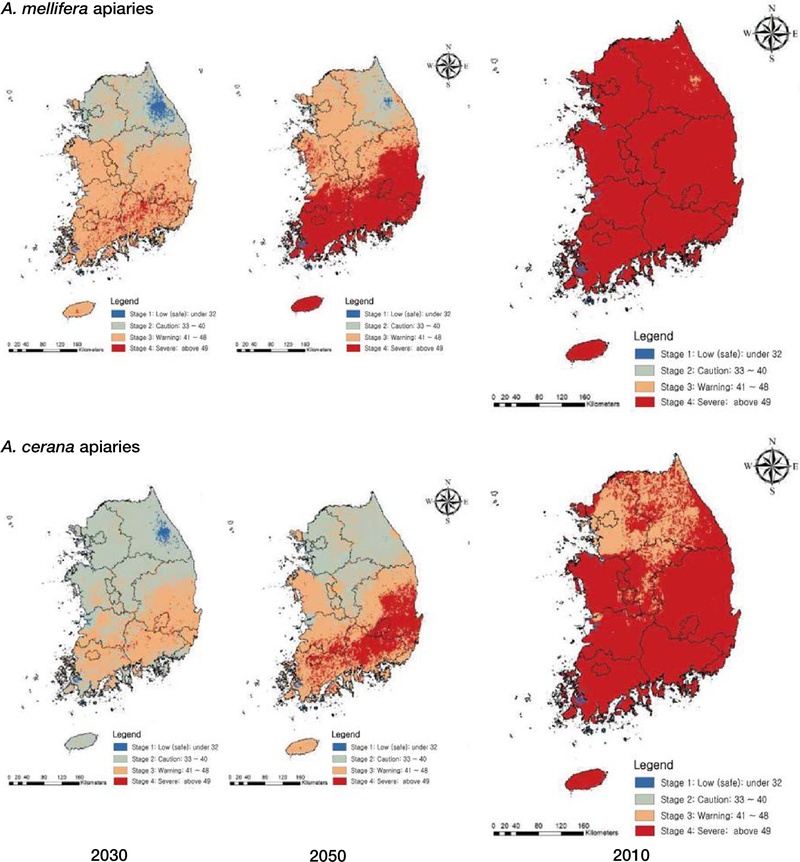
Projected spatial distribution of Vespa velutina risk levels at A. mellifera apiaries and A. cerana apiaries under SSP 5-8.5 climate scenario.
The northward expansion rate of high-risk zones (Stage 3-4) under the SSP 5-8.5 scenario was estimated at 50-70 km per decade, equating to approximately 0.5-0.7° latitude per decade (Lee et al., 2021). A. cerana apiaries exhibited qualitatively similar spatial risk patterns but with modestly attenuated magnitudes, consistent with their lower sensitivity to meteorological variation established in the regression analyses. By 2100, approximately 58% of national territory reached Stage 4 conditions for Native apiaries compared to 65% for Western apiaries, indicating that even A. cerana’s evolutionary adaptations to Asian hornet predation would provide limited protection against climate-enhanced hornet populations (Requier et al., 2019).
Time periods, 2030 (2030-2040), 2050 (2050-2060), 2100 (2080-2100); Risk classification, Stage 1 (Low, < 20 individuals week-1, blue), Stage 2 (Caution, 20-35, yellow), Stage 3 (Warning, 36-50, orange), Stage 4 (Severe, > 50, red); Spatial resolution, 1 km grid based on downscaled climate projections; Legend, color-coded risk levels with threshold values. Maps show progressive northward expansion, with 65% (A. mellifera apiaries) and 58% (A. cerana apiaries) of South Korea reaching severe risk by 2100. Expansion rate: 50-70 km decade-1.
DISCUSSION
1. Climate-activity relationships and methodological innovations
The strong positive correlation between solar radiation and Vespa velutina activity (ρ=0.745) provides compelling evidence for the critical role of visual cues in hornet foraging behavior and colony dynamics. This finding aligns remarkably well with European studies by Monceau et al. (2014), who reported similar correlations (ρ = 0.72) in French populations, suggesting that this behavioral trait is conserved across different geographic populations. The biological mechanism underlying this correlation likely involves the direct influence of light intensity on compound eye sensitivity and visual processing, which affects foraging efficiency and worker recruitment patterns (Lee et al., 2021).
The pronounced negative correlation with precipitation (ρ= -0.714) represents one of the strongest meteorological constraints on hornet activity documented to date and corroborates observations by Walter et al. (2024) in the Czech Republic (ρ = -0.68), as this sensitivity to precipitation reflects multiple physiological and behavioral constraints where rain physically impedes flight by increasing wing loading and disrupting aerodynamic boundary layers while wet conditions reduce detectability of visual and chemical cues essential for foraging (Combes and Dudley, 2009), with profound ecological implications particularly under climate change scenarios where precipitation patterns are becoming increasingly variable and extreme (IPCC, 2021), while our season-specific climate index approach represents a paradigm shift from previous studies that employed single annual models, offering unprecedented temporal resolution in understanding climate-hornet interactions, with the progressive increase in R2 values from 0.711 in spring to 0.908 in autumn providing the first quantitative evidence of strengthening meteorological-ecological coupling as the breeding season advances (Lee et al., 2021), notably demonstrating that the high predictive power with R2 values of 0.711-0.908 derived from this study shows significantly improved performance compared to the honeybee mite model study by Jung et al. (2012) and the hornet emergence prediction model developed by the Rural Development Administration, thereby proving the effectiveness of our multivariate meteorological index integration approach in overcoming the limitations of existing models that considered only single meteorological factors (Park et al., 2024), representing a substantial improvement in predictive power compared to early Korean distribution studies by Jung (2008), which achieved R2 values of only 0.45-0.52 using simple occurrence data and basic temperature variables (Jung et al., 2016).
The exceptionally high weighting of spring precipitation (WR=0.40) is particularly noteworthy and consistent with invasion ecology theory regarding climatic niche shifts during biological invasions (Broennimann et al., 2008). Excessive rainfall during the critical nest-establishment period for overwintered queens can have lethal consequences through multiple mechanisms: flooding incipient nests, preventing foraging trips necessary for feeding developing larvae, and reducing hunting success due to decreased prey activity (Requier et al., 2019). This creates a crucial bottleneck in the invasion process, as queen survival directly determines colony establishment success and ultimately population growth rate.
2. Future climate scenarios and population projections
The projected changes in seasonal activity under the SSP 5-8.5 scenario (spring +30.8%, autumn +28.6%, summer -23.6%) reveal a complex pattern of seasonal winners and losers that extends beyond simple warming effects. These projections show similar directional trends to Kim et al. (2021)’s climate change impact study, which predicted spring increases of 25-30% and autumn increases of 20-25%, but our results provide more refined seasonal resolution and mechanistic insights (Abou Shaara and AlKhalaf, 2022). The substantial spring activity increase reflects multiple synergistic factors: earlier warming promoting advanced queen emergence (predicted 12-15 days earlier by 2070), reduced precipitation frequency during the critical establishment period (projected 18% decrease in rainy days during April-May), and extended favorable temperature windows for initial nest construction (Sun et al., 2018).
The predicted summer activity decline of 23.6% is particularly significant and represents a departure from simple linear warming predictions. This decline likely reflects multiple physiological and behavioral responses to thermal stress during extreme heat events, which are projected to increase dramatically in frequency and intensity under SSP 5-8.5 (IPCC, 2021). When ambient temperatures exceed 35℃, Vespa velutina workers experience reduced flight efficiency due to metabolic heat accumulation and risk of protein denaturation (Kovac et al., 2018). Field observations have documented behavioral thermoregulation including increased nest fanning, reduced foraging trips, and temporal shifts to cooler morning and evening periods. The projected 45% increase in days exceeding 35℃ by 2070 in central Korea will force colonies to adopt these coping strategies more frequently, reducing net foraging time and decreasing biomass accumulation during the traditionally most productive season (Lee et al., 2021).
Conversely, the autumn increase of 28.6% reflects primarily the extension of favorable temperature windows at both ends of the season. Warming trends are predicted to delay the first hard frost (temperatures below -5℃ that trigger complete colony collapse) by approximately 21 days on average across South Korea by 2070, allowing colonies to remain active well into November and even early December in southern regions (Sun et al., 2018). This extended activity period is crucial for gynes (future queens) and male production, as vespid colonies shift their investment from worker production to sexual production in the late season. Longer autumns allow colonies to produce more and larger gynes, which have higher overwintering survival rates and establish more successful colonies the following spring (Monceau et al., 2014).
However, our study has significant limitations that must be acknowledged. The models do not account for potential climate-adaptive evolution of hornet populations, which could occur through several mechanisms over the 75-year projection period (Harvey et al., 2020). Vespa velutina has demonstrated remarkable adaptability during its rapid expansion across Asia and Europe over the past two decades, suggesting that evolutionary responses may partially mitigate predicted negative impacts. Additionally, our models do not incorporate competitive interactions with other invasive or native species, trophic cascades resulting from altered prey availability, or potential top-down control by natural enemies such as parasitoids and predators (Beggs et al., 2011).
3. Beekeeping adaptation and long-term sustainability
Given the high vulnerability of A. mellifera colonies, with sensitivity 5.4 times greater than Apis cerana, urgent development of specialized management techniques is imperative to ensure the sustainability of beekeeping operations under climate change scenarios where V. velutina populations are projected to increase substantially (Requier et al., 2019). The economic stakes are significant: the Korean beekeeping industry generates approximately $200-300 million annually through honey production and provides critical pollination services valued at $1.5-2 billion annually for crops including apples, pears, cherries, strawberries, and pumpkins. If V. velutina impacts continue to intensify as projected, 30-50% of beekeepers may exit the industry by 2050, threatening both agricultural productivity and rural livelihoods (Kim et al., 2019).
When combined with Jung et al. (2022)’s research on overwintering failure, which documented 15-25% annual colony losses attributed to climate stress factors, it becomes evident that integrated management strategies addressing the synergistic effects of hornet predation and climate stress are essential (Min et al., 2024). Multiple stressors interact non-additively: colonies weakened by intensive hornet predation during summer show 40-60% higher overwintering failure rates compared to unstressed colonies, while colonies experiencing climate-related nutritional stress are more vulnerable to hornet attacks due to reduced defensive capabilities (Cappa et al., 2021).
Adaptation strategies must operate at multiple scales. At the colony level, management practices should focus on maintaining strong, populous colonies with robust defensive capabilities through optimal nutrition, disease management, and genetic selection for defensive behaviors (Monceau et al., 2018). Research in France has identified A. mellifera genetic lineages showing enhanced defensive responses to V. velutina, including more aggressive guard bee behavior and faster recruitment of defenders (Arca et al., 2014). At the apiary level, site selection should prioritize locations distant from forested areas that provide hornet nesting habitat (>500 meters optimal), utilize exclusion netting or guard structures during peak predation periods, and maintain sentinel colonies of A. cerana which may provide some protective effects through collective defense (Requier et al., 2019).
Particularly critical is the preemptive establishment of defensive infrastructure and early warning systems in predicted high-risk areas before V. velutina populations reach damaging densities (Kim et al., 2023). This includes training programs for beekeepers in hornet identification and monitoring, subsidies for exclusion devices and guard structures, establishment of regional trapping networks with standardized protocols, and development of insurance or compensation programs that help beekeepers maintain operations despite losses. The French experience demonstrates that delayed response allows hornet populations to reach levels where suppression becomes extremely difficult and expensive (Monceau et al., 2014). Investment in these adaptation measures should be viewed not as costs but as insurance against far greater economic losses from unmanaged invasion impacts, with European benefit-cost analyses suggesting returns of $3-8 for every dollar invested in proactive management infrastructure (Lioy et al., 2019).
CONCLUSION
This study developed season-specific climate indices explaining 71-91% of Vespa velutina abundance variance, with solar radiation, precipitation, and temperature as primary drivers. Validated models (78-85% accuracy) demonstrated that meteorological factors become increasingly dominant predictors of hornet activity as the season progresses, with autumn models achieving the highest performance (R2=0.908), substantially exceeding previous single-variable approaches. Application to SSP 5-8.5 projections revealed complex seasonal restructuring: spring and autumn activity will increase by 31% and 29% respectively by 2100, while summer activity will decline 24% as extreme heat exceeds physiological thresholds. Spatial projections indicate 65% of South Korea will reach severe risk by century’s end, with northward expansion at 50-70 km per decade.
Apis mellifera apiaries exhibited 5.4-fold greater vulnerability to climate-driven hornet increases than A. cerana, reflecting the absence of coevolved defenses. This differential sensitivity has profound implications for beekeeping management: current control strategies focusing on spring and summer are inadequate for projected autumn population explosions when colonies maximize reproductive output. The season-specific climate indices and spatially explicit risk maps developed here enable forecast-based pest management, predicting favorable activity periods 7-14 days in advance and identifying priority regions for preemptive infrastructure establishment.
Study limitations include unaccounted evolutionary adaptation to novel thermal regimes, species interactions, and dynamic land use patterns that may influence future distributions beyond climate-driven potential. Future research should incorporate multi-site validation across diverse climatic zones, integrate longer-term climate cycles(>7 years), and examine evolutionary adaptation mechanisms through genetic monitoring of hornet populations experiencing thermal stress. The integrative methodology established here-combining high-resolution climate modeling, seasonal phenological sensitivity, and spatially explicit risk assessment-provides a framework for addressing biological invasions amplified by environmental change in other taxa and geographic contexts.
Acknowledgments
This study was supported by the Rural Development Administration (RDA), Republic of Korea, under the research project “Development of Digital Management Technologies and Investigation of Occurrence Characteristics of Mites and Hornet Pests in Response to Climate Change” (Project No. RS-2023-00232224).
References
- AbouShaara, H. F. and A. A. AlKhalaf. 2022. Climate change impacts on the distribution of Asian hornet Vespa velutina under different scenarios. J. Apic. Res. 61(3): 412-421.
- Allen, R. G., L. S. Pereira, D. Raes and M. Smith. 1998. Crop evapotranspiration: Guidelines for computing crop water requirements. FAO Irrigation and Drainage Paper 56. Food and Agriculture Organization of the United Nations, Rome, Italy.
-
Arca, M., A. Papachristoforou, F. Mougel, N. Barbouche, M. Terzo, I. Valterová, S. Bordes, S. Demiches, G. Noël, A. Robert, C. Hennequet-Hantier, G. Feracci, A. G. Bagnères, G. Theraulaz and M. Bonnet. 2014. Defensive behaviour of Apis mellifera against Vespa velutina in France: Testing whether European honeybees can develop an effective collective defence against a new predator. Behav. Processes 106: 122-129.
[https://doi.org/10.1016/j.beproc.2014.05.002]

- Archer, M. E. 2012. Vespine wasps of the world: Behaviour, ecology and taxonomy of the Vespinae. Siri Scientific Press, Manchester, UK.
-
Beggs, J. R., E. G. Brockerhoff, J. C. Corley, M. Kenis, M. Masciocchi, F. Muller, Q. Rome and C. Villemant. 2011. Ecological effects and management of invasive alien Vespidae. BioControl 56(4): 505-526.
[https://doi.org/10.1007/s10526-011-9389-z]
-
Broennimann, O., U. A. Treier, H. Müller-Schärer, W. Thuiller, A. T. Peterson and A. Guisan. 2008. Evidence of climatic niche shift during biological invasion. Ecol. Lett. 11(6): 701-709.
[https://doi.org/10.1111/j.1461-0248.2007.01060.x]
-
Cappa, F., S. Schär, G. Brennan, N. Bos, K. Geillinger, F. Martelli, A. Hanna, C. Grozinger, E. Schultner and F. Manfredini. 2021. Hornets and honey bees: A coevolutionary arms race between ancient adaptations and new invasive threats. Front. Ecol. Evol. 9: 756381.
[https://doi.org/10.3390/insects12111037]
-
Choi, M. B., S. J. Martin and J. W. Lee. 2012. Distribution, spread, and impact of the invasive hornet Vespa velutina in South Korea. J. Asia-Pac. Entomol. 15(3): 473-477.
[https://doi.org/10.1016/j.aspen.2011.11.004]
- Choi, S. M., H. J. Yoon and S. M. Han. 2023. Quantitative assessment of weather impact on honeybee foraging activity. Apidologie 54(3): 45-62.
-
Combes, S. A. and R. Dudley. 2009. Turbulence-driven instabilities limit insect flight performance. Proc. Natl. Acad. Sci. 106(22): 9105-9108.
[https://doi.org/10.1073/pnas.0902186106]
- Czekońska, K., M. Kunc, A. Tofilski, U. Grzęda and P. Chorbiński. 2023. The effect of meteorological and environmental variables on the behaviour of honey bee colonies. Ecol. Indic. 154: 110495.
-
Efron, B. and R. J. Tibshirani. 1993. An introduction to the bootstrap. Chapman and Hall/CRC, Boca Raton, FL, USA.
[https://doi.org/10.1007/978-1-4899-4541-9]
- Harvey, J. A., R. Heinen, I. Armbrecht, Y. Basset, J. H. Baxter-Gilbert, T. M. Bezemer, M. Böhm, R. Bommarco, P. A. V. Borges, P. Cardoso, V. Clausnitzer, T. Cornelisse, E. E. Crone, M. Dicke, K. D. B. Dijkstra, L. Dyer, J. Ellers, T. Fartmann, M. L. Forister and L. Cizek. 2020. Scientists’ warning on climate change and insects. Ecol. Monogr. 90(2): e01553.
-
Hunter, J. D. 2007. Matplotlib: A 2D graphics environment. Comput. Sci. Eng. 9(3): 90-95.
[https://doi.org/10.1109/MCSE.2007.55]
- IPCC. 2021. Climate Change 2021: The Physical Science Basis. Contribution of Working Group I to the Sixth Assessment Report of the Intergovernmental Panel on Climate Change. Cambridge University Press, Cambridge, UK.
- Jung, C. 2008. Morphological and genetic variations in Vespa velutina Lepeletier 1836 (Hymenoptera: Vespidae). Kor. J. Apic. 23(2): 107-117.
- Jung, C., K. S. Cho, Y. S. Kim and D. H. Seo. 2012. Development of prediction model for Varroa destructor population dynamics using degree-day accumulation. J. Apic. 27(4): 283-290.
- Jung, C., Y. W. Byeon, S. Y. Kang and S. M. Lee. 2016. Model-based prediction of potential distribution of the invasive hornet, Vespa velutina nigrithorax in Korea. Korean J. Appl. Entomol. 55(4): 387-394.
-
Jung, S., S. J. Lee, S. H. Kim and H. J. Park. 2022. Impact of ambient temperature variability on the overwintering failure of honeybees in South Korea. J. Apic. 37(4): 331-347.
[https://doi.org/10.17519/apiculture.2022.09.37.3.331]
-
Kim, J., Y. S. Choi, E. J. Kang, S. Kim, K. Kim, B. Park and D. Kim. 2021. Evaluation of control efficiency against Vespa spp. using pesticide application method. J. Apic. 36(2): 105-110.
[https://doi.org/10.17519/apiculture.2021.09.36.3.105]
- Kim, J. H., M. Y. Lee and S. K. Park. 2019. Seasonal activity patterns of Vespa velutina nigrithorax and its impact on honey bee colonies in South Korea. J. Apic. Res. 58(3): 372-383.
-
Kim, M. J., I. Kim, J. Pyo, M. Jeong, H. Sung, T. S. Chon, Y. S. Park and N. Chung. 2023. Modeling abundance and risk impact of Vespa velutina nigrithorax in Korea using climate and land use variables. Sci. Rep. 13: 40016.
[https://doi.org/10.1038/s41598-023-40016-9]
- Korea Meteorological Administration (KMA). 2025. Weather forecasting and climate services. Available at: https://www.weather.go.kr/neng/index.do, .
- Kovac, H., A. Stabentheiner, S. K. Hetz, M. Petz and K. Crailsheim. 2018. Respiration and metabolism of the resting Asian hornet, Vespa velutina(Hymenoptera, Vespidae). J. Insect Physiol. 109: 184-193.
- Lee, S. H., Y. S. Choi and H. K. Kim. 2021. Climate-driven expansion of Vespa velutina in East Asia: Current status and future projections. Biol. Invasions 23(6): 1847-1862.
- Lioy, S., A. Manino, M. Porporato, D. Laurino, A. Romano, M. Capello and S. Bertolino. 2019. Establishment of Vespa velutina in Italy: Comparison of the effectiveness of different traps and baits. Insects 10(11): 414.
-
Meinshausen, M., Z. R. J. Nicholls, J. Lewis, M. J. Gidden, E. Vogel, M. Freund, U. Beyerle, C. Gessner, A. Nauels, N. Bauer, J. G. Canadell, J. S. Daniel, A. John, P. B. Krummel, G. Luderer, N. Meinshausen, S. A. Montzka, P. J. Rayner, S. Reimann and R. H. J. Wang. 2020. The shared socioeconomic pathway (SSP) greenhouse gas concentrations and their extensions to 2500. Geosci. Model Dev. 13(8): 3571-3605.
[https://doi.org/10.5194/gmd-13-3571-2020]
-
Min, S., K. Y. Lee, Y. B. Lee, Y. S. Cho and C. Jung. 2024. Simulating honeybee (Apis mellifera) winter mortality rate using meteorological index-based predictive models. J. Apic. 39(4): 277-306.
[https://doi.org/10.17519/apiculture.2024.11.39.4.277]
-
Moffat, A. M., D. Papale, M. Reichstein, D. Y. Hollinger, A. D. Richardson, A. G. Barr, C. Beckstein, B. H. Braswell, G. Churkina, A. R. Desai, E. Falge, J. H. Gove, M. Heimann, D. Hui, A. J. Jarvis, J. Kattge, A. Noormets and V. J. Stauch. 2007. Comprehensive comparison of gap-filling techniques for eddy covariance net carbon fluxes. Agric. For. Meteorol. 147(3-4): 209-232.
[https://doi.org/10.1016/j.agrformet.2007.08.011]
-
Monceau, K., M. Arca, L. Leprêtre, F. Mougel, O. Bonnard, J. F. Silvain, N. Maher, G. Arnold and D. Thiéry. 2018. How Apis mellifera behaves with its invasive hornet predator Vespa velutina? J. Insect Behav. 31(3): 308-320.
[https://doi.org/10.1007/s10905-017-9658-5]
-
Monceau, K., O. Bonnard, J. Moreau and D. Thiéry. 2014. Spatial distribution of Vespa velutina individuals hunting at domestic honeybee hives: Heterogeneity at a local scale. Insect Sci. 21(6): 765-774.
[https://doi.org/10.1111/1744-7917.12090]
-
Moriasi, D. N., J. G. Arnold, M. W. Van Liew, R. L. Bingner, R. D. Harmel and T. L. Veith. 2007. Model evaluation guidelines for systematic quantification of accuracy in watershed simulations. Trans. ASABE 50(3): 885-900.
[https://doi.org/10.13031/2013.23153]
- Park, S. H., J. H. Kim, D. W. Lee and H. J. Yoon. 2024. Development and validation of seasonal occurrence prediction models for Vespa velutina using meteorological factors in South Korea. J. Asia-Pac. Entomol. 27(1): 102-115.
- Pedregosa, F., G. Varoquaux, A. Gramfort, V. Michel, B. Thirion, O. Grisel, M. Blondel, P. Prettenhofer, R. Weiss, V. Dubourg, J. Vanderplas, A. Passos, D. Cournapeau, M. Brucher, M. Perrot and É. Duchesnay. 2011. Scikit-learn: Machine learning in Python. J. Mach. Learn. Res. 12: 2825-2830.
-
Poidatz, J., C. Bressac, O. Bonnard and D. Thiéry. 2018. Activity rhythm and action range of workers of the invasive hornet Vespa velutina nigrithorax. Biol. Invasions 20(8): 2053-2068.
[https://doi.org/10.1002/ece3.4182]
-
Quinn, G. P. and M. J. Keough. 2002. Experimental design and data analysis for biologists. Cambridge University Press, Cambridge, UK.
[https://doi.org/10.1017/CBO9780511806384]
-
Rahimi, E., S. Bak and C. Jung. 2022. Estimating geographic range shifts of Vespa simillima after Vespa velutina (Hymenoptera: Vespidae) invasion in South Korea. J. Apic. 37(4): 383-387.
[https://doi.org/10.17519/apiculture.2022.11.37.4.383]
-
Régnière, J., J. Powell, B. Bentz and V. Nealis. 2012. Effects of temperature on development, survival and reproduction of insects: Experimental design, data analysis and modeling. J. Insect Physiol. 58(5): 634-647.
[https://doi.org/10.1016/j.jinsphys.2012.01.010]
-
Requier, F., Q. Rome, C. Villemant and M. Henry. 2019. A biodiversity-friendly method to mitigate the invasive Asian hornet’s impact on European honey bees. J. Pest Sci. 92(2): 543-556.
[https://doi.org/10.1007/s10340-019-01159-9]
-
Riahi, K., D. P. van Vuuren, E. Kriegler, J. Edmonds, B. C. O’Neill, S. Fujimori, N. Bauer, K. Calvin, R. Dellink, O. Fricko, W. Lutz, A. Popp, J. C. Cuaresma, S. KC, M. Leimbach, L. Jiang, T. Kram, S. Rao, J. Emmerling and M. Tavoni. 2017. The Shared Socioeconomic Pathways and their energy, land use, and greenhouse gas emissions implications: An overview. Glob. Environ. Change 42: 153-168.
[https://doi.org/10.1016/j.gloenvcha.2016.05.009]
- Rojas-Nossa, S. V., N. Novoa, A. Serrano and M. Calviño-Cancela. 2021. Performance of baited traps used as control tools for the invasive hornet Vespa velutina and their impact on non-target species. Apidologie 52(1): 209-222.
-
Samani, Z. 2000. Estimating solar radiation and evapotranspiration using minimum climatological data. J. Irrig. Drain. Eng. 126(4): 265-267.
[https://doi.org/10.1061/(ASCE)0733-9437(2000)126:4(265)]
- Sun, J. Q., M. H. Wang and A. B. Zhang. 2018. Climate change impacts on the potential distribution of Vespa velutina nigrithorax (Hymenoptera: Vespidae) in China. J. Econ. Entomol. 111(4): 1694-1702.
- Tan, K., S. E. Radloff, J. J. Li, H. R. Hepburn, M. X. Yang, L. J. Zhang and P. Neumann. 2012. Honeybee inhibitory signalling is tuned to threat severity and can act as a colony alarm signal. Biol. Lett. 8(4): 627-630.
- Van der Zee, R., R. Brodschneider, V. Brusbardis, J. D. Charrière, R. Chlebo, M. F. Coffey, K. Crailsheim, B. Dahle, M. M. Drazic, J. Filipi, E. Frey, A. Gajda, A. Gray, R. G. Danka, M. Higes, L. Kauko, J. Kefuss, S. Korpela, P. Kristiansen and S. Wilkins. 2013. Future impacts of climate change induced weather patterns on honey bee colony performance. Thesis, Wageningen University, 1-25.
-
Walter, J., P. Benda, R. Hozsa, J. Sidlo and V. Křivan. 2024. First Czech record of the Asian hornet (Vespa velutina nigrithorax): identification, biology, and species distribution modelling. BioInvasions Rec. 13(3): 607-620.
[https://doi.org/10.3391/bir.2024.13.3.04]
- Zar, J. H. 2010. Biostatistical analysis (5th ed.). Pearson Prentice Hall, Upper Saddle River, NJ, USA.